
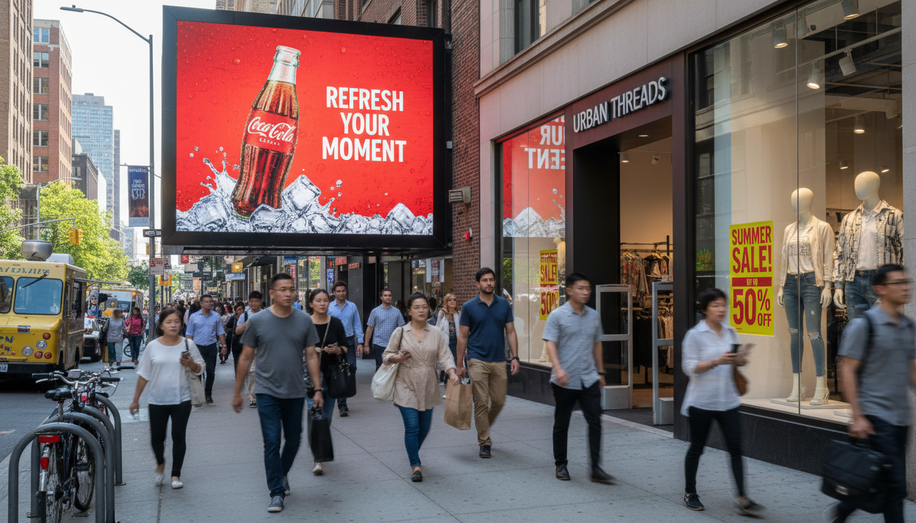

In the evolving landscape of advertising, brands are discovering that combining out-of-home (OOH) with retail media creates a powerful synergy, bridging the gap between broad awareness and precise point-of-purchase influence. This integration leverages the massive reach of OOH—billboards, transit ads, and digital displays—with the targeted precision of retail media networks (RMNs), where screens at store entrances, checkouts, and aisles capture shoppers in the moment of decision. The result is enhanced visibility that drives foot traffic and conversions, with data showing cross-channel campaigns delivering 2-3x higher engagement rates than standalone efforts.
OOH has long excelled at building top-of-mind awareness, interrupting daily commutes and urban routines with contextually relevant messaging. Proximity-based campaigns, for instance, have generated over 1.3 million additional store visits by placing ads near retail destinations, turning passive exposure into actionable intent. Retail media, meanwhile, dominates the in-store environment, projected to account for 55.9% of total digital OOH growth between 2025 and 2029, as RMNs integrate with programmatic platforms for real-time optimization. Together, they form a seamless funnel: OOH primes consumers en route, while retail media seals the deal inside the store.
Consider a fashion brand launching a summer collection. Programmatic digital OOH (DOOH) on commuter routes activates dynamic ads based on weather triggers—rainwear during storms, sunglasses on sunny days—extending campaign life beyond static bursts from TV or traditional OOH. As shoppers arrive at retail partners, RMN screens near entrances reinforce the message with personalized promotions, drawing on shared audience data for continuity. Talon benchmarks reveal such integrations boost purchase intent by 3x and brand relevance by 15%, proving the measurable lift from connecting physical and digital touchpoints.
This convergence thrives on technological advancements like programmatic DOOH, which enables real-time adjustments for traffic patterns, consumer behavior, and even time-of-day relevance. Brands can retarget mobile users post-OOH exposure, serving follow-up ads that lead directly to in-store activations via QR codes or geolocation tracking. Inside retail spaces, collaboration between merchants and media teams is key; merchants prioritize product visibility, while retail media overlays ads without displacing shelves, blending merchandising with advertising to enhance the shopping journey. For fast-moving consumer goods, this means pairing media screens with premium product placements, reassuring brands wary of space competition and driving immediate sales alongside long-term loyalty.
Experiential elements amplify the impact further. Interactive OOH, such as AR-enabled billboards or shareable installations, generates viral social media buzz—45% higher recall and 3x engagement compared to static displays. Retailers extend this “retailtainment” indoors, using dynamic in-store screens for storytelling that showcases store benefits and blur entertainment with commerce. Paramount+’s Halo campaign, for example, rotated weekly content on digital OOH billboards, maintaining visual consistency while evolving narratives, a tactic easily mirrored in retail media for sustained shopper immersion. Social amplification follows: OOH creates photo-worthy moments that flood feeds, boosting organic reach and funneling traffic back to physical stores.
Measurement has demystified this pairing, with advanced tools providing clear ROI. Brand lift surveys, geofencing, and attribution data track the full path from OOH impression to retail purchase, revealing 65% higher conversion rates from integrated efforts. Programmatic platforms unify planning across channels, allowing brands to optimize in real-time—scaling OOH budgets toward high-performing retail zones or tweaking creatives based on in-store dwell times. As consumers fluidly navigate screens, streets, and stores, this omnichannel approach delivers a coherent story, with DOOH emerging as a full-funnel staple in retail media evolution.
Challenges persist, particularly in aligning retailer priorities. Merchants focus on sales, while media teams chase advertiser dollars, but shared goals around shopper experience resolve tensions. Governance strategies that integrate sustainability—vital as eco-concerns rise—further unify efforts, positioning retail environments as both commercial and experiential hubs. Resource allocation must adapt too, with multifaceted programming incorporating tech innovation and consumer-centric ads to navigate the complexity.
For brands, the strategy is straightforward: audit audience journeys, select high-ROI OOH locations like transit hubs and urban districts, and partner with RMNs for in-store extension. Design unified creatives—contextual, interactive, and measurable—then layer in retargeting and social hooks. A beverage giant might deploy DOOH near supermarkets with QR-linked promotions, followed by checkout screens offering instant discounts, culminating in data-proven lifts in basket size.
Ultimately, this fusion redefines advertising efficiency. In a world where physical retail rebounds amid e-commerce fatigue, OOH-retail media combos not only heighten visibility but transform consumer paths into revenue streams. Early adopters report amplified performance across metrics, from awareness to advocacy, signaling a blueprint for 2026 and beyond. As programmatic ecosystems mature, brands ignoring this integration risk ceding ground to those mastering the blend of mass reach and micro-moments.