
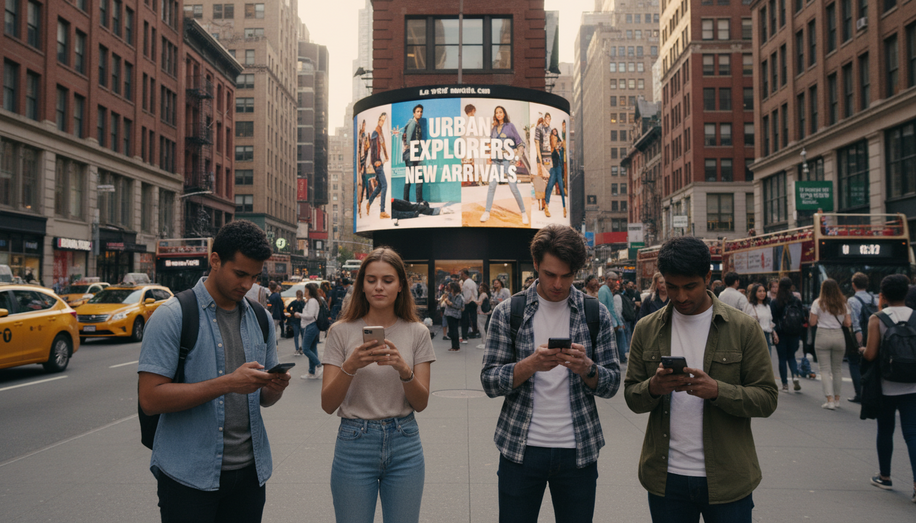

Out-of-home advertising is experiencing a renaissance with younger audiences, driven by a fundamental shift in how Gen Z and Millennials consume media and interact with brands. As digital channels become increasingly saturated and performance metrics deteriorate, OOH offers a refreshingly authentic alternative that resonates with audiences fatigued by algorithmic feeds and targeted tracking.
The appeal begins with authenticity. Gen Z craves genuine brand experiences, and OOH delivers exactly that—physical, tangible, unskippable presence that cannot be filtered through algorithms or dismissed as synthetic content. In an era where 40% of younger consumers turn to TikTok or Instagram instead of Google for searches, and where trust in digital messaging continues to erode, the simple fact that a billboard exists in physical space becomes a powerful proof point. Brands like Liquid Death demonstrate how unconventional OOH tactics paired with influencer-driven strategies can capture younger audiences, with Gen Z and Millennials now accounting for approximately 80% of the brand’s consumer base.
Strategic creativity matters enormously when reaching younger demographics. Humour remains massively underused in advertising, yet 72% of people say they would choose a humorous brand over one that doesn’t make them laugh. For Gen Z specifically, OOH resonates most powerfully when it’s interactive or outrageous, breaking through the noise with unexpected moments that feel fresh rather than corporate. The emotional impact is substantial—95% of purchase decisions are driven by emotion, and OOH’s bold, large-scale formats amplify humour and joy instantly, creating standout moments that build mental availability quickly. Joyful campaigns spark organic social sharing without requiring additional paid promotion, extending reach across digital channels while maintaining the authentic physical presence that younger audiences find compelling.
Context and relevance prove equally important. Rather than relying on intrusive personal data collection, innovative OOH campaigns can deliver relevance through time, place, and environment. This approach addresses growing privacy concerns among younger consumers who increasingly resent hyper-personalisation and data tracking. By speaking to audiences collectively rather than as tracked individuals, campaigns maintain scale while aligning with rising sensitivity around surveillance-based marketing. The result feels helpful rather than creepy, allowing brands to build credibility and trust without compromising consumer values.
Cultural timing amplifies OOH’s effectiveness with younger audiences. Gen Z and Millennials engage most deeply with brands that feel timely, in touch, and genuinely reflective of culture around them. Major cultural moments—from sporting events to festivals and national movements—offer powerful opportunities for authentic connection. When campaigns blend meaning with emotion and spotlight values that matter to younger consumers, like sustainability and affordability, they resonate deeply without coming across as preachy or performative. Research shows that cultural moments in messaging deliver 6% higher action and are 1.3 times more likely to drive purchase intent.
The integration of OOH with broader marketing strategies cannot be overlooked. Modern out-of-home advertising integrates cleanly with digital initiatives, creating synergistic effects across channels. OOH serves as a real-world trigger for digital discovery journeys, sending consumers into search and social with confidence grounded in physical proof. For younger audiences navigating an increasingly fragmented media landscape, this multi-channel approach provides the coherence and authenticity they seek.
As brands compete for attention in crowded digital ecosystems, OOH’s advantages become increasingly apparent. It delivers guaranteed visibility without platform fragmentation, reaches audiences who trust the message more, and builds both brand awareness and emotional connection simultaneously. For marketers targeting Gen Z and Millennials in 2026, the message is clear: innovative OOH campaigns that prioritise authenticity, humour, cultural relevance, and respect for privacy are no longer simply complementary to digital strategies—they are essential to cutting through noise and building genuine brand affinity with younger consumers.