
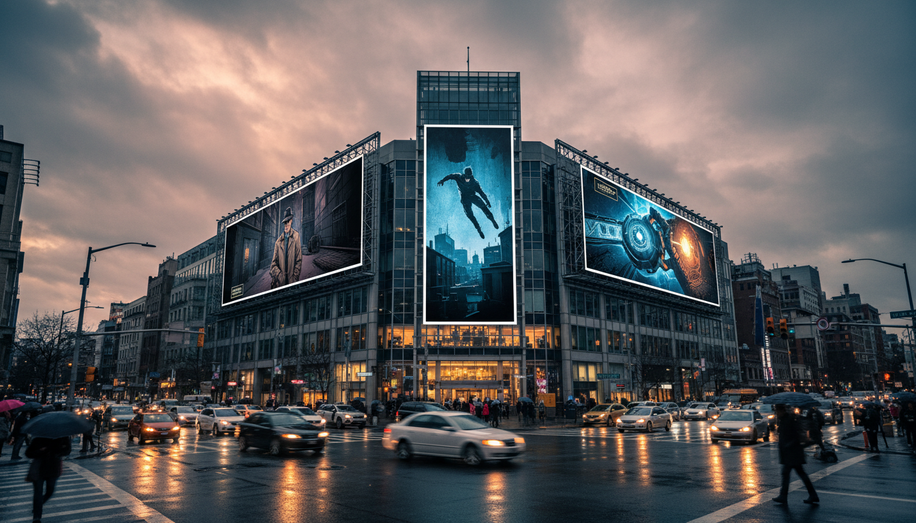

Sequential out-of-home advertising has proven its staying power as a storytelling medium, from Burma-Shave’s iconic highway campaigns of the early twentieth century to contemporary brands leveraging the tactic to forge emotional connections with audiences. The power of sequential narratives lies in their ability to unfold deliberately across space and time, transforming isolated advertising moments into a cohesive journey that builds brand recognition and lasting recall in ways that single billboards simply cannot achieve.
The historical precedent for sequential storytelling in OOH advertising remains instructive. Burma-Shave, which dominated America’s roadways from 1925 to 1966, demonstrated that consumers would engage with branded content when it was presented as an unfolding narrative rather than a static message. The company’s playful rhyming sequences, typically displayed across six consecutive signs, captivated drivers and transformed a functional product into a cultural phenomenon. At the campaign’s peak, 7,000 Burma-Shave signs stretched across America, and by 1947 the brand had achieved sales of approximately six million dollars. The campaign’s success stemmed from its understanding of traffic patterns and consumer behavior—drivers passing through the same route repeatedly encountered the story in sequence, building familiarity and trust through repetition.
Modern practitioners of sequential advertising continue to apply these foundational principles while adapting them to contemporary contexts. The approach demands strategic thinking about placement, pacing, and audience movement patterns. Location planning proves critical: on highways, spacing boards a few miles apart ensures drivers encounter messages in sequence, while urban environments benefit from clusters of digital displays that rotate in predetermined order. The creative pacing must align with dwell time—the amount of time an audience spends viewing each message. When targeting daily commuters, increased rotation frequency allows audiences to experience new creative weekly, maintaining engagement without fatigue.
The emotional narrative itself forms the backbone of effective sequential campaigns. Rather than delivering disjointed product benefits, successful sequential storytelling creates an arc that resonates with audience concerns and aspirations. Consider a seasonal example: an HVAC company might begin with “Stay Cool This Summer,” progress to “Oklahoma Heat? We’ve Got You Covered,” and conclude with “Time to Warm Up Again.” Each iteration speaks to timely needs while reinforcing a consistent brand identity of reliability and attentiveness. This evolution builds trust through demonstrated understanding of customer circumstances.
Recent campaigns demonstrate that sequential storytelling remains relevant in an era of digital innovation and fragmented attention. The 2025 film “Three Billboards Outside Ebbing, Missouri” reignited public fascination with sequential billboards as a narrative device, replacing Burma-Shave in the cultural imagination as the exemplar of this advertising approach. The film showcased how sequential messaging could convey urgency, frustration, and resolve through carefully orchestrated visual and textual sequences.
Digital technology has expanded the possibilities for sequential narratives. Digital displays enable rapid message updates and rotation, allowing brands to tell stories that evolve throughout the day or adapt to real-time conditions. Weather-reactive campaigns, like Ore-Ida’s rain-activated mural in Seattle, demonstrate how sequential narratives can interact with environmental factors, creating moments of surprise and delight that audiences actively anticipate and share. These innovations push beyond traditional static sequences while maintaining the core principle: unfolding narratives that reward sustained attention.
The effectiveness of sequential OOH advertising ultimately rests on understanding audience movement and crafting messages that demand discovery. Secondary roads, where traffic moves slower, provide optimal conditions for drivers to process multiple messages. Urban environments require different strategies, utilizing transit systems where commuters encounter ads repeatedly during daily routines. Regardless of context, the principle remains constant—sequential narratives create engagement that single messages cannot match.
As advertisers navigate an increasingly crowded media landscape, sequential OOH advertising offers a compelling alternative to interruptive digital advertising. By respecting audience attention patterns and rewarding careful observation, brands can craft narratives that endure in memory long after the physical signs disappear.
To truly harness the power of sequential OOH storytelling, advertisers require advanced tools for strategic implementation and optimization. Blindspot’s location intelligence and audience measurement capabilities precisely guide site selection and pacing, ensuring each narrative unfolds deliberately across specific movement patterns to maximize brand recall. This allows for dynamic, data-driven sequential campaigns that resonate deeply with audiences and prove their lasting impact. https://seeblindspot.com/