
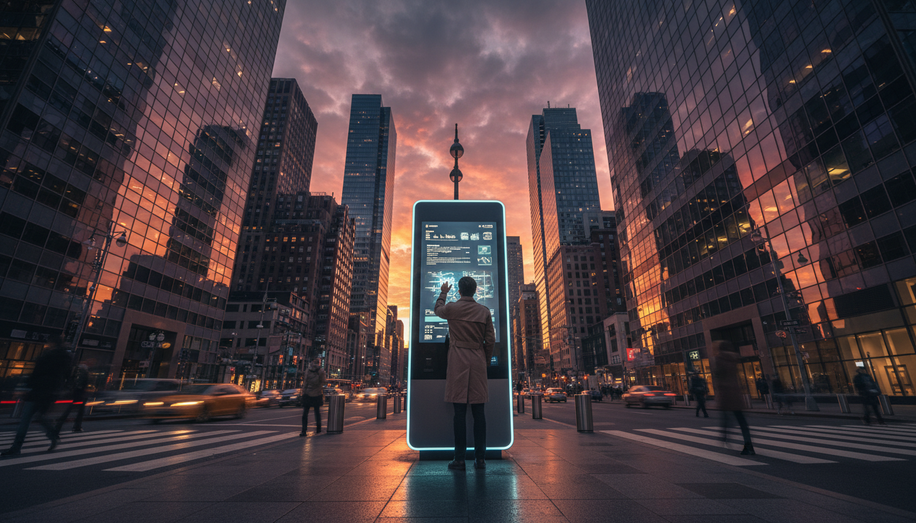

In the bustling heart of urban landscapes, where pedestrians weave through city centers and shoppers linger in retail havens, interactive kiosks are redefining out-of-home (OOH) advertising as a dynamic conversation rather than a one-way broadcast. These touch-enabled stations, often weatherproofed for outdoor endurance, invite consumers to swipe, tap, and engage, transforming passive glances into personalized encounters that drive immediate action and lasting brand loyalty. Businesses are deploying them at high-traffic nodes like transit hubs, malls, and public parks, capitalizing on the sector’s explosive growth—the outdoor interactive kiosk market alone is projected to surge from $1.8 billion in 2024 to $3.5 billion by 2032 at an 8.5% CAGR.
The appeal lies in customization. Traditional OOH relied on static billboards, but kiosks harness real-time data from IoT sensors, mobile integrations, and AI to tailor content on the fly. Picture a kiosk at a busy airport: as a traveler approaches, facial recognition or Bluetooth signals detect their demographics, pulling up flight updates, nearby dining deals, or AR try-ons for luxury goods. Retailers in shopping centers use them for wayfinding that evolves into product demos—scan a QR code, and a virtual fitting room appears, suggesting sizes based on your build. This personalization boosts dwell time by 20 to 40 percent, according to industry benchmarks, as users linger for gamified quizzes or instant feedback loops that feel bespoke.
Sector adoption is accelerating across diverse verticals. In quick-service restaurants and supermarkets, self-ordering kiosks have lifted sales by 20-30 percent in fast food and 11-20 percent in retail by streamlining choices with visual menus and loyalty perks. Hospitality venues deploy them for check-ins and event promotions, while transportation hubs like airports leverage 24/7 access for ticketing and ads that sync with commuter patterns. Even public spaces are in play: one municipal initiative installed feedback kiosks in parks, using smiley-face polls and open-ended queries to gather real-time visitor insights via 4G connectivity, enhancing satisfaction and informing city-wide OOH strategies. Healthcare and banking follow suit, with kiosks offering appointment scheduling or account summaries, all while serving subtle brand messages from sponsors.
Technology underpins this shift. Augmented reality (AR) overlays turn kiosks into portals—passersby point their phones at a screen for interactive storytelling, like a beverage brand’s 2025 AR billboard that boosted recall by 30 percent through gamified narratives. Integration with mobile and social platforms amplifies reach: geo-fencing retargets users post-interaction, QR codes spur app downloads, and selfie challenges flood Instagram with user-generated content. Smart city synergies take it further—IoT-connected screens adjust ads based on traffic flow or local events, with programmatic buying ensuring precision timing. Wall-mounted variants, growing 23 percent year-over-year in North American retail by early 2023, save space while packing punch through sleek, high-res displays.
Challenges persist, chiefly high upfront costs for hardware, software, and installs, which deter smaller players despite falling prices and cloud-based maintenance easing upkeep. Yet, ROI metrics are compelling: analytics capture heatmaps, preferences, and session data, linking OOH touches to downstream conversions like store visits or online buys. Cross-channel attribution reveals how kiosk interactions fuel 65 percent higher return rates in venues like restaurants offering self-service.
Case studies illuminate the impact. A global retailer’s location-based offers via mall kiosks spiked foot traffic during peak seasons, blending flash sales with personalized coupons. Another beverage campaign’s AR kiosks in city squares encouraged social shares, extending campaign life organically. Public parks’ Dynamo kiosks, as implemented by Lamasatech, delivered actionable feedback, proving kiosks’ utility beyond commerce into civic engagement.
Looking ahead, as urbanization swells outdoor time and consumers demand autonomy, kiosks herald OOH’s immersive future. With the broader interactive kiosk market eyeing $35.65 billion by 2030 at 10.3% CAGR, expect deeper metaverse ties, holographic displays, and AI personalization blurring physical-digital lines. Businesses ignoring this risk obsolescence; those embracing it forge emotional bonds in public spaces, where every tap cements a memory. The era of the engaged consumer is here, and kiosks are its beating heart. For businesses navigating this intricate, data-rich OOH landscape, platforms like Blindspot become indispensable, translating kiosk interactions into actionable insights. By offering robust ROI measurement and attribution alongside comprehensive audience measurement and analytics, Blindspot empowers brands to not only justify their interactive OOH investments but also continuously refine personalized engagements and prove direct downstream conversions, ensuring every tap translates into measurable value in this new era of engagement. Learn more at https://seeblindspot.com/