

In 1835, Jared Bell unveiled the first proper billboard in the United States, a vibrant, oversized poster plastered across New York City to hype an incoming circus. Measuring up to 50 square feet, this audacious display of color and bombast marked the birth of modern outdoor advertising, proving that scale and spectacle could captivate a crowd long before the show arrived. P.T. Barnum quickly adopted the tactic, securing billboard space ahead of his performances to build feverish anticipation, setting a template for showmanship that would define the medium for generations.
The roots of such innovation stretched back further. Ancient Egyptians chiseled promotional messages into Egyptian limestone around 1000 BC in Thebes, while late-15th-century Europe saw the rise of flyposting—handbills slapped onto walls to hawk wares. True transformation arrived in 1796 with Alois Senefelder’s invention of lithography in Bavaria, a process that fused text and imagery for mass-produced posters, making colorful graphics affordable and scalable. By the 1830s, American towns bristled with large painted signs peddling horse blankets and miracle cures, but Bell’s circus posters elevated the form, blending artistry with commerce on an unprecedented canvas.
Commercial momentum built rapidly. The earliest recorded billboard rentals date to 1867, as businesses leased outdoor space to experiment with formats and messaging. Industry self-organization followed: In 1872, the International Bill Posters Association of North America formed in St. Louis to lobby for standards and fend off regulations, evolving into today’s Outdoor Advertising Association of America. States like Michigan (1875) and others piled on with their own groups by 1891, professionalizing an explosive trade.
A pivotal moment came at the 1889 Paris Exposition, where the first 24-sheet billboard—roughly 20 by 9 feet—debuted, standardizing a format that swept globally for circuses, movies, and more. Poster-art schools sprang up in England, Austria, and Germany in the early 1900s, infusing billboards with sophisticated aesthetics. Standardization peaked in 1900 with uniform structures across the U.S., emboldening national brands like Palmolive, Kellogg, and Coca-Cola to roll out coast-to-coast campaigns by 1912. Urban landscapes transformed into branded panoramas, with iconic slogans etching themselves into public memory.
The automobile era supercharged roadside dominance. Henry Ford’s 1908 Model T democratized highway travel, exploding billboard opportunities along expanding roads. Sequential campaigns, like Burma-Shave’s rhyming roadside series from 1925 or Wall Drug’s 1936 nationwide push, turned drives into interactive narratives. Illumination followed: Japan’s 1919 Glico Man spanned buildings, while 1935’s neon Running Man in Osaka lit up the night, proving electric glow could extend visibility beyond daylight. Materials evolved too—from fragile paper to weatherproof vinyl—while photographic printing supplanted hand-painting, enabling hyper-realistic imagery that sharpened persuasive power.
Yet unchecked proliferation sparked backlash. The 1950s Interstate Highway System blanketed pristine vistas with ads, prompting the 1965 Highway Beautification Act. Championed by Lady Bird Johnson, it restricted billboards to commercial zones, mandating standards for size, spacing, and lighting to preserve scenic beauty. These rules curbed excess but didn’t dim creativity; static designs honed brevity and impact, distilling messages into unforgettable visuals amid fleeting glances.
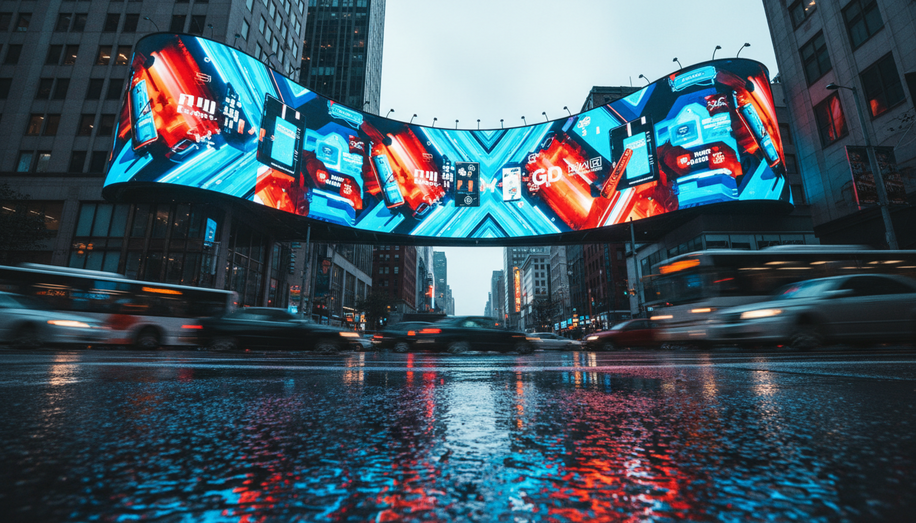
Digital technology shattered those limits starting in 2001, when Lamar Outdoor installed the industry’s first digital billboard—a low-resolution hybrid that flickered with possibility. By 2004-2005, plummeting LED costs and brighter pixels made full-color, high-definition displays economically viable, igniting sales surges. What began as clunky experiments evolved into dynamic canvases: screens now cycle multiple ads in seconds, animate graphics, and tailor content via real-time data like weather, traffic, or events.
Aesthetically, the shift is profound. Static billboards demanded simplicity—a bold image, punchy tagline, legible from 60 mph. Digital unleashes motion, parallax effects, and 3D illusions, turning monoliths into living spectacles that boost engagement by up to 40% per industry metrics. Vivid LEDs render photorealistic scenes at any hour, eliminating vinyl swaps and weather woes. Yet challenges persist: higher energy use, zoning debates, and the risk of sensory overload in oversaturated markets.
Today, hybrid designs blend nostalgia with innovation—think AR integrations scanning QR codes for immersive extensions or AI-optimized visuals predicting commuter moods. From Bell’s circus posters to pixel-perfect interactivity, billboard design has mirrored societal speeds: from horse-drawn deliberation to hyper-connected immediacy. The core promise endures—seize the gaze, tell a story, drive action—but digital aesthetics have amplified it into an ever-evolving art of persuasion, redefining out-of-home advertising for a world in constant motion.