
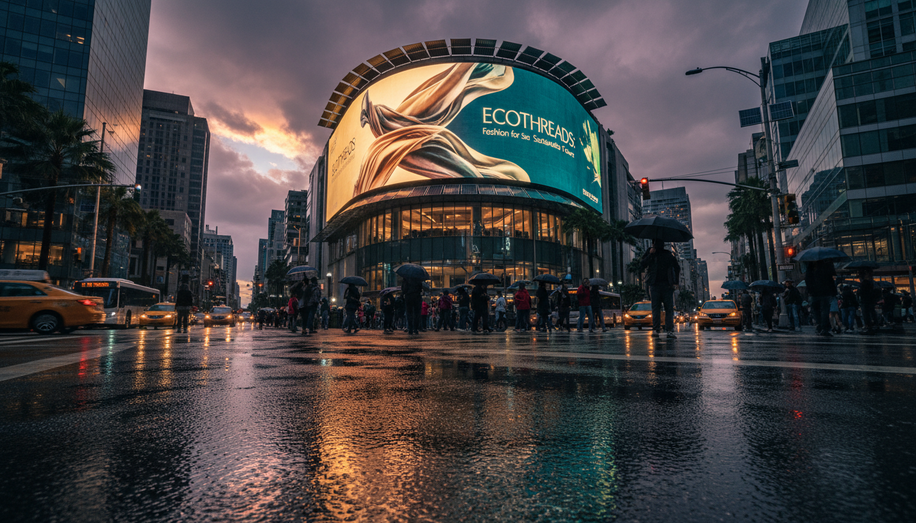

In the evolving landscape of out-of-home (OOH) advertising, sustainability has emerged as a defining force, propelling brands toward eco-friendly practices amid intensifying environmental pressures and consumer demands for accountability. As the global OOH market surges from $37.18 billion in 2025 to a projected $40.42 billion in 2026, industry leaders are integrating green innovations to align physical media with broader sustainability goals, transforming billboards and digital screens into symbols of responsible marketing. This shift reflects not just regulatory compliance but a strategic response to a media environment where trust and real-world impact reign supreme, positioning OOH as a resilient channel in a fragmented digital era.
The push for sustainability in OOH stems from its inherent physicality—billboards, transit ads, and digital out-of-home (DOOH) displays occupy real spaces, consuming energy, materials, and land in ways that demand scrutiny. Traditional static billboards, once criticized for waste, are giving way to DOOH, which by Q3 2025 accounted for 67% of OOH spend due to its efficiency and adaptability. DOOH screens, powered by LED technology, use up to 70% less energy than older models, enabling dynamic content that reduces the need for frequent physical replacements and cuts material waste. Brands like those in the UK market are prioritizing programmatic DOOH for its precision targeting, which minimizes overexposure and optimizes energy use by scheduling content based on audience flow rather than constant illumination.
Major advertisers are leading the charge with tangible commitments. For instance, global campaigns now incorporate solar-powered billboards that harness renewable energy, slashing carbon footprints in high-traffic urban zones. In 2026, this aligns with broader trends like climate adaptation and resilience, where OOH providers retrofit structures with recyclable materials and low-VOC paints to lower emissions during installation and maintenance. Transit advertising, a staple of OOH, sees brands adopting biodegradable wraps on buses and trains, replacing vinyl with plant-based alternatives that decompose without microplastic pollution. These practices not only reduce landfill contributions but also enhance brand perception; studies show 55% of consumers view contextually relevant OOH as more trustworthy when tied to purpose-driven messaging like sustainability.
Measurement advancements further bolster sustainable OOH by proving its efficacy without excess spend. Mobile location data tracks exposure zones, revealing how eco-focused campaigns drive foot traffic and search lift while justifying leaner, greener executions. This data-driven approach allows brands to scale back on redundant placements, conserving resources. In cultural moments—from festivals to national events—OOH delivers shared experiences with minimal environmental impact through temporary, reusable installations that amplify purpose without preachiness. Emotional resonance peaks here: culturally fluent ads blending affordability and sustainability yield 6% higher action rates and 1.3 times more purchase intent.
Yet challenges persist. While DOOH’s rise promises greener operations, the sector grapples with e-waste from outdated screens and the energy demands of always-on displays in a climate-vulnerable world. Geopolitical tensions and new local health and fitness (LHF) regulations add layers, urging OOH firms to innovate in resilient infrastructure. Brands counter this by partnering with tech providers for AI-optimized scheduling, dimming screens during low-traffic hours and integrating weather-responsive content to extend hardware life. In brand-building strategies, 37% of UK advertisers plan increased investment in 2026, favoring OOH’s scale and credibility for sustainable narratives that build mental availability without digital mistrust.
Consumers, fatigued by intrusive online ads, reward this evolution. OOH’s unskippable nature—reaching millions in real environments—fosters trust, with 83% recalling ads within 30 minutes of shopping exposure. When paired with authentic sustainability, it weaves into the customer journey: awareness via mass-reach billboards, consideration through ambient placements in gyms or offices, and response near retail with proximity-triggered DOOH. This integration proves OOH’s role as a “real-world trigger,” sparking AI-driven discovery while lending authenticity to digital channels.
Looking ahead, 2026 marks OOH’s corrective phase, rebalancing budgets from inefficient digital to reliable physical media that prioritizes sustainability. As privacy expectations rise and platforms fragment, eco-practices like carbon-neutral production and biodiversity-friendly site selection will define leaders. Brands embracing these—through inclusive innovation and culturally relevant creative—not only mitigate risks but capture growth in a market valuing genuine impact. Ultimately, sustainable OOH transcends compliance; it redefines advertising as a force for environmental stewardship, ensuring the channel’s momentum endures in an increasingly conscious world.