
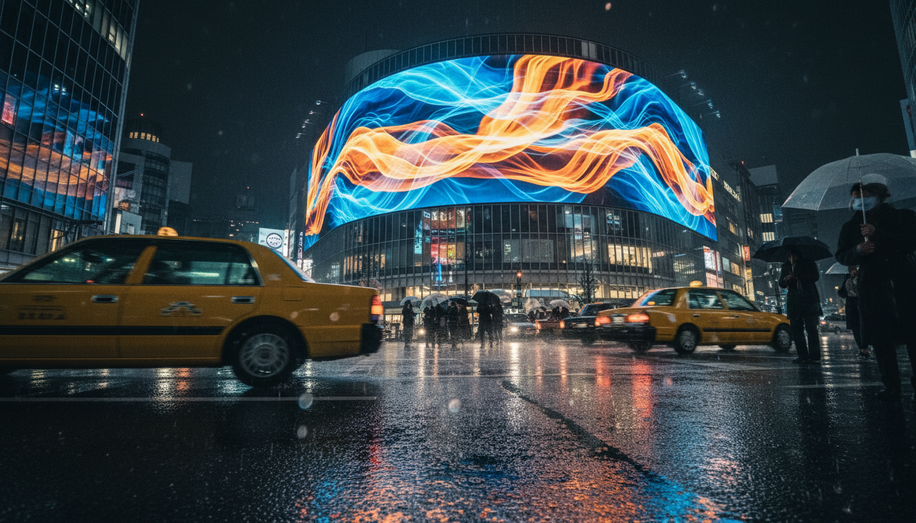

In the fast-paced world of out-of-home advertising, where drivers glance at billboards for mere seconds amid highway blurs, motion graphics have emerged as a game-changer for digital billboards. A groundbreaking study by WOW Media and Neuro-Insight reveals that center-read, full-motion digital billboards are 5.8 times more effective than traditional static ones, encoding impressions deeper into long-term memory through dynamic visuals and vibrant motion. This isn’t mere hype; it’s neuroscience-backed proof that animation doesn’t just grab eyes—it rewires brains for lasting brand recall.
The science behind this edge lies in how our brains process movement. Vision research shows that motion, especially on the periphery, triggers the superior colliculus, a brain region that reflexively orients our gaze toward stimuli before conscious awareness kicks in. For commuters zipping by at 60 miles per hour, this split-second hijack is gold. Static billboards compete with a cluttered visual field, but animated ones demand attention immediately. Eye-tracking studies, including those from Nielsen’s Arbitron Outdoor research, confirm digital billboards generate 63% longer gaze times and 47% more visual fixations than static formats, with a higher percentage of glances in the critical first two seconds of exposure. The average viewing window? Just 6-10 seconds on highways, making that initial hook indispensable.
Quantitative data underscores the recall supremacy. The Outdoor Advertising Association of America reports digital billboards with motion graphics deliver more than twice the ad recall of static ones, with Nielsen’s 2022 study pegging recall at 55% for digital versus 28% for static. WOW Media’s neuro-study, using brain-activity scans and eye-tracking on 84 Los Angeles drivers in a simulated commute, quantified this further: full-motion DOOH scored a Neuro-Impact Factor showing stronger memory encoding, thanks to high-quality imagery, color vibrancy, and captivating narratives. Even non-full-motion digital billboards outperformed static by 3.2 times in neuro-response peaks.
Beyond raw attention, motion graphics amplify emotional and narrative impact. They allow advertisers to tell stories in loops—think a product exploding into view, swirling with color gradients, or characters leaping across the screen. Netflix’s Stranger Things campaign in New York exploited this with motion-triggered billboards that “glitched” like the show’s Upside Down, generating 47 million impressions and viral social buzz. Such creativity turns passive passersby into engaged spectators, fostering shareable moments that extend reach online. Interactive elements take it further: ambient lighting synced to ads boosts effectiveness 5.75 times over unlit static boards, while motion-tracking sensors invite gesture-based participation, yielding up to 47% more viewing time.
Positioning matters too. Center-read digital billboards, facing drivers head-on, prove 3.6 times more effective than side-facing static ones, maximizing visibility in high-traffic corridors like Los Angeles freeways to Beverly Hills or LAX. Repeat exposures don’t fatigue; the study found no wear-out, with campaigns building impact over time. Brands like those on WOW Media’s immersive network leverage this for bigger, bolder content rivaling Times Square’s spectacle, all while adapting in real-time to weather, events, or performance data.
Cost-effectiveness seals the deal. Digital billboards rack up 400% more views than static, per industry observations, while offering flexibility to swap creatives instantly without reprinting vinyl. Physical billboards hold a solid 40% ROI, edging digital’s 38%, but motion-infused DOOH promises higher yields through measurable lifts—like 38% spikes in mobile brand searches post-exposure. Platforms like Blip enable A/B testing of animated variants, harvesting QR scans and engagement metrics for optimization on the fly.
Critics might argue information overload dilutes impact, yet data counters: dynamic content processes faster cognitively, sticking via evolving narratives over bland images. As DOOH surges toward $58 billion by 2031, motion graphics aren’t a luxury—they’re the evolution from shouting to captivating. For advertisers, the message is clear: in OOH’s attention economy, stillness loses; motion wins, turning fleeting glances into enduring impressions.