
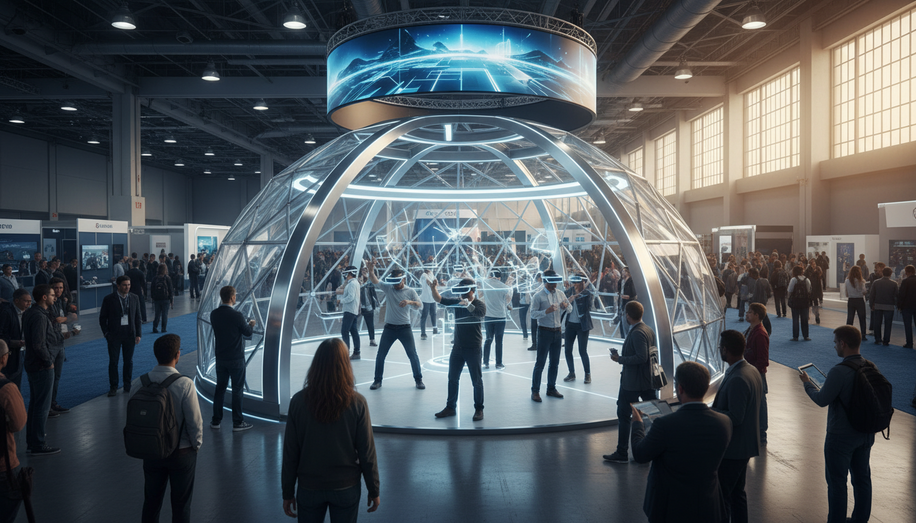

In the bustling streets of major cities, where commuters rush past towering billboards and subway posters, a quiet revolution is underway. Virtual reality (VR) and its close cousin augmented reality (AR) are emerging as powerful tools to transform static out-of-home (OOH) advertising into immersive portals that pull audiences into branded worlds. While traditional OOH relies on fleeting glances, these technologies promise deeper engagement, turning passive viewers into active participants and forging emotional connections that linger long after the ad fades.
The appeal lies in immersion. AR overlays digital elements onto the real world via smartphones, requiring little more than a QR code scan, while full VR demands headsets for total sensory envelopment. In OOH contexts, AR dominates due to its accessibility—no bulky gear needed amid urban hustle. Campaigns like Jackson Family Wines’ Siduri Holographic Experience exemplify this: shoppers scan a QR on in-store billboards to summon a photorealistic hologram of founder Adam Lee, who shares the wine’s story with playful antics. Built on WebAR, it launches instantly in a mobile browser, no app download required, drawing eyes to shelves and differentiating the brand from rivals.
Burger King’s audacious “Burn That Ad” campaign took rivalry to fiery heights in Brazil. Users pointed their phones at competitors’ billboards—McDonald’s included—to virtually incinerate them via the BK app, revealing a Whopper coupon in the ashes. The stunt netted one million downloads in a month and a 56.4% sales spike in the app, proving AR’s knack for virality and direct conversion. Similarly, BON V!V Spiked Seltzer deployed WebAR murals in Los Angeles and San Diego, letting passersby “place” a virtual vending machine, select flavors, and watch 3D animations dispense drinks—complete with maps to stores or online purchase links. This seamless blend of physical ad and digital action boosted awareness and sales without friction.
Healthcare and education sectors showcase AR’s broader potential. The UK’s NHS Blood and Transplant installed billboards in Birmingham and London where scanners “donated” virtual blood via an overlaid needle, filling a patient’s bag and animating their recovery. The first-person perspective created empathy, turning awareness into action. Ally Bank’s Monopoly-themed treasure hunt scattered 36 AR-enabled game squares across six U.S. cities. WebAR scans unlocked Mr. Monopoly dispensing points and prizes, yielding 100,000 plays and 86% completion rates—gamifying financial literacy with real-world stakes.
Even without apps, brands are pushing boundaries. Vodafone’s AR billboards and murals deliver surprise visuals that dominate public spaces, fostering real-time engagement and massive visibility. Maybelline’s colossal 4,000-square-meter AR mirror at Kyiv’s Gulliver Mall let shoppers virtually try mascara in real-time, morphing a screen into a personal beauty consultant. Pepsi Max’s “Unbelievable” bus shelter illusion, localized globally, used AR to make aliens and buses burst from screens, sparking social buzz.
Yet VR proper, with its headset-driven isolation, poses challenges for OOH’s transient environments. Nike’s 2018 Reactland campaign bridged the gap at Shanghai bus stops: treadmills synced to screens plunged runners into VR worlds showcasing shoe tech, blending physical exertion with virtual realms. Coca-Cola’s 2024 Tokyo digital vending machine billboard invited AR gestures to “grab” virtual Cokes, reacting with personalized animations—a step toward VR-like tactility in public. Samsung’s 2022 “Tiger in the City” 3D DOOH roared across global billboards, with a lifelike tiger leaping out, hinting at VR’s holographic future as hardware shrinks.
These campaigns underscore VR/AR’s metrics: increased dwell time, shareability, and analytics. AR boosts brand retention by personalizing encounters—users bond through interaction, sharing clips online for amplified reach. WebAR’s app-less nature lowers barriers, vital in OOH where attention spans are microseconds. Early data shows sales lifts (Burger King), download surges, and completion rates (Ally), signaling ROI beyond impressions.
Challenges persist. High production costs demand proven returns, and tech glitches—like poor lighting or low smartphone penetration—can alienate. Privacy concerns arise with camera access, and urban clutter risks overwhelming users. Still, advancements in spatial computing and 5G are digitizing billboards into AR canvases anywhere. Gamified OOH, like live leaderboards or AR street games, points to a future where cities become interactive playgrounds.
As OOH evolves into DOOH, VR/AR isn’t a gimmick—it’s the immersive edge. Brands ignoring it risk blending into the background, while pioneers like Vodafone and Maybelline redefine public spaces as storytelling arenas. With WebAR maturing, expect more holographic sommeliers, virtual hunts, and flame-throwing rebellions, proving that in advertising’s next era, the most memorable campaigns aren’t seen—they’re lived.