
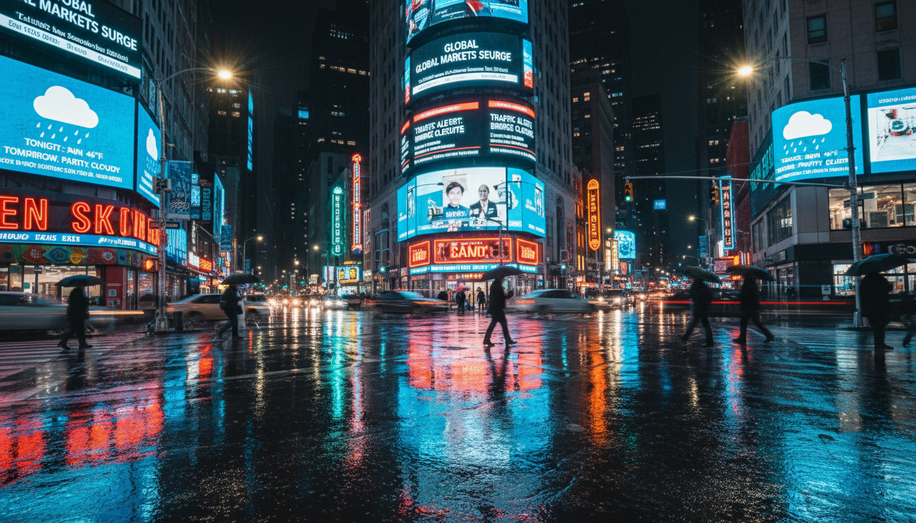

In the bustling heart of a city square, a digital billboard flickers to life, its message shifting seamlessly from a sunny beach promotion to an umbrella-clad shopper’s delight as rain clouds gather overhead. This is the power of dynamic content strategies in digital out-of-home (DOOH) advertising, where screens harness live data feeds to deliver hyper-relevant messages in real time, transforming passive viewers into engaged consumers.
Gone are the days of static billboards locked into unchanging narratives. Today’s DOOH networks integrate triggers like weather APIs, sports scores, breaking news, and even inventory levels to orchestrate content that feels eerily personal. For instance, a retail chain might display “Nearest store: 0.2 miles away – 50% off umbrellas” during a sudden downpour, pulling location data and stock information to drive immediate foot traffic. Sports venues take this further: screens near stadiums update with live scores, flashing “Your team leads 3-1 – Grab victory gear now!” to capitalize on the electric atmosphere. This responsiveness isn’t mere novelty; it’s a strategic evolution fueled by programmatic platforms and AI, enabling advertisers to swap headlines, images, or calls-to-action via modular templates without manual intervention.
At the core of these strategies lies Dynamic Creative Optimization (DCO), an advanced programmatic technique that automates ad assembly from data inputs. Weather changes prompt ice cream ads on hot days or hot soup promotions in the chill; rush-hour commuters see coffee deals while evening crowds get dinner specials. News feeds allow timely tie-ins—stock market surges might spotlight investment apps, while traffic jams advertise nearby delivery services. Even inventory levels feed into the loop: if a store’s shelves run low on sneakers, screens pivot to promote apparel instead, ensuring messages align with availability and avoiding frustrated clicks. Platforms like Innervate and Perion exemplify this, using AI to blend environmental factors, demographics, and events for geo-targeted, time-based delivery across networks.
The mechanics rely on robust integrations. Live data streams from sources like weather services or APIs sync with content management systems (CMS), triggering rules-based or AI-driven swaps in milliseconds. A master creative—a core video or image—serves as the foundation, with DCO layering in dynamic elements: swap a blue sky for storm clouds, insert real-time scores, or geo-fence promotions to the closest outlet. This modular approach slashes production costs; no need for hundreds of static variants when one template adapts fluidly. For media owners, it unlocks revenue: a single screen cycles multiple campaigns daily, offering flexible slots that appeal to brands seeking precision over broad blasts.
Real-world results underscore the impact. Container firm PODS deployed an AI-powered billboard generating over 6,000 hyperlocal messages, boosting website visits by 60% through contextual learning. Kia, targeting EV charging stations, saw an 8% sales lift from dynamic ads tailored to waiting drivers. Research highlights broader gains: dynamic creatives yield 38% more ad impact than static ones, thanks to heightened relevance that resonates personally. Engagement surges as viewers linger longer on screens mirroring their moment—rainy walks prompt waterproof gear, game wins fuel merchandise buys.
Beyond engagement, these strategies illuminate performance. Real-time analytics reveal which triggers convert best—say, weather beats sports 2:1—allowing instant optimizations and cross-channel insights for social or mobile syncing. QR codes bridge offline to online, scanning viewers into apps for deeper funnels. Yet challenges persist: data privacy demands careful handling, latency must stay under seconds, and creative quality can’t suffer amid swaps.
Looking ahead, as 5G and edge computing proliferate, DOOH’s real-time edge sharpens. Inventory-triggered ads could evolve to predict shortages via AI forecasting, while news integrations grow predictive, preempting viral moments. Brands weaving DOOH into omnichannel ecosystems—where a billboard promo flows to app notifications—stand to dominate attention economies.
Ultimately, dynamic content turns DOOH from spectacle to conversation partner, proving relevance trumps reach in captivating a distracted world. As triggers multiply, so does the imperative for advertisers to master them, ensuring every glance sparks action.