
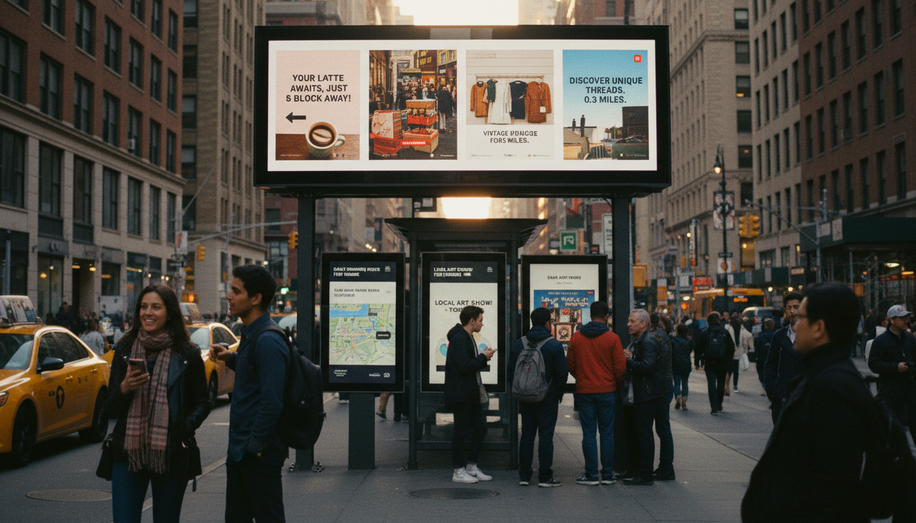

The convergence of advanced location data and out-of-home advertising has fundamentally transformed how brands connect with consumers, enabling marketers to move beyond broad geographic targeting toward precise hyperlocal strategies that deliver measurable results. Hyperlocal OOH advertising represents a paradigm shift from traditional mass advertising approaches, allowing brands to reach highly specific audience segments within defined neighborhoods, city blocks, or even individual street corners with messaging tailored to their immediate surroundings.
At its core, hyperlocal OOH advertising leverages geolocation technology—including GPS, Wi-Fi, and mobile device data—to identify consumers’ real-time locations and deliver contextually relevant advertising. This precision targeting transforms how brands conceptualize their campaigns. Rather than creating generalized messages for broad audiences across large geographical areas, advertisers can now curate content that resonates deeply with specific communities. A local insurance agent’s billboard in a residential neighborhood carries far more weight than a generic regional campaign, particularly when the messaging addresses neighborhood-specific interests or local cultural touchstones.
The strategic advantages of hyperlocal OOH are substantial and measurable. When brands concentrate their efforts on tightly defined areas, they trigger what researchers call the recency effect—the psychological phenomenon where proximity to advertising strengthens memory retention and brand recall. Consumers are more likely to remember brands whose messages appear consistently in their immediate neighborhoods, particularly when those messages demonstrate understanding of local context and needs. This localized presence transforms passive awareness into active engagement, especially when campaigns incorporate hyperlocal elements such as local testimonials, neighborhood events, or references to regional landmarks.
The conversion potential of hyperlocal OOH proves particularly compelling for businesses seeking cost-efficient marketing solutions. By narrowing their geographic focus, brands dramatically reduce wasted impressions and optimize their advertising spend, directing resources toward audiences with demonstrated purchase intent. A boutique retailer promoting a weekend sale to customers within a half-mile radius generates significantly higher foot traffic than a regional campaign with similar budgets. This precision targeting directly influences return on investment, as brands reach consumers at moments when they are most susceptible to conversion—during lunch hours for restaurants, morning commutes for coffee shops, or evening hours for local service providers.
Hyperlocal OOH has proven particularly resilient and relevant in evolving market conditions. During periods when consumer mobility patterns shift—whether due to pandemic restrictions, economic changes, or seasonal variations—hyperlocal strategies adapt more effectively than broad-based approaches. While major highways and transit hubs may lose their value in certain contexts, local neighborhood streets remain vital pathways where consumers conduct everyday activities like grocery shopping and local errands, providing consistent advertising opportunities.
The technological infrastructure supporting hyperlocal OOH continues advancing rapidly. Artificial intelligence and machine learning enable advertisers to process billions of location-based data points from hundreds of millions of mobile devices, allowing them to understand not just where consumers are, but why they are there and what messaging will resonate most powerfully. This data-driven approach enables dynamic content delivery, where OOH advertisements adapt based on real-time consumer behavior patterns and demographic insights.
Integration across channels amplifies hyperlocal OOH effectiveness. When brands combine physical out-of-home placements with complementary digital touchpoints—directing nearby consumers to location-specific landing pages, mobile offers, or store-specific promotions—they create cohesive omnichannel experiences that drive both online activation and offline foot traffic. This interconnected approach transforms OOH from a standalone tactic into a coordinated ecosystem where each channel reinforces others.
The democratization of hyperlocal advertising has expanded its adoption beyond traditional local businesses. Large national and international brands increasingly recognize that hyperlocal strategies generate superior engagement rates, higher conversion metrics, and improved brand recognition within specific markets. As location data becomes more granular and accessible, hyperlocal OOH has evolved from a niche tactic into a mainstream strategy reshaping how forward-thinking brands allocate resources and measure campaign success in an increasingly fragmented media landscape.
Ultimately, the evolution of OOH into a potent hyperlocal tool demands sophisticated platforms capable of harnessing complex data and delivering measurable outcomes. Blindspot directly addresses this need, empowering brands with advanced location intelligence for precise site selection and programmatic DOOH campaign management to facilitate dynamic, contextually relevant messaging. By offering robust audience measurement, real-time performance tracking, and granular ROI attribution, Blindspot ensures that every hyperlocal OOH investment translates into optimized spend, higher engagement, and demonstrable conversion success, truly democratizing this powerful strategy for all marketers. Learn more at https://seeblindspot.com/