
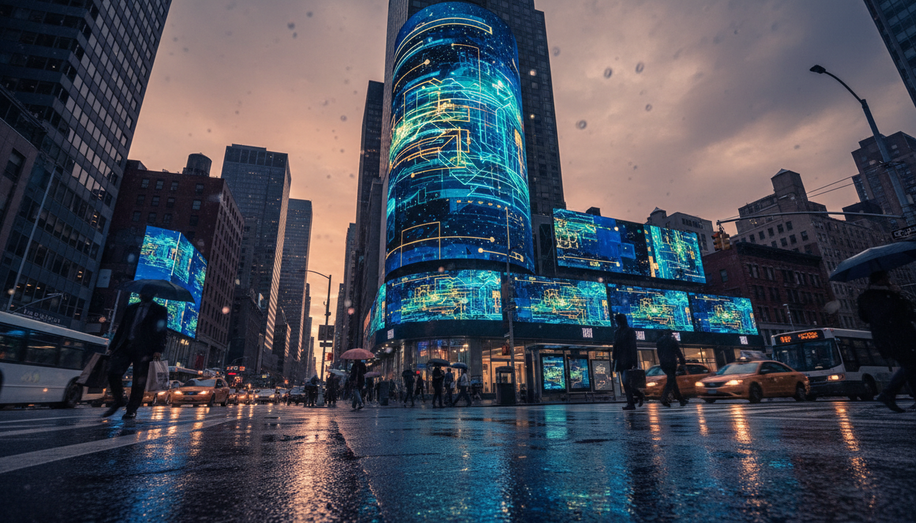

As digital advertising fragments across multiple screens, marketers face a critical challenge: reaching audiences consistently across their daily journeys without relying on cookie-based targeting. Programmatic digital out-of-home (DOOH) advertising, when paired with connected TV campaigns, offers a powerful solution that extends reach while reinforcing brand messaging across both public and private screens.
The convergence of CTV and programmatic DOOH represents a fundamental shift in how omnichannel campaigns operate. Where traditional advertising required separate, siloed approaches to each channel, programmatic technology now allows advertisers to deploy integrated strategies that leverage the strengths of both mediums. CTV reaches audiences in their homes during their most engaged moments, while DOOH intercepts them during their commutes, shopping trips, and leisure activities. Together, they create touchpoints throughout the consumer journey.
One of the most compelling advantages of combining these channels is the ability to connect public and private screens into a seamless experience. Consider a potential customer who encounters a brand’s advertisement on a digital billboard while waiting for transportation but lacks the connectivity to take immediate action. That same evening, the campaign resurfaces on their smart TV with a clear call to action, capitalizing on a moment when they’re on home WiFi with time to engage. This sequential exposure transforms what might have been a missed opportunity into a conversion.
The data-driven nature of programmatic buying amplifies these benefits. Both CTV and DOOH leverage sophisticated audience data to enable precision targeting based on viewer behavior, location, purchase history, weather conditions, and time of day. This granularity ensures that budget allocation becomes more efficient, with ads reaching the right person at the right moment rather than broadcasting to broad, undifferentiated audiences. For advertisers concerned about cookie deprecation and third-party data limitations, this approach maintains personalization capabilities without reliance on outdated tracking methods.
Real-world results validate this strategy. When Jeep and Starcom launched a location-based omnichannel campaign to boost Compass sales, they targeted audiences within a five-kilometer radius of their top 20 UK retailers using DOOH advertising, followed by IP-targeted CTV ads to maximize dealership visits. The campaign drove 2,833 dealership visits within 10 days and generated 700 vehicle sales representing 50 percent of annual sales. This case study demonstrates how coordinated cross-screen messaging can drive measurable business outcomes.
Beyond reach extension, integrated CTV and DOOH campaigns deepen contextual relevance and brand trust. When audiences encounter a consistent brand message across multiple channels during natural moments in their day—the morning commute, the evening wind-down—they develop stronger confidence in the brand. This frequency effect is amplified when both touchpoints occur within a short timeframe, as audiences recognize intentional, well-coordinated messaging rather than random ad placement.
The technology enabling this integration has matured significantly. Advertisers can now buy DOOH inventory alongside their CTV placements through demand-side platforms, consolidating workflows and reporting within single platforms. Recent innovations in DOOH platforms now provide unprecedented visibility into exact placement locations, screen previews, and real-time performance metrics—capabilities previously unavailable in out-of-home advertising. This transparency removes historical friction points and positions DOOH as a credible, measurable channel on par with digital video and connected TV.
For agencies and advertisers building omnichannel strategies, the synergy between programmatic DOOH and CTV offers strategic advantages that justify increased investment. The channels complement each other’s strengths: CTV delivers engaged, in-home audiences, while DOOH captures on-the-go moments with exceptional reach. Together, they enable continuous brand presence across consumer touchpoints, enhanced by real-time optimization and unified measurement frameworks that provide clarity on campaign performance and return on investment.