
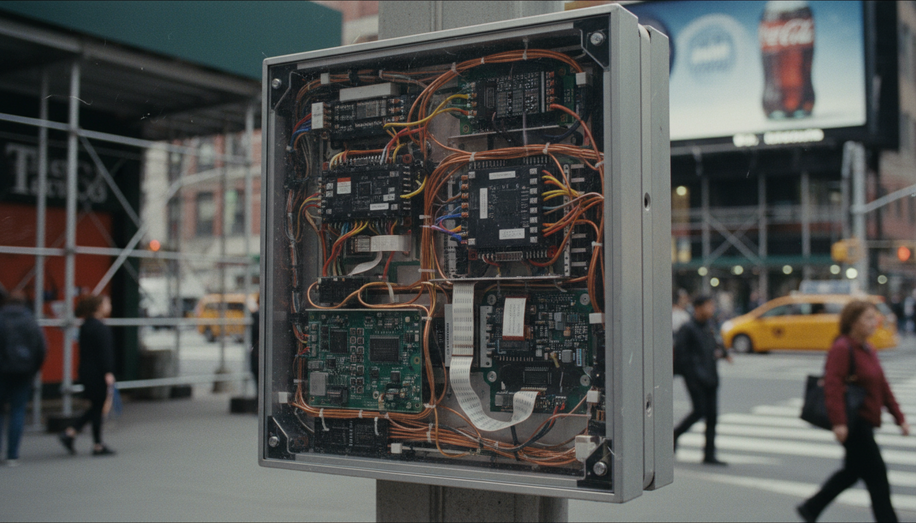

In the shadow of towering skyscrapers and bustling highways, modern out-of-home (OOH) advertising has evolved from weathered static billboards into sophisticated engineering marvels that pulse with data and adaptability. These smart displays represent a convergence of structural resilience, electrical innovation, and data orchestration, engineered to withstand relentless environmental assaults while delivering hyper-targeted, dynamic content to millions of daily passersby.
At the core of this transformation lies structural engineering, designed to anchor these behemoths against wind gusts exceeding 100 miles per hour, seismic shifts, and thermal expansion in extreme climates. Traditional billboards relied on simple steel frames bolted to concrete foundations, but today’s setups incorporate advanced materials like high-strength aluminum alloys and composite polymers that reduce weight by up to 40 percent without sacrificing rigidity. Wind tunnel testing and finite element analysis ensure these frameworks flex rather than fracture during storms, with modular designs allowing sections to be swapped out in hours rather than weeks. In urban canyons, where vibrations from traffic and construction are constant, dampening systems—vibrating isolators and tuned mass dampers—absorb oscillations, preventing pixel fatigue in the displays above. This durability isn’t just about survival; it’s engineered for longevity, with corrosion-resistant coatings and IP65-rated enclosures shielding internals from rain, dust, and salt spray in coastal deployments.
Powering these giants demands electrical engineering prowess, as digital OOH displays guzzle energy equivalent to dozens of households yet must operate flawlessly 24/7. High-brightness LED panels, often exceeding 10,000 nits for daytime visibility, rely on redundant power supplies and uninterruptible power systems (UPS) to handle grid fluctuations or outages. Engineers employ pulse-width modulation (PWM) drivers to optimize brightness dynamically, slashing power draw by 30-50 percent during low-light hours while maintaining vivid 4K or 8K resolution. Thermal management is critical: forced-air cooling with variable-speed fans, heat pipes, and phase-change materials dissipate the kilowatts of heat generated, keeping junction temperatures below 85°C even in 50°C ambient heat. Solar integration is increasingly standard, with photovoltaic arrays on display hoods feeding microinverters that offset 20-40 percent of consumption, aligning with sustainability mandates and reducing operational costs. These systems often include smart metering for real-time energy auditing, ensuring efficiency peaks during high-traffic windows.
The true wizardry unfolds in data engineering, where sensors, AI, and cloud connectivity turn passive screens into responsive organisms. Embedded cameras and LiDAR arrays anonymously capture anonymized audience metrics—demographics, dwell time, even mood via facial analysis—processing petabytes through edge computing to sidestep latency. Geofencing and Bluetooth beacons triangulate smartphone data, enabling programmatic ad swaps in milliseconds: a coffee chain’s billboard might pivot from iced lattes to hot brews based on weather APIs detecting a sudden chill. Content management systems (CMS) hosted on scalable cloud platforms like AWS orchestrate this ballet, using machine learning algorithms to predict traffic flows from historical patterns and live feeds from city IoT networks. For interactivity, capacitive touch overlays or gesture recognition via infrared grids allow passersby to engage, triggering AR experiences scanned via QR codes that blend virtual elements with the physical display. Security layers—end-to-end encryption, blockchain-ledgered ad verification, and anomaly detection—guard against hacks, ensuring data integrity amid rising cyber threats.
This trifecta of engineering doesn’t just enable flashy ads; it drives measurable outcomes. Displays now boast 5-10 times the engagement of static predecessors, with real-time A/B testing refining creatives on the fly. Programmatic DOOH platforms automate buying via auctions, leveraging first-party data for precision targeting that rivals online channels. Yet challenges persist: high upfront costs—$500,000-plus for a prime urban install—demand ROI justification through granular analytics tracking footfall to sales lifts. Regulatory hurdles, like privacy laws curbing facial recognition in Europe, force adaptive designs with opt-in consent flows.
Looking ahead, 5G and edge AI will supercharge this ecosystem, enabling holographic projections and drone-synced swarms for pop-up spectacles. Structural innovations like self-healing polymers and foldable mega-screens promise scalability, while quantum-dot LEDs push efficiency toward 200 lumens per watt. In essence, the engineering behind modern OOH isn’t merely supportive—it’s the silent force propelling advertising into a smarter, more immersive era, where every display is a node in the urban nervous system.