
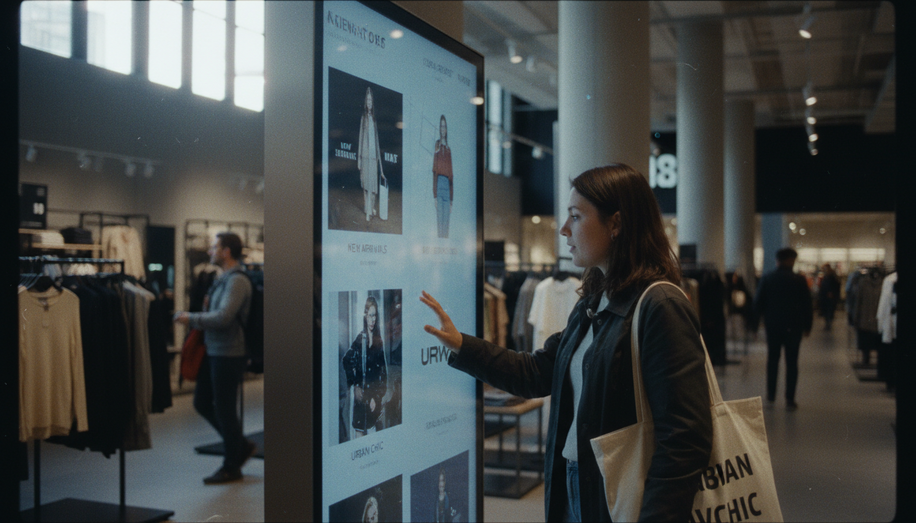

The retail media revolution is reshaping how brands connect with consumers at their moment of highest purchase intent, and out-of-home advertising has emerged as a critical catalyst in this transformation. As global spending on retail media environments reached $179.5 billion in 2025 with a projected compound annual growth rate of 14.1% through 2028, the strategic integration of OOH advertising into retail spaces has become essential for brands seeking to maximize their marketing impact. This convergence of physical and digital touchpoints represents far more than an advertising trend—it’s a fundamental reimagining of how consumers engage with brands across their entire shopping journey.
The power of OOH in retail environments lies in its precision timing. When consumers are actively making purchase decisions, their receptivity to messaging reaches peak levels. Research demonstrates that 59% of shoppers are likely to buy after seeing OOH advertising within 30 minutes of entering a store, underscoring the channel’s effectiveness at the critical juncture between consideration and conversion. This immediacy translates directly into measurable sales outcomes. In-store advertising can boost sales by up to 20% by influencing last-minute purchase decisions, while a recent campaign for a major ice cream brand achieved a 17% sales lift in nearby grocery stores, with an impressive Return on Ad Spend of $5.37.
The strategic positioning of digital screens throughout retail environments—from shelves and entrances to checkout zones—captures shoppers’ attention precisely when they are most susceptible to influence. Near-store OOH proves particularly powerful in this regard, with 71% of shoppers noticing advertisements positioned outside retail locations. Beyond immediate sales influence, data from a DOOH campaign showed that 51% of people who saw directional advertising to specific retail locations actually visited them, and 93% of those visitors completed a purchase. These metrics reveal that OOH advertising functions as both a priming mechanism and a conversion driver across the customer journey.
What distinguishes the modern OOH retail media approach from traditional outdoor advertising is its integration with sophisticated data capabilities and real-time optimization. Programmatic digital out-of-home advertising allows brands to track campaign performance and adjust messaging on the fly, enabling continuous refinement that maximizes return on investment. By combining programmatic DOOH with first-party data from retail environments, advertisers can leverage purchase history and in-store behavior to deliver highly personalized messages to relevant audiences, substantially improving conversion rates. This data-driven sophistication transforms retail spaces into dynamic, responsive marketing channels rather than static advertising venues.
The growth trajectory underscores the strategic importance of OOH within retail media ecosystems. Digital out-of-home now accounts for 36.3% of total OOH revenues, representing a 9.4% year-over-year increase as of Q2 2025, with programmatic buying attracting tech and direct-to-consumer brands seeking to integrate OOH into omnichannel strategies. Retail media itself is projected to comprise nearly one-fifth of total ad spending by 2027, with in-store retail media ads accounting for 55.9% of total DOOH growth between 2025 and 2029.
The integration of OOH with retail media also addresses a fundamental shift in consumer behavior. With 61% of consumers aged 16-34 indicating they’re more likely to spend in physical stores than online, brick-and-mortar environments remain vital commercial spaces. OOH advertising serves as a bridge between these physical touchpoints and broader omnichannel marketing strategies, ensuring that brands can maintain consistent messaging while capitalizing on in-store shopping moments. This full-funnel approach allows OOH to prime awareness when consumers are out and about, reinforce messaging as they approach retail locations, and drive conversion at the point of sale.
As retail environments continue evolving into multifaceted advertising platforms, the strategic deployment of OOH advertising has become indispensable for brands seeking to influence consumer behavior at its most critical moment. By combining proven effectiveness, sophisticated data capabilities, and real-time optimization, OOH stands as a key pillar in the retail media revolution, driving measurable results both in physical stores and across omnichannel strategies.