
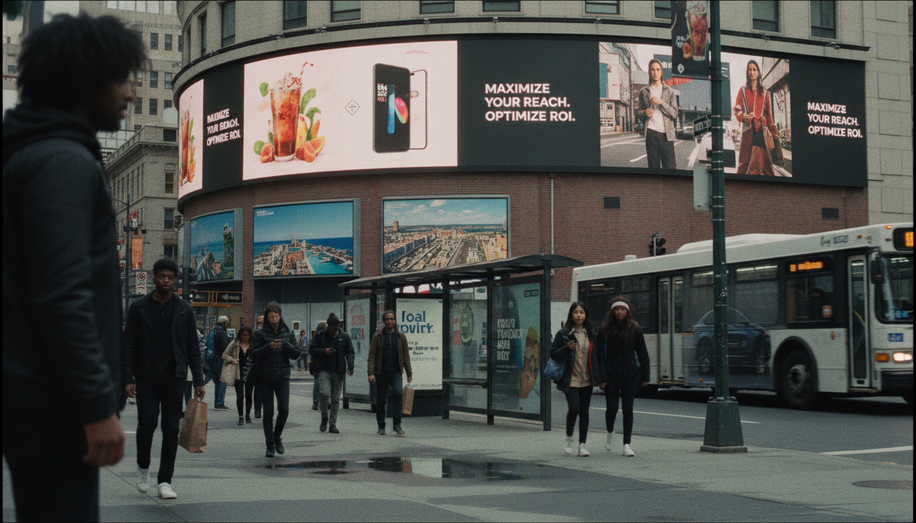

In an era where marketing budgets are scrutinized more intensely than ever, out-of-home (OOH) advertising stands out as a channel capable of delivering outsized returns through strategic allocation rather than blanket spending. Marketers who shift just a few percentage points of their media mix toward OOH—often by trimming over-optimized channels like TV and digital—can unlock substantial gains in return on ad spend (ROAS), awareness, consideration, and purchase intent, all without expanding overall budgets. This measured reallocation approach, backed by rigorous modeling from groups like the Out of Home Advertising Association of America (OAAA) and Benchmarketing, reveals that small tweaks yield the biggest lifts, making OOH not just a standalone powerhouse but a multiplier for entire campaigns.
Consider the data from OAAA’s analysis across automotive, CPG food, and retail grocery sectors. In automotive, bumping OOH from 1% to 2% of the media plan generated $52.1 million in revenue gains, accounting for 75% of the total optimization improvement. Retail grocery saw a jump from 8% to 14% OOH allocation drive $16.04 million, or 61% of the uplift, while CPG food’s modest shift from 5% to 6% delivered $2.42 million, representing 70% of gains. Benchmarketing’s research corroborates this, showing an average 13% improvement in relative ROAS (RROAS) across industries and goals, from brand awareness to sales activation. Analytic Partners adds that brands devoting a higher proportion to OOH achieve 17% stronger ROI overall. These figures underscore a key principle: the initial incremental investment in OOH captures the lion’s share of value, allowing planners to test and scale without risk.
Yet optimizing budgets goes beyond mere percentages; it demands evaluating formats for cost-effectiveness against specific objectives. Billboards, with an average cost per thousand impressions (CPM) of about $5, offer the lowest CPM among major media, delivering broad reach at scale. Static and digital billboards excel in high-traffic corridors, where 90% of OOH impressions stem from just 10% of locations, emphasizing the need for data-driven site selection. Transit ads, meanwhile, target captive audiences with repeated exposure, ideal for detailed messaging or activation goals, while street furniture like bus shelters provides hyper-local relevance in neighborhoods. Digital OOH adds flexibility through programmatic buying, real-time personalization, and dynamic content, boosting integration with online campaigns—95% of marketers value this for an 80% lift in incremental ROAS when paired with digital.
To maximize returns beyond impressions, prioritize audience demographics, geography, and context. High-traffic spots build mass awareness, but niche placements near retail clusters or events amplify relevance and conversion. For instance, partnering with local businesses or tying into events can heighten engagement, drawing advertisers to static OOH for community-targeted resonance. Seasonality and product cycles further refine allocation: flex budgets toward peak traffic hours or launches, using platform analytics to optimize display times and locations. Creative execution seals the deal—75% of ad effectiveness hinges on memorable, pain-point-driven content that’s bold and contextually sharp.
OOH’s true edge lies in its amplification of other channels, turning it into a budget extender. Adding OOH to TV lifts ROI by 18%; it supercharges display ads by 18%, paid search by 54%, radio by 17%, and print by 14%. A $100,000 display investment effectively becomes $118,000 with OOH synergy, stretching every dollar across the mix. Cross-platform strategies amplify this: national brands might lead with urban digital billboards for recognition, layering transit for neighborhood depth, then syncing with digital for measurement. Request for proposals (RFPs) from suppliers ensure inventory matches goals, while one-stop shops streamline cross-media execution.
Challenges persist, including CMOs’ tilt toward short-term digital (around 60% of budgets), counter to long-term brand-building wisdom like the 60/40 split advocated by Field and Binet. OOH counters this myopia, blending immediate impact with enduring narratives through its unskippable presence. For small businesses, focus on impression metrics and CPM to scout high-ROI spots, learning from past campaigns to refine. Ultimately, success hinges on media-agnostic planning: audit current allocations, model incremental OOH shifts, select formats by objective, and integrate boldly. The evidence is unequivocal—strategic OOH investment doesn’t just spend budgets; it transforms them, delivering ROI that reverberates across the plan.