

In the bustling corridors of modern healthcare, out-of-home (OOH) advertising stands as a towering beacon, capturing the attention of millions daily through billboards, transit shelters, and digital displays. This unskippable medium has evolved from a supplementary tool into a powerhouse for hospitals, pharmaceutical brands, and public health campaigns, delivering messages that resonate when people are most mobile and receptive. With the global healthcare advertising market projected to reach $66.45 billion by 2030, growing at a 6.7% compound annual rate, OOH’s role in driving awareness, patient acquisition, and behavioral change has never been more critical.
Hospitals have long recognized OOH’s potential to spotlight services amid fierce competition. A cross-sectional study of over 4,500 U.S. acute care hospitals from 2008 to 2016 revealed that nearly half—about 49%—engaged in direct-to-consumer advertising, collectively spending $3.39 billion during that period. These institutions, often nonprofit and financially robust with higher net assets and incomes, used OOH to boost visibility and demand. Research shows that a $1,000 increase in hospital advertising correlates with 10.1 additional patients per month, while also enhancing market share and consumer ratings. OOH proves especially cost-effective here: it delivers the lowest cost per thousand impressions (CPM) among media, saving at least $10 per thousand compared to alternatives, with a return on investment 40 cents higher per dollar spent than TV or print. About 70% of OOH ads promote local businesses like hospitals, and 83% of viewers find them informative, prompting 58% to go online for more details.
Pharmaceutical brands, facing diminishing returns from traditional TV, have turned to OOH for precision and measurability. Clear Channel Outdoor’s campaign for a major pharma player exemplified this shift, strategically placing billboards on highways, urban transit shelters, and surface roads—both digital and static—to target audiences efficiently. Paired with mobile extensions, the effort yielded compelling results: a Veeva Crossix analysis showed significant lifts in brand awareness and prescriptions, proving OOH’s viability in a data-driven era. Digital out-of-home (DOOH) amplifies this further; Nielsen Research indicates data-driven DOOH can boost sales by 93%, leveraging real-time targeting without HIPAA concerns that plague digital alternatives. Unlike skippable online ads, OOH commands attention 24/7, reaching 99% of adults aged 18-64 weekly and building emotional affinity akin to television. As direct-to-consumer pharma ad spend rose 26% from 2019 to 2023, OOH emerged as a smarter buy, not a bigger one.
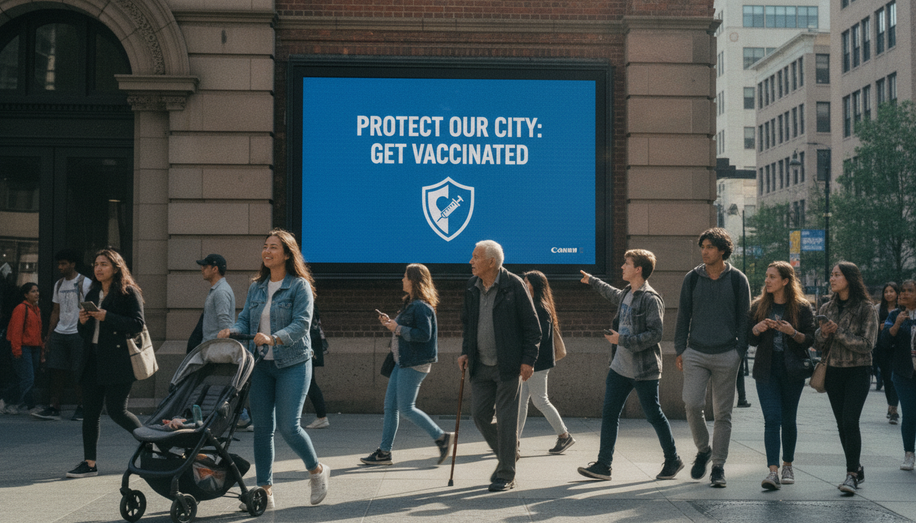
Beyond commercial promotion, OOH excels in public health initiatives, where broad reach and immediacy save lives. During the COVID-19 pandemic, digital billboards flashed vaccination reminders and mask mandates, driving compliance in high-traffic zones. Wellness campaigns, from anti-smoking drives to mental health awareness, harness OOH’s ubiquity: its ads cannot be paused, zapped, or ignored, fostering positive consumer emotions and sustained recall. In urban areas, transit posters urge screenings for conditions like diabetes or cancer, targeting demographics precisely by geography—near clinics or low-income neighborhoods—without privacy pitfalls. Success metrics underscore the impact: OOH’s round-the-clock presence ensures messages linger, with viewers 7 in 10 times more likely to engage local services.
Yet, OOH’s healing power extends to integration with multichannel strategies. When combined with point-of-care (POC) marketing in waiting rooms—which grew 171% to over $803 million by 2023—OOH exposure primes patients for action. Studies show patients seeing both digital and POC ads are 200 times more likely to convert than digital alone; 58% of those encountering office ads discuss treatments with doctors, 38% search online, and 34% fill new prescriptions. For hospitals, this synergy means OOH billboards near highways funnel traffic to facilities, where POC reinforces the call. Independent practices, budgeting 1-5% of revenue for marketing, find OOH accessible—even $20 daily in some markets—amplifying referrals and reviews.
Critics question advertising’s ties to quality. The hospital study found no clear link between ad spend and objective performance metrics like readmission rates, though higher spenders showed slightly lower mortality (11.2% vs. 12.7% in lowest terciles). Financially stable hospitals dominate, raising debates on profit motives versus public good. Still, in public health, OOH’s neutrality shines: nonprofit campaigns sidestep commercial biases, prioritizing equity.
Looking ahead, innovation cements OOH’s dominance. DOOH’s programmatic buying enables dynamic content—tailored by weather, time, or events—while AI optimizes placements. As healthcare marketing digitizes, with ad spend topping $19 billion annually, OOH bridges physical and virtual worlds, turning passersby into patients and skeptics into advocates. In an industry where trust is paramount, OOH’s bold, unavoidable presence heals not just through information, but by humanizing care at every turn.