
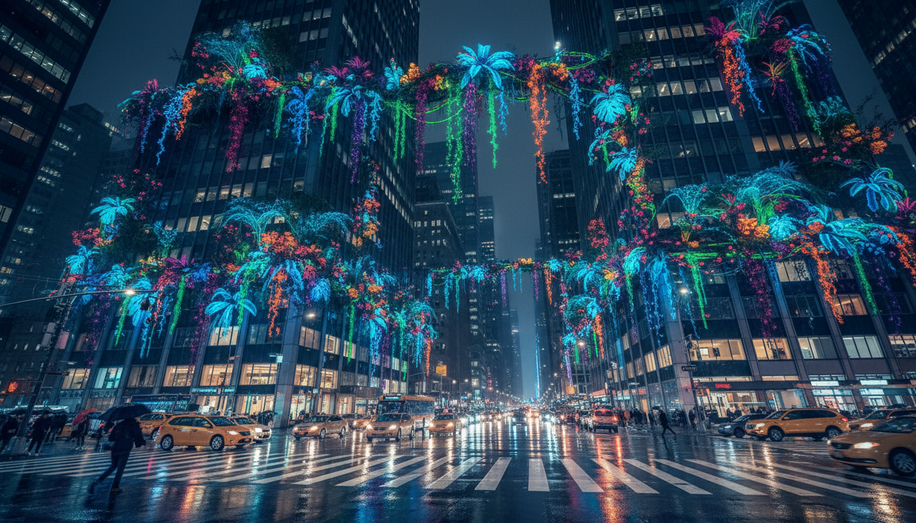

In the heart of a bustling city, where skyscrapers pierce the night sky and pedestrians weave through neon-lit streets, a building facade suddenly stirs to life. Ethereal figures cascade down its surface, lights pulse like a heartbeat, and an entire narrative unfolds before awestruck onlookers—all without a single brushstroke or LED screen. This is projection mapping, the transformative technology turning urban environments into immersive theaters for out-of-home (OOH) advertising, where brands commandeer cityscapes to deliver unforgettable spectacles.
Projection mapping, also known as video mapping, employs high-powered projectors to overlay digital animations, videos, and effects onto irregular surfaces like buildings, monuments, or natural landmarks. Unlike traditional billboards, which deliver static messages, this technique distorts visuals to match the contours of its canvas, creating the illusion of three-dimensional depth and motion. Marketers harness it to craft large-scale campaigns that blend storytelling with spectacle, captivating passersby and generating viral buzz in an era dominated by the experience economy. As urban dwellers crave interactivity amid digital overload, projection mapping elevates OOH from passive viewing to participatory wonder, drawing crowds that share the moment across social media.
Consider Volkswagen’s architectural masterpiece at Autostadt in Wolfsburg, where projectors rendered hyper-realistic illusions on a building, so lifelike that viewers questioned reality itself. The campaign showcased automotive innovation through fluid animations that seemed to reshape the structure, proving how projection mapping can make products leap from facades. Similarly, Toyota’s Auris promotion narrated the car’s origin story across its body, turning a vehicle into a cinematic protagonist and setting a benchmark for product-focused displays.
Fashion brands have mastered this street-stage alchemy. Ralph Lauren projected a towering catwalk of models onto its Bond Street store in London, halting traffic with three-story illusions of garments swaying in digital wind. Taking it further, the brand illuminated a 60-foot water wall in New York City’s Central Park for its Polo for Women launch, fusing fashion with fluid technology to etch the campaign into public memory. Harrods in London invited interactivity with a Fabergé egg projection across store windows, allowing visitors to select patterns via app, blending personalization with daytime visibility through varied lighting techniques.
Sports and entertainment amplify the medium’s reach. Adidas brought soccer icon Lionel Messi to life on Barcelona’s buildings, monuments, and trees, simulating him sprinting past spectators to hype the Adizero f50 cleats—a guerrilla-style stunt that turned streets into playing fields. Sony transformed Madrid buildings into colossal football pinballs, drawing 1,500 onlookers on premiere night, while AC Sparta Praha lit Prague’s Old Town Astronomical Clock for a jersey launch, merging heritage with hype.
Even natural wonders bow to this art. Groove Jones projected Disney’s Avatar: The Way of Water onto Niagara Falls, syncing bioluminescent Pandora scenes with cascading water to evoke the film’s themes of nature and awe. The installation, splashed across global news, won awards and underscored projection mapping’s power to humanize landmarks. In Sydney, Vivid festival’s Lighting of the Sails honored artist John Olsen by animating his works across the Opera House, reflections dancing in the harbor for waterfront viewers.
These campaigns thrive on precision: teams scan surfaces with lasers for exact mapping, deploy ultra-bright projectors for daylight viability, and synchronize with sound or interactivity. Coca-Cola’s nightly Iceberg Skating Palace show during the 2014 Sochi Olympics painted skies in Olympic fervor over two weeks, while Temple University’s “Temple Made” mobile projections roamed Philadelphia streets before climaxing on its bell tower. Target’s Halloween “Skeletown Square” at L.A. Live used 11 projectors for choreographed skeletons, and Van Gogh immersive exhibits blanketed industrial spaces with 360-degree masterpieces via dozens of units.
Yet, the street as stage demands more than tech wizardry; it requires narrative daring. New York’s New Museum facade became a canvas for artist-driven light performances, countering commercial glare with site-specific public art. Glowing Atoms’ “Seaside” animated Dutch beaches with flying sand and glowing shells, proving even landscapes yield to mapping’s magic. LEGO’s activations at Ovation Hollywood and Grand Central Station spawned LEGO universes on facades—monkeys scaling windows, characters space-bound—igniting play in urban cores.
Challenges persist: weather, permissions, and scale test logistics, but advancements in brightness and mobility make it viable year-round. As cities evolve into 24/7 canvases, projection mapping redefines OOH, not as interruption but invitation. Brands like Philips, Samsung, and Huawei pioneer it for product reveals, while events like Singapore’s Gardens by the Bay supertree floral projections draw tens of thousands. In crowded markets, these dynamic displays cut through noise, forging emotional bonds that static ads can’t match.
Ultimately, projection mapping positions the street as the ultimate billboard—ephemeral, enormous, and alive. It invites the public to co-star in brand stories, transforming commutes into concerts and plazas into portals. As technology sharpens, expect more cities to pulse with projected dreams, proving the urban stage is boundless. However, translating this breathtaking spectacle into measurable business outcomes and ensuring optimal logistical execution remains paramount. This is where platforms like Blindspot become indispensable, offering precise location intelligence for identifying high-impact canvases and robust audience measurement and ROI attribution to quantify the true effectiveness of these grand, ephemeral campaigns. Learn more at https://seeblindspot.com/