
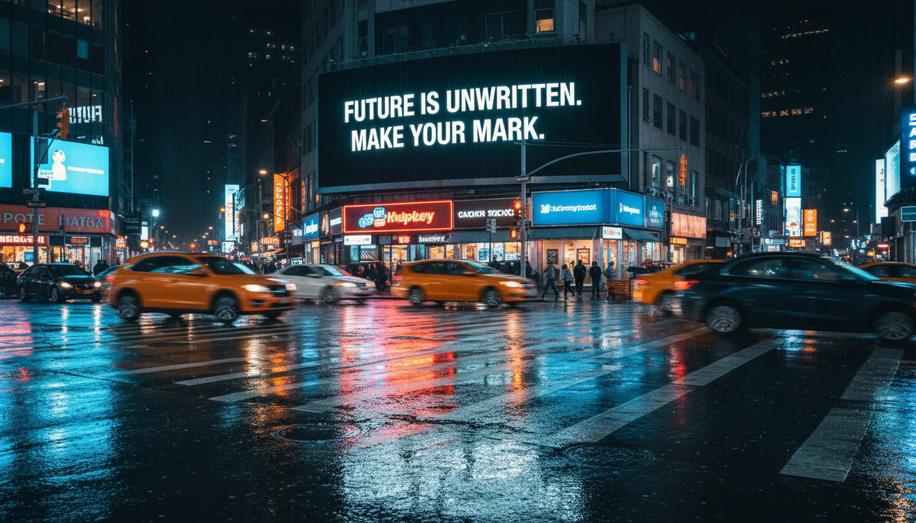

In the relentless rush of urban life, where drivers glance at billboards for mere seconds and pedestrians spare a fleeting look at street posters, out-of-home (OOH) advertising demands designs that pierce the visual noise like a laser. The mantra “less is more” has never rung truer: by embracing simplicity, readability, contrast, and visual hierarchy, creators craft unforgettable campaigns that not only capture attention but lodge in the collective memory of passersby.
Simplicity stands as the cornerstone of effective OOH design, stripping away excess to deliver a singular, potent message. Industry experts unanimously advocate the K.I.S.S. principle—keep it super simple—limiting copy to five to seven words at most, focusing on one central idea to sidestep confusion. Clutter kills comprehension; a Microsoft study cited in design guides notes the average human attention span has shrunk to eight seconds, meaning ads must transmit their essence instantly. Consider iconic campaigns like those from Sensory Logic research, which emphasize imagery over verbose explanations, relating messages to familiar concepts such as home or family to foster immediate emotional resonance without overwhelming the viewer. This minimalist ethos transforms potential overload into elegant precision, turning a billboard into a visual burst rather than a cluttered canvas.
Readability elevates simplicity from mere restraint to functional power, ensuring messages survive the dual challenges of speed and distance. OOH audiences are mobile—hurtling in cars or striding briskly—affording only seconds for absorption, yet high-frequency exposures build retention over time. Fonts must be bold and sans-serif, like Helvetica or Futura, which remain legible from 500 feet for billboards or across streets for storefront signs; ornate scripts or serifs falter under scrutiny from afar. Placement dictates scale: horizontal panels demand balanced headlines, while vertical formats shift emphasis upward. Testing visibility at various times of day, including dusk when lighting falters, prevents disasters—subtle tweaks like added illumination can make the difference between invisibility and impact.
Contrast amplifies readability, wielding color as a weapon to boost recall by 38%, according to research highlighted across multiple OOH resources. High-contrast pairings—vibrant yellow against deep black, or red screaming over white—cut through haze, twilight, or glare, making elements pop from afar. Color psychology adds depth: blue evokes trust, as favored by 42% of men and 29% of women in a University of Maryland study and ubiquitous in top brand logos; red ignites urgency for promotions; green signals eco-friendliness. Yet contrast extends beyond hue to value and saturation—low-contrast blends dissolve into the background, while strategic clashes guide the eye unerringly. Negative space, often underutilized, acts as a silent ally, providing breathing room that enhances legibility and imparts a modern, professional sheen.
Visual hierarchy orchestrates this symphony, dictating the path of the gaze in those precious moments. It functions as the blueprint, prioritizing elements through size, color, contrast, and motion—dynamic digital components naturally claim primacy, drawing eyes before static text or images. Bold headlines or product logos in arresting colors command first attention, followed by supportive graphics, with branding anchored reliably in the bottom right for horizontals or upper half for verticals. Whitespace reinforces this flow, preventing overcrowding and allowing key assets to dominate; well-hierarchized designs not only boost recognition but tie seamlessly to brand identity via distinctive elements like logos, outperforming complex or unbranded efforts in both recall and likability. Consistency across a campaign—uniform colors, fonts, and motifs—amplifies this, creating a cohesive presence that passersby intuitively link to the advertiser.
These principles converge in real-world triumphs, where restraint yields outsized results. A bannerbuzz analysis underscores how super-simple ads with high-contrast imagery drive foot traffic and sales, while PSA Research stresses color’s emotional pull in mobile contexts. Regulations and location further refine execution—vertical orientations in tight urban spots demand recalibrated hierarchies, and cultural sensitivities ensure relevance. Ultimately, OOH mastery lies in disciplined economy: fewer words, sharper contrasts, clearer paths for the eye. In a world drowning in data, these core rules ensure ads don’t just compete for glances—they command them, etching brands into the subconscious of every commuter and stroller alike.