
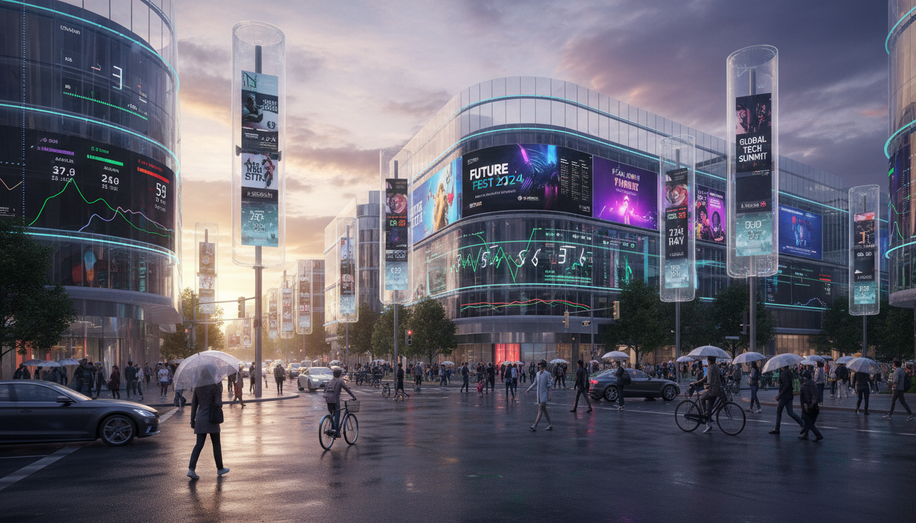

In the pulsating heart of modern cities, outdoor advertising is shedding its static skin, evolving into a vital cog in smart city machinery. Once confined to hawking products at bus stops, out-of-home (OOH) assets like digital billboards and interactive kiosks now pulse with real-time data, fostering urban connectivity and delivering public value far beyond commercial pitches. This integration marks a paradigm shift, where advertising infrastructure doubles as a public utility, enhancing everything from traffic flow to emergency alerts.
Consider AI-powered billboards, which analyze traffic patterns, weather, and crowd demographics to serve hyper-relevant content. In Tokyo’s Shibuya district, these displays adjust messaging based on passersby’s age and gender, boosting engagement while minimizing visual clutter in dense urban corridors. Similarly, New York’s Times Square leverages them for interactive ads that draw in tourists and locals alike, blending commerce with experiential vibrancy. Programmatic digital OOH takes this further, triggering ads or announcements based on live triggers like heavy foot traffic or weather shifts, ensuring messages land when they matter most.
This fusion extends to practical urban services, transforming ad spaces into nodes of connectivity. Outdoor digital signage in high-traffic zones relays transit updates, alternative routes, and pollution levels, empowering commuters with actionable insights. In Zurich, screens promote electric vehicle adoption, while Norway’s smart bicycle pavilions use DOOH to encourage sustainable transport, weaving environmental nudges into everyday navigation. France and Austria deploy digital totems for citizen awareness, from community events to healthcare info, turning billboards into all-day information hubs. These assets bridge digital and physical realms, promoting local businesses, cultural happenings, and recycling drives tailored to neighborhoods, thereby strengthening community ties and local economies.
Public safety emerges as another frontier. During emergencies, billboards pivot seamlessly from ads to critical alerts, integrating with transportation and alert systems for rapid dissemination. Programmatic DOOH has proven this in public health campaigns, activating screens in crowded areas to enforce social distancing or broadcast vital updates, curbing risks through precise targeting. Interactive elements amplify this: touch-enabled hybrid displays offer maps, timetables, and tourist directories alongside ads, with one screen for engagement and another for dynamic content. IBM’s “Smarter Outdoor” initiative exemplified early ingenuity, outfitting benches, shelters, and ramps with informative posters that doubled as public service tools, sparking social media buzz around urban innovation.
Sustainability and efficiency underscore the appeal. Energy-efficient displays and AI-driven personalization reduce waste, aligning OOH with green city goals. Facial recognition and augmented reality (AR) add layers of immersion; AR overlays on digital signs create emotional bonds, as seen in campaigns letting users “donate” blood virtually via billboards, fostering lasting connections. Remote management enables instant updates, keeping content fresh amid urban flux.
Case studies illuminate global momentum. Denmark’s healthcare facilities use wayfinding signage as virtual reception desks, streamlining visitor experiences. In the Czech Republic, LCD info-boards ensure 24/7 community access, funding infrastructure like public kiosks through ad revenue. These examples reveal OOH’s role in financing smart projects, from EV stations to interactive pavilions, proving advertising can underwrite public good.
Looking ahead, the trajectory points to deeper symbiosis. Advancements in AI, machine learning, and AR promise signs that adapt to time, traffic, and even individual profiles via spatial computing. Cohesive campaigns spanning OOH, mobile, and social media will amplify reach, with partnerships between advertisers, governments, and tech firms unlocking scale. As cities like those in Europe and Asia pioneer these hybrids, OOH transcends revenue streams to become indispensable infrastructure—informative, adaptive, and integral to connected urban life.
This evolution challenges traditional views of advertising as mere interruption. Instead, OOH assets cultivate smarter habitats, where every glance informs, engages, or safeguards. In an era of relentless urbanization, their contributions to connectivity and foresight position them not just at the bus stop, but at the core of tomorrow’s cities.