
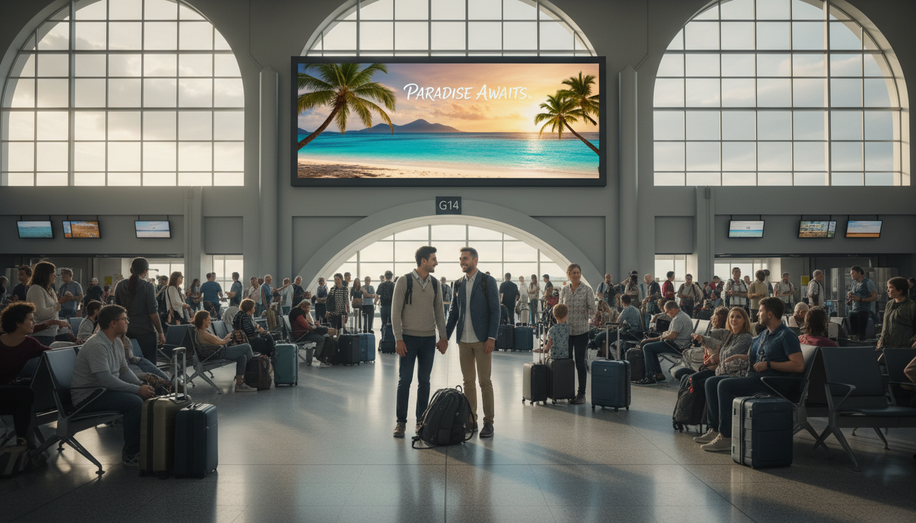

In the bustling corridors of airports worldwide, where travelers pause between flights, destinations are seizing a prime opportunity to shape itineraries and ignite wanderlust. Out-of-home (OOH) advertising in these high-traffic hubs has evolved from static billboards to immersive experiences that extend far beyond the terminal, influencing decisions for trips yet to be booked. A Nielsen study commissioned by Clear Channel Outdoor reveals that 57% of frequent flyers take action after viewing airport ads—up 8% from 2022—with 82% reading them and 61% recalling them vividly. This captive audience of business travelers and high-value passengers, often twice as likely to be AI decision-makers in their companies, represents a goldmine for regions, cities, and attractions aiming to convert idle moments into bookings.
Airports offer unparalleled demographic precision, targeting users in gate areas, lounges, security queues, and baggage claim with digital screens, Wi-Fi-enabled device ads, and experiential setups. EAM’s campaign for Radisson Hotels in South America and Mexico City blended physical branding and digital displays to boost awareness of properties in tourist hotspots, reaching business travelers in airline lounges who frequent such exclusive spaces. Similarly, Media Frankfurt’s La Prairie activation at Frankfurt Airport created a seamless cross-media network: digital and analog spaces in Terminal B, promotion zones in transit areas, and tie-ins with duty-free shops, ensuring no passenger escaped the luxury skincare brand’s allure. These efforts demonstrate how airport OOH captures attention during downtime, fostering emotional connections that linger post-flight.
Yet the true power lies in campaigns that propel marketing beyond the airport’s walls, turning passersby into visitors. Rochester International Airport (RST) went further with targeted digital pushes promoting competing destinations, using a “FlyMyAirport” widget to track searches and build retargetable audiences for sales campaigns. This data-driven approach not only drove engagement but quantified traveler interest, proving airports can serve as launchpads for regional tourism. A Clear Channel study underscores this momentum: as U.S. air travel surges toward record volumes through 2025, airport media influences the full marketing funnel, from awareness to action like website visits and QR scans.
Creative activations amplify this reach, blending OOH with digital and social extensions. At Košice International Airport in Slovakia, a live influencer challenge dubbed “around the world in 80 hours” partnered with Turkish Airlines to spotlight global connections from Eastern Slovakia. Five influencers received sealed boarding passes on arrival, live-streaming jaunts to Istanbul, Dubai, Mauritius, New York, and Bangkok, with followers voting on detours via social media. The campaign amassed 6.1 million impressions and spiked Turkish Airlines’ local passengers, transforming the terminal into a global showcase. Helsinki Airport’s #LIFEINHEL stunt echoed *The Terminal*, housing Chinese actor Ryan Zhu in an 8-square-meter cabin at the gate area for 30 days. Broadcast on YouTube and social platforms, his “life in HEL” won him a Lapland family trip, proving airports could be destinations unto themselves while hyping Finland’s northern wonders.
Even subtle tech innovations extend influence outdoors. Scandinavian Airlines’ compass-based app at airports overlays flight destinations onto users’ real-time views via GPS, turning smartphones into virtual globes that point travelers toward Nordic escapes no matter their facing direction. Such integrations leverage airport Wi-Fi for precise targeting, engaging devices as passengers roam terminals or exit to nearby hotels and transit hubs. Destinations like Lapland or Slovakia’s regions benefit immensely, as these tactics build excitement for off-airport attractions—ski resorts, cultural sites, or urban adventures—prompting spontaneous extensions to trips.
The data validates the strategy’s ROI. Frequent flyers, primed for high-intent decisions, respond robustly: over half act on ads by researching or booking, amid airports’ evolution into vibrant commercial ecosystems. For cities and attractions, this means deploying OOH not just inside terminals but syncing with external billboards, ride-share wraps, and geofenced mobile alerts to create a persistent narrative. Radisson’s multi-format blitz, for instance, drove conversions by immersing travelers in aspirational imagery from lounge to luggage reclaim. As air travel booms, destinations ignoring airport OOH risk ceding ground to rivals who master this “moment of truth.”
Challenges persist—cluttered spaces demand standout creativity, and measurement requires tools like RST’s widgets—but successes abound. From La Prairie’s duty-free synergies to Helsinki’s viral residency, airport OOH proves a catalyst for destination love affairs. Regions leveraging it don’t just advertise; they orchestrate journeys, turning transient flyers into loyal explorers long after wheels-up. In an era of surging skies, the terminal is no endpoint—it’s the spark for adventures afar.