
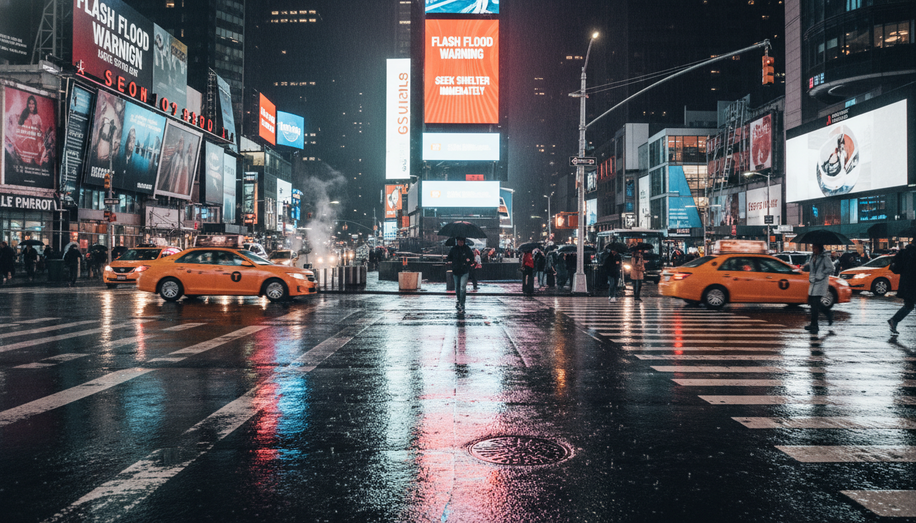

In the shadow of a hurricane barreling toward the coast, digital billboards flicker to life along evacuation routes, flashing urgent directives: “Evacuate now. Highway 10 north open. Shelter at Civic Center.” This is out-of-home (OOH) advertising at its most vital—not selling products, but saving lives. Beyond its commercial roots, OOH has evolved into a cornerstone of public information and crisis communication, leveraging its ubiquity, immediacy, and visual punch to cut through chaos when seconds count.
Governments and emergency agencies have long recognized OOH’s unmatched ability to reach people in motion, unfiltered by screens or skepticism. The National Center for Missing & Exploited Children (NCMEC), a Department of Justice arm, has blasted over 1,700 AMBER Alerts across digital billboards since 2008, capitalizing on the medium’s speed and flexibility during those critical first hours after an abduction. “The hours immediately following an abduction are critical to law enforcement efforts,” noted Robert Lowery of NCMEC’s Missing Children Division. “The speed and flexibility of digital billboards make the OOH advertising medium a vital component of the AMBER Alert network.” Tips from these displays have fueled arrests, including that of the East Coast Rapist, proving OOH’s role in turning passive viewers into active informants.
Public safety campaigns amplify this power on a routine basis. The National Highway Traffic Safety Administration (NHTSA) deploys OOH for anti-distracted driving messages, while the FBI credits digital formats with generating leads that nabbed 57 fugitives. Assistant Director Stephen Richardson of the FBI’s Criminal Investigative Division put it bluntly: “In times of crisis, in times of national emergency, if we’re looking for bad guys or bad gals, we use the billboards’ system in order to get the message out to the public.” These aren’t optional add-ons; they’re strategic necessities, blanketing high-traffic highways, transit hubs, and urban corridors where millions commute daily, oblivious to digital silos.
When disasters strike, OOH’s real-time adaptability shines. Clear Channel Outdoor, for instance, updates its digital billboards instantaneously during hurricanes, wildfires, heat waves, and snowstorms, delivering tailored alerts as conditions evolve. State emergency management agencies partner directly with OOH providers to warn of ice storms, floods, or chemical spills, often donating space for free. The Federal Emergency Management Agency (FEMA) even offers an Alert Message Generator, enabling customized creatives for any scenario—from evacuation routes to shelter locations—pushed out nationwide in minutes. In Texas, OOH companies have donated inventory for burn bans, water shortages, and storm warnings, ensuring rural and urban dwellers alike get the word without relying on spotty internet or power grids.
Health crises underscore OOH’s precision targeting. During the COVID-19 pandemic, the Ad Council rallied OOH leaders like Clear Channel Outdoor and the Out of Home Advertising Association of America (OAAA) to donate inventory and create PSAs. ReachTV alone beamed messages to 90 airports, hitting 18.3 million viewers monthly, plus 15 million video views on social platforms. Place-based OOH—ads in specific venues like transit stops or retail spaces—excels here, allowing rapid localization in multiple languages and markets. Federal and state health agencies deploy it for flu vaccinations, disease outbreaks, or environmental hazards, reaching underserved groups in low-connectivity areas where digital ads falter. Campaigns like “Click It or Ticket” or flu shot reminders gain traction through bold visuals on buses and billboards, reinforcing messages seen online or on TV for multi-channel impact.
What sets OOH apart in crises? Scale and inescapability. Unlike push notifications that can be silenced or social feeds drowned in noise, OOH invades daily routines—commuters on highways, pedestrians in cities, travelers in airports—delivering concise, unmissable visuals with large text and stark imagery. It’s democratic, too, bridging demographics: rural farmers, urban non-digital natives, even international visitors at large events, where public information officers now prioritize multilingual OOH alongside alerts and signage. In economically disadvantaged regions, it fills media voids, ensuring no one is left out.
Yet OOH’s edge lies in integration. It complements broader strategies, from PIO-led rumor control to stakeholder coordination, amplifying unified messaging across channels. During 2020’s pandemic surge, OOH PSAs echoed White House and CDC guidance, boosting compliance without overwhelming airwaves. Post-event, it educates on recovery, turning billboards into ongoing sentinels.
Critics might dismiss OOH as fleeting, but data and precedent tell otherwise. The FBI’s fugitive captures, NCMEC’s recoveries, and FEMA’s deployments quantify its ROI in lives preserved. As climate threats intensify and urbanization swells, OOH’s infrastructure—over 11,000 digital faces nationwide—positions it as indispensable. Governments increasingly lean on it not just for branding, but for the raw imperative of informing and protecting.
In an era of misinformation tsunamis, OOH stands as a beacon of trusted, immediate truth. When phones fail and power flickers, the billboard endures, a silent sentinel whispering—then shouting—survival. Its evolution from commerce to crisis conduit redefines public service, proving that the most effective ads aren’t sold; they’re served to society at its most vulnerable. This transformative role demands precision, speed, and verifiable impact. Platforms like Blindspot offer the advanced programmatic and location intelligence capabilities necessary for governments and emergency agencies to deploy critical messages instantaneously, ensuring optimal reach across diverse audiences and providing vital real-time performance tracking and ROI measurement for these life-saving campaigns. Learn more about empowering OOH for public good at https://seeblindspot.com/