
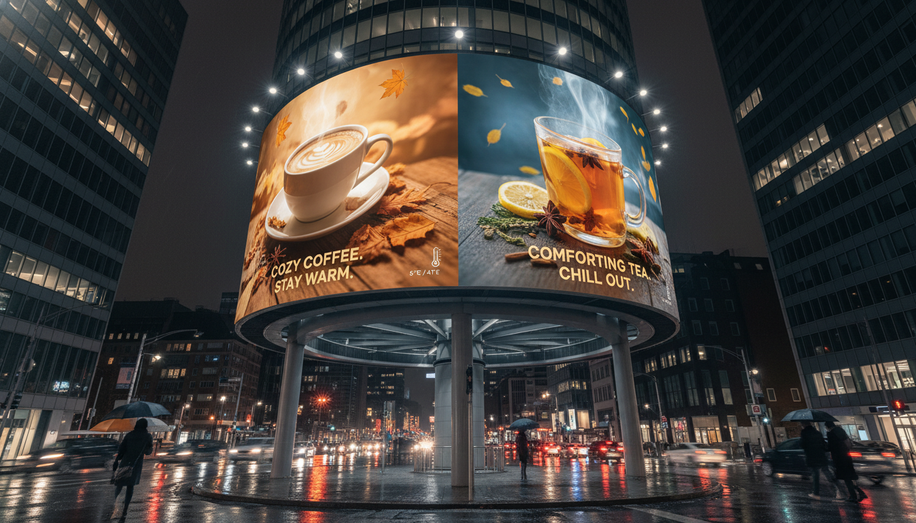

In the evolving landscape of out-of-home advertising, the ability to deliver the right message at precisely the right moment has become a competitive imperative. Dynamic Creative Optimization (DCO) is transforming how programmatic digital out-of-home (DOOH) campaigns operate by automatically adapting ad content in real time based on live data signals, moving beyond the static creative model that has long dominated the medium.
DCO represents a fundamental shift in how advertisers approach OOH campaigns. Rather than creating a single ad variation and hoping it resonates across all times and locations, DCO leverages machine learning and automation to adjust messaging and visuals on the fly. The technology uses real-time data inputs—including weather patterns, traffic conditions, time of day, audience demographics, and even current events—to ensure each impression is optimized for maximum relevance. This continuous adaptation allows advertisers to show viewers the most contextually appropriate message for any given moment, fundamentally changing what’s possible in outdoor advertising.
The mechanics of implementing DCO are more accessible than many marketers might assume. Rather than requiring completely new creative assets for every scenario, modern DCO systems utilize modular templates built with interchangeable elements such as headlines, images, and calls to action. Advertisers begin by identifying which data triggers they want to deploy, uploading their creative assets, and defining rules that determine when each variation should display. Once configured within a supply-side platform, the system automatically delivers the appropriate creative to the right screen, adapting seamlessly to real-time conditions without manual intervention.
The practical applications of DCO span numerous industries and use cases. A retail brand, for instance, can display promotions based on proximity to the nearest store location or update ads according to current weather conditions—a winter coat brand would see their messaging surface during cold snaps, while ice cream promotions take prominence during heat waves. Airlines can feature different destinations based on flight availability, while sports brands can adjust content around live match odds. This contextual relevance represents a significant departure from traditional DOOH, where creative remained static regardless of external circumstances.
The performance data supporting DCO implementation is compelling. Research from Clear Channel UK found that incorporating contextually relevant messaging in DOOH campaigns increases effectiveness by an average of 17 percent. More dramatically, a study by Analytic Partners revealed that investing in OOH creative, particularly dynamic and tailored messaging, can drive 2.5 times higher returns compared to static approaches. The same research highlighted that creative accounts for 41 percent of the potential ROI from the medium, underscoring how critical creative strategy is to campaign success. These findings suggest that DCO isn’t simply an incremental improvement—it’s a fundamental lever for maximizing advertising impact.
Beyond performance metrics, DCO delivers operational efficiencies that extend across the entire campaign lifecycle. By removing the need to produce static assets for every conceivable scenario, advertisers significantly reduce production time and overhead costs. The system can generate hundreds of creative variations and automatically select the most relevant option to serve consumers, going far beyond what traditional A/B testing can accomplish. This automation enables faster time to market and allows creative teams to focus on strategic asset development rather than routine production tasks.
The evolution of dynamic creative has also expanded the definition of what “dynamic” means in OOH advertising. While the term once simply referred to motion or video, today’s DCO capabilities encompass fluid, automated content that adapts through multiple variations or template-based approaches powered by live data. This technological sophistication, combined with programmatic buying mechanisms like real-time bidding, streamlines campaign management and helps marketers optimize delivery at scale.
As personalization rises in priority across all advertising channels and real-time data becomes increasingly accessible, DCO is emerging as a critical strategy for DOOH campaigns seeking meaningful competitive advantages. By ensuring that each impression is tailored to its specific context—whether that’s weather, location, audience, or temporal factors—advertisers can deliver more relevant messaging that resonates with audiences and drives measurable business results. For forward-thinking OOH advertisers, DCO represents not just an optimization technique but a foundational shift in how effective outdoor advertising campaigns are conceived and executed.