

In the bustling marketplaces of ancient Egypt around 3000 B.C., merchants carved hieroglyphics into stone obelisks and walls to proclaim laws, treaties, and wares, marking the humble beginnings of out-of-home (OOH) advertising as a public proclamation etched into the urban fabric. These early inscriptions, placed along trade routes to catch the eyes of travelers, evolved through Greek and Roman eras where painted announcements on city walls hyped gladiatorial spectacles, theater shows, and everyday goods like olive oil and wine, proving that capturing attention in shared public spaces has always been the medium’s enduring power.
Fast-forward to the 19th century, when OOH truly ignited as a commercial force. The invention of lithography in 1796 enabled vibrant illustrated posters, but it was Jared Bell in the 1830s who scaled it up, producing massive 50-square-foot posters to promote Ringling Brothers circus spectacles—the “greatest show on earth.” Billposters, armed with glue pots and sheaves of paper, plastered these across any available surface, sparking fierce rivalries where one advertiser’s print would bury another’s in a chaotic precursor to modern wildposting. By the 1860s, the practice formalized: landowners began leasing wall space, birthing dedicated advertising structures and standardizing the industry. National brands like Coca-Cola, Palmolive, and Kellogg piled in after 1901, when the U.S. standardized billboard formats, turning highways into rolling canvases as the Model T Ford spurred road-building and mass mobility.
Technological leaps soon painted these static displays with light and motion. Times Square flickered to life in the 1910s with the first electric billboard, a dazzling harbinger of illuminated spectacle that by the 1940s bloomed into ubiquitous neon signs, infusing city nights with electric allure. Mobile innovations accelerated reach: streetcar ads emerged in the 1830s, evolving into motorized trucks by the 1920s, where businesses fitted panels with bold visuals to roam cities and countryside. World War II repurposed these trucks for patriotic drives, peddling war bonds and recruitment to remote locales traditional media ignored, while postwar booms saw Coca-Cola and Marlboro cruising open highways in iconic campaigns that mirrored America’s wanderlust.
Mid-century refinements sharpened OOH’s edge. The 1889 Paris Exposition codified the familiar 2:1 poster ratio, stitching 24 lithographed sheets into seamless giants, while associations lobbied for standards amid booming demand. By 1970, hand-painted boards gave way to computer-generated vinyl prints, slashing production time and costs. That same decade, mobile and transit ads proliferated, capitalizing on commuters’ captive gazes. A landmark 1975 campaign by Outdoor Advertising Inc. (OAI), featuring fresh Miss America Shirley Cochrane on nationwide billboards, skyrocketed her name recognition by 940%, irrefutably proving OOH’s recall power just as tobacco brands pivoted to it post-broadcast bans.
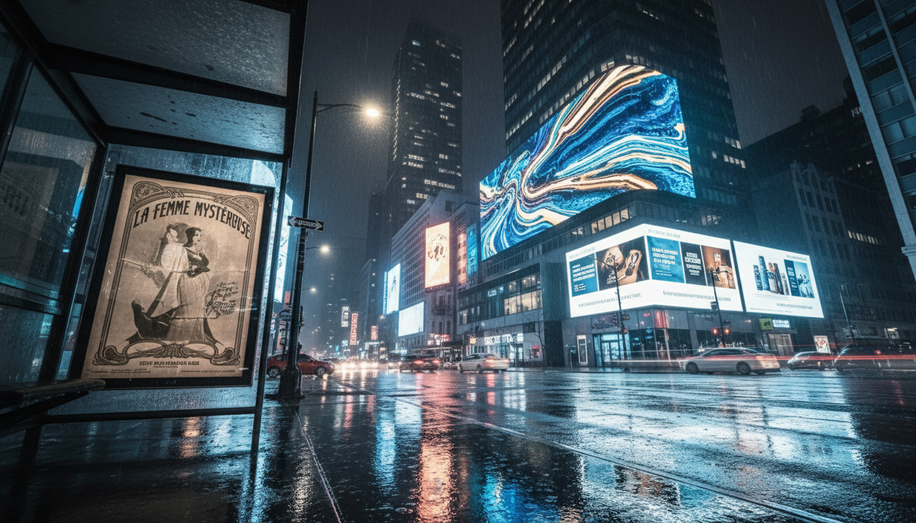
Yet evolution demanded reinvention. The late 20th century’s printing advances and vehicle customizations set the stage, but the early 2000s unleashed digital out-of-home (DOOH), swapping static vinyl for LED screens beaming real-time, dynamic content. Times Square, already a neon legend, became DOOH’s global icon, pulsing with targeted messages that shifted by weather, traffic, or audience data. This pivot addressed OOH’s ebbs—competition from digital media in the 1990s and 2000s—by blending legacy scale with programmability, enabling instant swaps and interactivity.
Cultural shifts amplified these strides. Early OOH hawked entertainment and staples, reflecting societal pulse; wartime it rallied nations, peacetime it championed public service from open boards stocked with PSAs since 1913. Standardization by 1912 reached every major city, while post-1908 highways birthed roadside empires. Today, DOOH fuses AI analytics for precision targeting, programmatic buying for efficiency, and interactivity via QR codes or sensors, turning passive passersby into engaged consumers.
From Egyptian stone to pixelated precision, OOH’s century-plus arc reveals resilience: it thrives by mirroring human movement, harnessing tech to command shared spaces amid cultural flux. Iconic campaigns—from Bell’s circus posters to Cochrane’s breakout to Times Square’s digital symphony—underscore its knack for cultural imprinting. As urban density swells and data democratizes, OOH hurtles toward a future where augmented reality overlays and AI-driven personalization erase lines between ad and environment, ensuring painted walls’ progeny endures as the original mass medium.