
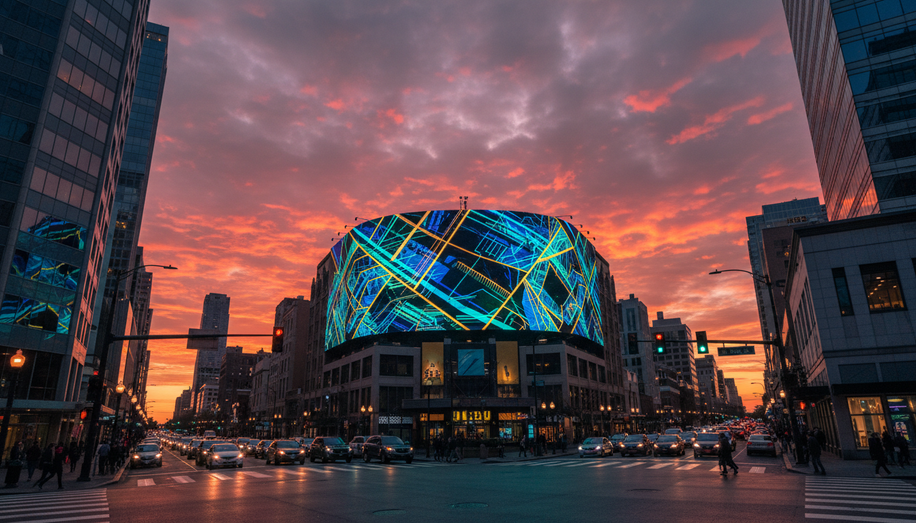

In the fleeting world of out-of-home (OOH) advertising, where commuters glance at billboards from speeding cars and pedestrians catch sights amid urban chaos, design is not merely aesthetic—it’s a survival tactic. Viewers have mere seconds to register a message, often from distances of 50 feet or more under varying light conditions, making every element a calculated strike for impact. Mastering this creative canvas demands adherence to core principles: typography that commands attention, color theory that pierces distractions, image selection that evokes instant emotion, and messaging honed to razor-sharp conciseness.
Typography sets the stage for readability in OOH’s unforgiving environment. Bold, sans-serif fonts dominate because they remain legible at high speeds and afar, eschewing skinny or ornate styles that blur into irrelevance. Experts advocate high-contrast pairings—think thick black letters on white or vivid yellow on deep blue—to ensure text “pops” against cluttered backdrops. Font sizes must scale massively; headlines should span at least one-fifth of the ad’s height to dominate the visual hierarchy, guiding the eye from left to right and top to bottom, mimicking natural reading patterns. Subtle gradients or decorative flourishes? Avoid them. As one study notes, simplicity in type leads to stronger attention fixation, boosting memory encoding by up to 38% in digital OOH rotations.
Color theory amplifies this foundation, turning visibility into visceral pull. High-contrast schemes are non-negotiable: dark on light or light on dark ensures legibility regardless of time of day or weather. Bold hues like fiery reds, electric blues, or sunny yellows cut through the “fog” of digital and physical noise, evoking emotion while maintaining brand consistency. Negative space plays a starring role here, providing “visual breathing room” so elements don’t compete. Psychedelic mash-ups or pastel subtleties fail; instead, opt for palettes that create strong silhouettes, recognizable even in outline form. This approach not only enhances recall but aligns with the brain’s preference for emotional triggers, where 70% of decision-making happens instinctively.
Image selection transforms passive viewing into active engagement, leveraging the full canvas of OOH formats—from towering billboards to digital projections. High-quality, emotionally resonant visuals should dominate, using lifestyle photography or product shots that tell a story in a glance. Let images “do the talking,” conveying mood or intent without textual crutches; a single compelling photo can outperform verbose explanations. Prioritize drama: dynamic compositions with ample negative space draw the eye, while over-detailed clutter repels it. For roadside placements, ensure shapes register at speed, creating memorable silhouettes. Tailor to context—local landmarks or seasonal motifs forge personal connections, elevating a generic ad into something unforgettable.
Above all, message conciseness is the linchpin, distilling complex ideas into seven words or fewer. Brevity empowers: a single headline, one core idea, and a subtle call-to-action like a QR code or vanity URL suffice. Overloading dilutes impact; as principles dictate, stick to one takeaway—be it brand awareness, product push, or lifecycle nudge. Compelling copy must stand alone, instantly understood, with logos unobstructed for immediate recall. Rotate variations in digital formats to reinforce without overwhelming. This “simple, striking, succinct, sensible” formula ensures the ad doesn’t just compete with real-life noise—it conquers it.
Contextual savvy ties these elements together. Ads thrive when rooted in objectives: boost recognition? Amplify the logo. Drive action? Spotlight a memorable CTA. Localize for relevance—reference nearby events or culture—to spark favorability. Brand consistency across visuals, type, and color cements cohesion, while testing for real-world conditions (distance, motion, lighting) refines execution. In 2024 and beyond, digital tools enable vibrant prints, but timeless rules endure: clarity over complexity, boldness over subtlety.
Designers who internalize these principles unlock OOH’s superpower: turning transient glances into lasting impressions. Simplicity cuts through clutter, visuals ignite emotion, and precision messaging drives results. In a landscape bombarded by stimuli, the canvas that masters restraint wields the greatest power.