
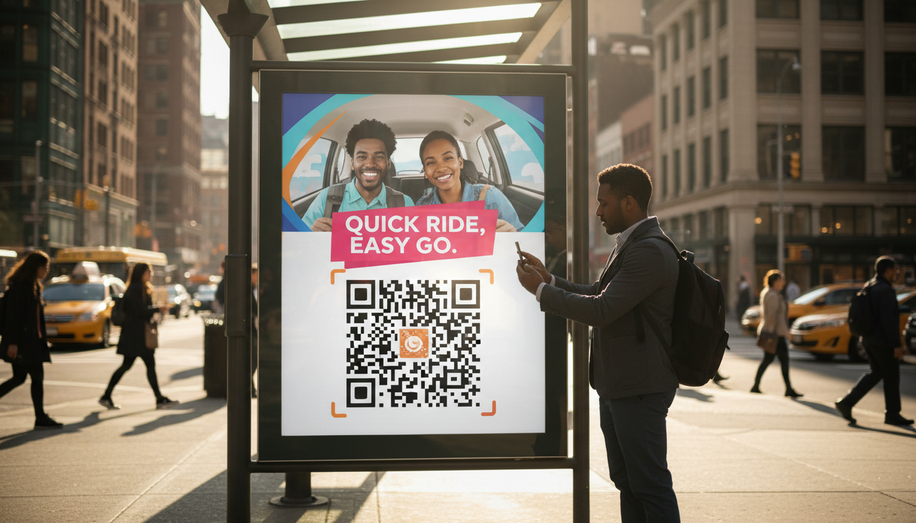

Out-of-home advertising has traditionally operated in isolation, capturing attention on transit vehicles, billboards, and street-level displays with limited mechanisms to measure direct consumer action. Yet as digital integration accelerates, OOH campaigns are increasingly bridging the gap between physical exposure and mobile engagement, creating measurable pathways that convert fleeting glances into concrete app downloads and digital interactions.
The convergence of OOH and mobile advertising represents a fundamental shift in how outdoor campaigns drive business results. Rather than serving solely as brand awareness tools, modern OOH placements now function as direct response vehicles, equipped with trackable elements that guide consumers from the street to their smartphones. This integration enables advertisers to capture the moment when physical attention translates into digital action, transforming the OOH experience into a multi-channel conversion funnel.
QR codes have emerged as the primary bridge technology, allowing consumers to move seamlessly from billboard to app store. When a retail brand installs a billboard featuring a scannable QR code, customers can immediately access mobile apps where they redeem special offers or locate nearby stores. This frictionless transition eliminates the friction of manual searches and creates a direct attribution path, enabling marketers to track precisely how many scans led to app installations. The approach works because it respects consumer intent—those interested enough to scan have already self-selected as potential users.
Geofencing technology extends this capability further, enabling location-triggered mobile ads that reinforce OOH messages with personalized follow-ups. When a consumer walks past a physical billboard, targeted ads can appear on their smartphone moments later, creating a coordinated touchpoint sequence that amplifies recall and encourages action. This layer of precision targeting ensures that mobile engagement occurs when brand awareness peaks, maximizing conversion probability.
Real-world case studies demonstrate measurable impact. Tinder’s “It Starts with a Swipe” bus wrap campaign drove significant results, with consumers exposed to the campaign proving 79% more likely to download the app than unexposed groups. The campaign generated 1,045 downloads among exposed audiences and sustained download momentum throughout its duration, ultimately achieving 3x more app downloads in the exposed group compared to the control group. Full bus wraps proved particularly effective, delivering 10.4 downloads per vehicle—twice the rate of other transit formats. These metrics underscore how creative OOH executions, when strategically placed, function as efficient app acquisition channels.
Webull’s campaign similarly targeted high-value audiences through contextually relevant placements spanning transit, billboards, airports, and college campuses across major cities. By concentrating frequency in locations where key demographics concentrate, the campaign maximized the probability of exposure among users most likely to engage with investment platforms.
The integration of data analytics has become essential to quantifying OOH’s digital impact. Modern attribution systems now connect impression-based OOH delivery with mobile app install data, allowing advertisers to understand conversion pathways. Rather than relying on proxy metrics, campaigns can now measure direct cause-and-effect relationships. A restaurant chain might deploy mobile-integrated billboards tracking how many users scanned QR codes to view menus or place orders, providing transparent ROI insight.
Beyond functional metrics, innovative OOH campaigns build emotional resonance that extends into digital spaces. Apple’s “Shot on iPhone” campaign transformed customer photos into OOH content, turning users into brand ambassadors while creating local relevance. This approach generates organic social sharing and hashtag engagement, amplifying reach beyond the physical placement as consumers document and discuss the campaigns online.
As the physical and digital worlds continue converging, OOH advertising’s capacity to drive app downloads and digital engagement will only deepen. The most successful campaigns recognize that outdoor exposure represents just one chapter in a consumer’s journey—the bridge to mobile engagement determines whether that exposure converts into lasting user relationships. By embedding trackable mechanics, respecting geographic context, and measuring attribution rigorously, OOH practitioners can transform streets and transit systems into genuine acquisition channels that drive measurable digital outcomes. To truly harness this potential, platforms like Blindspot offer the advanced analytics required to connect OOH exposure with concrete digital actions. By providing robust ROI measurement and attribution, real-time performance tracking, and granular audience measurement, Blindspot empowers advertisers to optimize campaigns for maximum digital conversion and transparency. Its precise location intelligence and site selection capabilities further ensure strategic placements that transform OOH into a high-performing digital acquisition engine. Learn more at https://seeblindspot.com/