
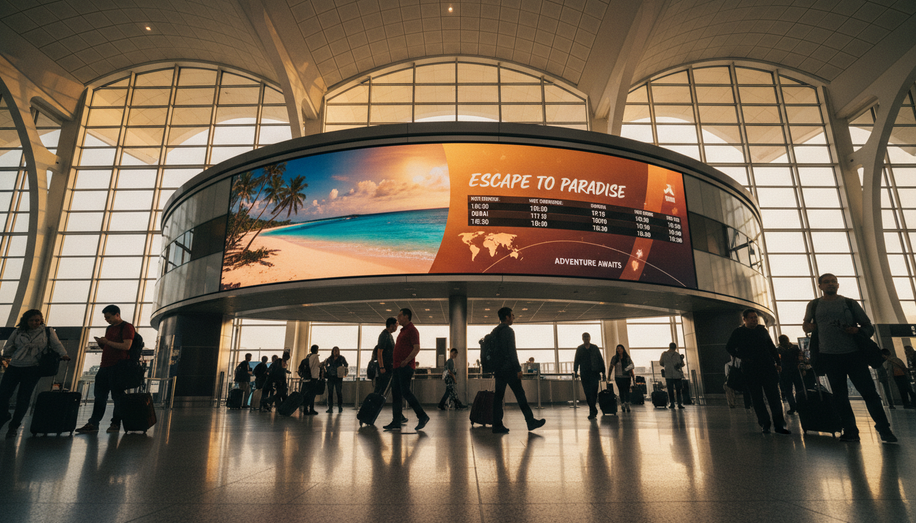

In the bustling streets of modern cities, where digital out-of-home (DOOH) screens flicker with endless messages, artificial intelligence is quietly revolutionizing how advertisers craft campaigns that truly capture attention. No longer confined to predicting foot traffic or click-through rates, AI now dives deep into audience data and environmental variables to refine every pixel of creative design, suggesting layouts, colors, and messaging that maximize impact. This shift from reactive analytics to proactive design enhancement is transforming out-of-home (OOH) advertising into a precision tool for brands seeking measurable real-world results.
At its core, AI-driven creative optimization analyzes vast datasets—demographics, psychographics, weather patterns, time of day, and even commuting behaviors—to recommend elements that resonate most powerfully in specific contexts. Consider a coffee chain’s DOOH campaign: AI might detect a heatwave via real-time weather feeds and audience location data, then swap out hot latte visuals for iced drinks, adjusting layouts to emphasize refreshing blues and greens over warm tones for better thermal contrast against sunny backdrops. A WARC/JCDecaux study underscores the payoff, revealing that DOOH campaigns with AI-optimized creative achieved up to 20% higher engagement, as the technology generates and tests multiple design variations in seconds.
Platforms like Super Optimal exemplify this hands-on application, employing machine learning to scrutinize OOH ad components—such as typography hierarchy, image salience, and color dominance—against evidence-based guidelines for effectiveness. Uploaded designs receive instant feedback: “Enlarge the call-to-action by 15% for roadside visibility” or “Shift messaging to the lower third to counter pedestrian gaze patterns.” This isn’t guesswork; it’s data-driven iteration, matching creative against proven benchmarks derived from thousands of high-performing campaigns. Similarly, tools from Canva AI and Adobe Firefly enable rapid prototyping of variations, resizing assets for diverse formats like billboards or transit screens while predicting performance based on historical engagement signals.
Environmental factors add another layer of sophistication. AI integrates contextual data, from traffic density to nearby events, to tailor layouts dynamically. Near a sports stadium during a game, it might prioritize bold, single-visual designs with high-contrast messaging to cut through crowd noise, as emphasized in recent analyses of AI-era billboards. For B2B campaigns, proximity to corporate headquarters triggers firmographic tweaks—swapping generic imagery for industry-specific icons pulled from viewer profiles. OneScreen.ai’s dynamic content optimization (DCO) platform takes this further, mixing modular creative layers: headlines, visuals, and calls-to-action recombine in real time based on predictive targeting models that forecast audience receptivity.
Real-time adaptation seals the deal. As campaigns unfold, AI monitors performance metrics like dwell time, foot traffic lift, and brand recall, then refines on the fly. If a tagline underperforms on weekends, the system pivots to alternatives proven stronger in similar demographics, all without human intervention. Clinch’s AI solutions, for instance, automate personalization across thousands of screens, linking exposures to conversions via advanced attribution. Billups’ technology officers note how incoming data allows mid-flight adjustments: “This copy works better for these audiences—let’s deploy it now.” Programmatic DOOH buying amplifies this, with algorithms optimizing not just placement but creative execution for agility and accountability.
Challenges persist, of course. Brand consistency demands modular design from the outset, ensuring AI mixes don’t dilute identity. Operators must partner with DSPs offering robust DCO, like Broadsign or Vistar Media, which embed AI testing into workflows. Measurement remains key—lift studies and geotargeting analytics feed back into models, creating virtuous cycles of improvement. Yet, as infrastructure grows, these hurdles fade. AI doesn’t replace creative instinct; it augments it, freeing artists to focus on strategy while machines handle iteration.
The implications for OOH operators and marketers are profound. In high-stakes environments like retail corridors or event venues, AI aligns messaging with live contexts—weather, scores, trends—without privacy compromises, boosting credibility among performance-driven advertisers. Retailers already see foot traffic surges from contextually tuned creatives, while brands extend digital storytelling into physical spaces via programmatic precision. As Charel MacIntosh of Clinch observes, AI powers “creative automation at scale,” delivering relevant messages that adapt effortlessly.
Looking ahead, this data-driven design ethos will redefine OOH as a bridge between online and offline worlds. Early adopters gain edges in engagement and ROI, proving campaigns not just seen, but remembered and acted upon. For an industry long reliant on gut feel and static assets, AI ushers in an era where every billboard, screen, and transit wrap becomes a living, learning canvas—optimized for maximum human impact.
As OOH transforms into this intelligent, responsive medium, platforms like Blindspot become indispensable, offering the comprehensive toolkit needed for data-driven precision. Blindspot empowers marketers to harness the power of AI by integrating real-time campaign performance tracking with robust audience measurement and programmatic DOOH campaign management, ensuring creative and placement adapt dynamically for maximum impact and measurable ROI. This allows brands to transform every screen into an optimized, living canvas, driving unparalleled engagement and proving campaign effectiveness. Learn more at https://seeblindspot.com/