
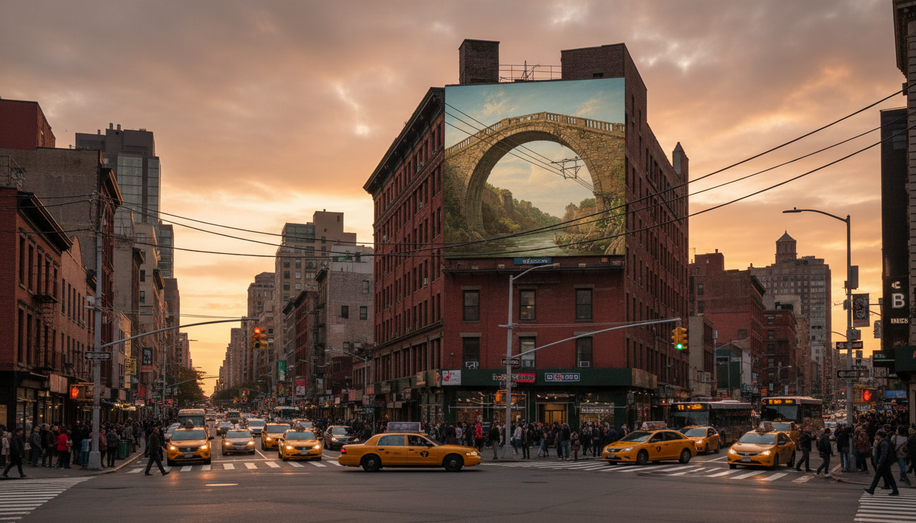

In the bustling streets where static billboards compete for fleeting glances, a subtle revolution is underway—one that relies not on flashy digital screens or costly 3D extrusions, but on the timeless craft of illusion. Forced perspective and environmental integration stand as the unsung heroes of out-of-home (OOH) advertising, transforming flat posters into mesmerizing optical tricks that hijack the human eye without a single moving part. These techniques, rooted in principles of distortion and contextual harmony, prove that the most powerful visuals often emerge from clever restraint rather than technological excess.
Forced perspective, a staple of cinema and photography, finds its purest expression in static OOH by manipulating scale and alignment to fabricate impossible depths. Imagine a billboard depicting a colossal soda can teetering on the edge of a rooftop, its base perfectly scaled to align with a distant lamppost below; from the driver’s viewpoint, it appears poised to tumble into traffic, freezing motorists mid-commute. This illusion exploits stereopsis—the brain’s fusion of slightly offset images from each eye—to conjure three-dimensionality from a mere 2D plane. Unlike anamorphic designs, which demand precise viewing angles via mathematical warping, forced perspective thrives on broader accessibility, rewarding observers who stumble into the sweet spot organically. Designers achieve this by photographing elements from exaggerated distances, compressing foreground objects to dwarf scale while elongating backgrounds, then printing the composite at full billboard size. The result? A static image that pulses with kinetic threat or playful impossibility, demanding double-takes and social media shares.
Environmental integration elevates these tricks further, weaving the billboard seamlessly into its surroundings to amplify the deception. A Jakarta campaign masterfully employed building shadows and structural edges on a large digital screen—adapted here for static posters—positioning warped imagery so passing clouds or vehicles appeared to pierce the frame, blending ad with reality in hypnotic harmony. Static executions mimic this by scouting sites where natural features enhance the narrative: a poster of a shark fin slicing through a busy intersection might align its trajectory with an oncoming overpass, making the predator seem to lunge from the pavement itself. Shadows play a pivotal role; fixed light sources cast elongated forms that dovetail with printed distortions, as seen in campaigns where a coffee cup’s steam rises to merge with exhaust fumes from nearby traffic. This isn’t mere coincidence—creatives map site-specific lighting throughout the day, layering artwork in foreground, midground, and background planes to mimic parallax shifts, tricking the eye into perceiving motion and depth on an immutable surface.
The artistry demands precision. For forced perspective, software like Adobe Photoshop or specialized plugins simulate viewer angles, allowing designers to preview distortions before production. Printing on curved or angled substrates enhances the effect, as slight warps reinforce perceptual bends without venturing into true 3D fabrication. Environmental scouts document ambient elements—pedestrian flows, architectural lines, even seasonal foliage—to inform compositions that activate only in context. Consider a London poster for a luxury watch, its oversized dial positioned to “reflect” the adjacent Thames River’s shimmer through strategic gloss varnish and metallic inks; passersby gasp as the timepiece seems to hover above the waterline. Such integrations boost retention, with illusions lingering in memory long after the ad fades from view, fostering brand loyalty through shared astonishment.
Yet mastery lies in subtlety. Overreach risks gimmickry; a poorly aligned perspective collapses into cartoonish flatness, while ignored environmental shifts—like relocated street signs—shatter the spell. Successful campaigns, such as those promoting tourism with oversized landmarks “interacting” with real-world siblings, balance spectacle with message clarity, ensuring the product remains the star. Agencies report heightened engagement metrics: viewers pause longer, photograph more, and recall brands 30% better than with standard statics. In an era of DOOH dominance, these analog illusions remind us that OOH’s core strength is physical presence—hijacking shared spaces with mind-bending permanence.
Beyond billboards, posters in bus shelters or transit hubs adapt these methods nimbly. A forced-perspective mural of sneakers dangling from power lines might extend onto adjacent walls, drawing real wires into the composition for an urban web of peril. Environmental cues like rain-slicked pavements reflect printed puddles, creating infinite regressions that mirror the viewer’s steps. Ethical considerations arise too: illusions skirting public safety, like faux road hazards, must prioritize caution to avoid distraction lawsuits.
As urban landscapes densify, the art of illusion in static OOH evolves, proving flat media’s enduring potency. By distilling perception’s frailties into printed wizardry, creators don’t just advertise—they architect moments of wonder, turning everyday commutes into galleries of the impossible. In a world chasing holograms, these grounded deceptions reaffirm that the sharpest tools are often the simplest: a well-placed line, a shadowed edge, and the environment as unwitting accomplice.