
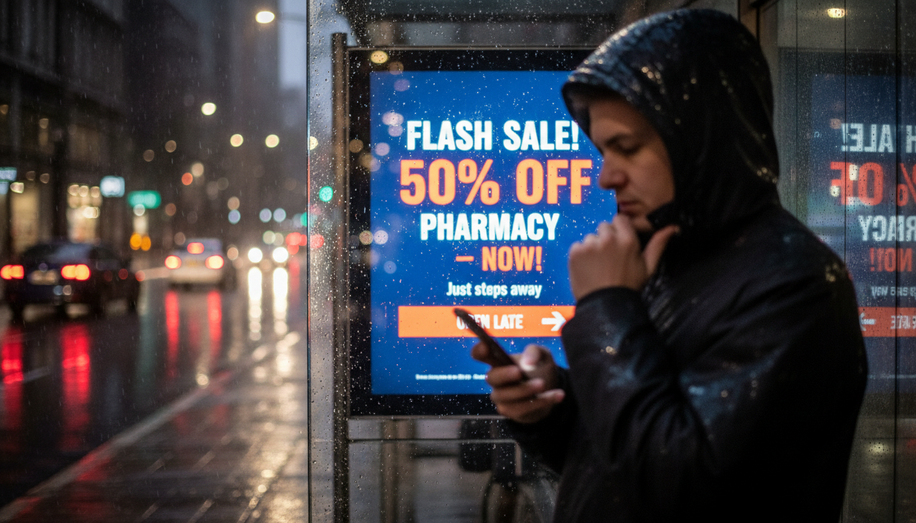

In the frantic final moments of the consumer journey, when shoppers teeter on the edge of decision, out-of-home (OOH) advertising emerges as the ultimate catalyst, propelling them from awareness to action with unmatched immediacy. Picture a pedestrian hustling down a bustling sidewalk, phone in hand, eyes scanning for lunch options: a digital OOH screen at the corner flashes “Order ahead, pick-up now—7th & 33rd,” complete with a directional arrow and a QR code linking straight to the app. This isn’t serendipity; it’s strategic precision, capitalizing on proximity to convert passive glances into store visits. Data underscores the potency: digital OOH drives secondary actions like purchases at a 49% rate, outpacing streaming video (40%), social media (38%), paid search (26%), and audio (19%). For retailers, this “last-mile” activation transforms OOH from mere visibility into a direct revenue driver.
The power lies in location-first execution. OOH thrives in high-intent zones—office corridors, entertainment districts, shopping enclaves—where consumers are already primed for impulse buys. Placing ads within a few blocks of stores exploits this geography: imagine dynamic screens tailoring messages with real-time distance cues, like “Your nearest sale: 2 blocks away,” or countdowns to flash promotions that scream urgency. Shoppers exposed to such proximity-based campaigns report heightened retention—49% are “active, alert, and interested” outdoors, far above in-home media benchmarks—making OOH ideal for spotlighting limited-time deals or exclusive offers when wallets are loosest. Beverage brands, for instance, lead with consumer craved hooks: new product news (45% preference) or price savings (41%), ensuring the ad’s single value proposition cuts through urban noise.
Digital out-of-home (DOOH) elevates this further with programmatic wizardry, adapting creatives on the fly via data feeds. Weather shifts? A beverage truck’s LED display swaps iced drinks for hot coffee as temperatures plunge. Nearing a stadium? It pivots to team-specific gear. Retailers layer in store-specific promos when GPS detects shopping centers, or midday lunch specials in business districts, all automated for peak relevance. This isn’t static billboarding; it’s a living conversation. Cross-channel synergy amplifies it: a shopper spots an online ad, then reinforces it at a bus shelter with consistent messaging and a QR code bridging to the promotion. The result? 2-3x higher engagement than siloed efforts, priming searches and sealing sales.
Experiential twists turn viewers into participants, blurring the line between ad and activation. Mobile fleets—glass trucks, LED vehicles, even giant product replicas—roll brands directly to consumers, enabling touch-and-try encounters that static posters can’t match. A branded Airstream touring campuses garners leads exponentially beyond flyers, while proximity campaigns have spiked store visits by over 1.3 million through data-driven targeting. In retail media’s evolution, EV charging stations exemplify untapped potential: screens at retail-center plugs captive-audience drivers with tailored offers, merging dwell time and purchase intent. High-traffic formats like urban panels and transit furniture near stores stack directions atop promotions, guiding foot traffic while longer-dwell environments reinforce messaging along the path to purchase.
Retailtainment reshapes the paradigm, intersecting OOH with store environments to spark buzz and traffic. Interactive elements—think robotic point-of-purchase displays or AR-enabled billboards—boost engagement tenfold over traditional setups, fostering omnichannel journeys where physical exposure fuels online research and vice versa. Consistent naming across street ads, SERPs, and shelves ensures seamless transitions: see the OOH prompt for a personal care item, search it, and buy from the manufacturer’s site. Measurement tracks the wins—impressions, social lift, content creation—proving ROI beyond doubt.
Critics might dismiss OOH as fleeting, yet benchmarks affirm its last-mile supremacy, especially amid retail’s omnichannel shift. Programmatic tools now enable real-time customization, from weather-responsive creatives to audience-specific urgency, making every exposure a potential transaction. For flash sales, new openings, or everyday traffic boosts, OOH delivers where digital falters: unskippable, contextual relevance at decision’s doorstep.
Brands ignoring this forfeit the sidewalk’s edge. As urban consumers navigate hybrid paths—scrolling one moment, striding the next—OOH commands the final turn. Deploy it with data-driven proximity, crisp calls-to-action, and integrated flair, and watch abstract awareness crystallize into tangible purchases. The journey ends not in contemplation, but at the checkout.