
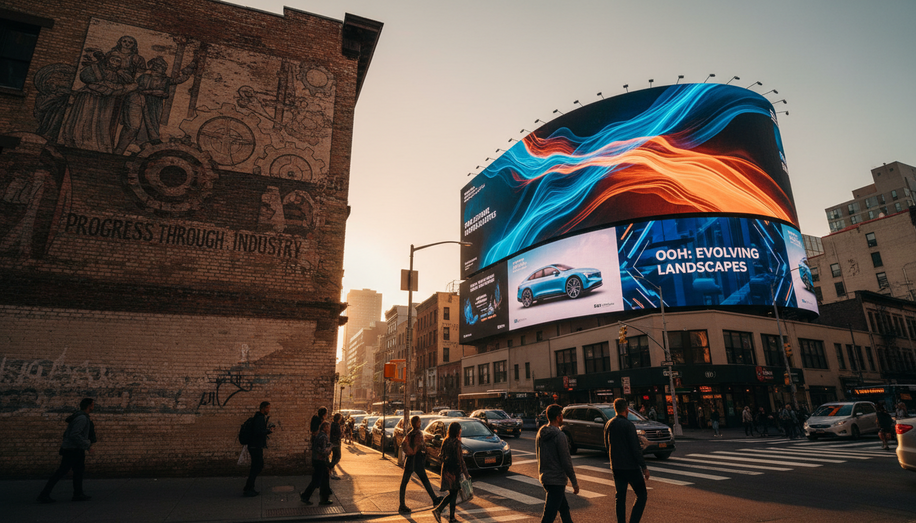

Out-of-home advertising, the venerable giant of the marketing world, has been whispering—or shouting—its messages to the masses since the dawn of civilization. Long before neon lights flickered or algorithms targeted our feeds, ancient Egyptians carved tall stone obelisks around 3000 B.C. to broadcast laws, treaties, and royal decrees. These monolithic billboards stood as enduring testaments to the power of public proclamation, proving that OOH’s core mission—to capture attention in shared spaces—has roots deeper than recorded history itself.
Fast-forward to the 15th century, when Johannes Gutenberg’s 1450 invention of movable type printing ignited the modern advertising era. Handbills, those humble precursors to posters, fluttered through Europe’s streets, hawking everything from potions to performances. By 1796, the perfection of lithography ushered in the illustrated poster, transforming flat walls into vibrant canvases. In America, the 1830s marked the birth of the billboard as we know it. New York printer Jared Bell pioneered 50-square-foot circus posters, while roadside merchants slathered fences and barns with hand-painted signs directing travelers to remedies for rheumatism or supplies for horse blankets. Billposters, those intrepid warriors of the trade, waged turf wars by plastering over rivals’ work, sometimes deploying up to 1,000 sheets a day in a chaotic precursor to today’s wildposting.
The golden age of hand-painted murals flourished from the 1920s through the 1940s, turning urban walls, grain silos, and rural barns into massive artworks. These murals peddled circuses, sodas, and elixirs with bold strokes and vivid pigments, thriving as an affordable medium amid booming car culture. Yet prosperity bred regulation: President Lyndon B. Johnson’s 1965 Highway Beautification Act curtailed roadside sprawl, forcing the industry to adapt. Vinyl printing in the late 1960s accelerated the shift, enabling quicker, cheaper installations that sidelined traditional sign painters. Faded “ghost signs” on weathered bricks remain as poignant relics of this era, evoking nostalgia for a tactile craft now largely lost.
By the 1860s, the concept of leasing outdoor space revolutionized the business, allowing landowners to monetize prime real estate while advertisers built dedicated structures in high-traffic zones. Standardization followed at the 1889 Paris Exposition, where the iconic 24-sheet, 2:1 poster format debuted, stitching lithographed panels into seamless spectacles. Transit advertising emerged alongside, with streetcar conductors renting ad space as early as the 1830s, evolving into the subway wraps and bus sides that blanket cities today.
The turn of the millennium heralded OOH’s high-tech renaissance. Digital billboards lit up in 2005, offering dynamic, programmable displays that rotate messages and adapt to time of day. Porsche’s 2015 interactive billboard, responding to passing cars with exhaust-mimicking smoke, blurred the line between ad and event. By the late 1990s, LED screens supplanted static signs, and the 2000s birthed Digital Out-of-Home (DOOH), splitting the market into traditional and tech-driven realms. Today, 3D holograms, AI-driven personalization, and augmented reality overlays—like those projecting virtual products onto real-world billboards—push boundaries further. Mobile billboards on trucks and experiential installations, such as immersive street furniture, extend OOH’s reach into everyday motion.
What endures through these metamorphoses is OOH’s unyielding relevance. Unlike fleeting digital scrolls, it commands unavoidable exposure: 98% of U.S. adults encounter it weekly, per industry metrics, with superior recall rates compared to TV or online ads. In an age of ad fatigue and shrinking attention spans—now averaging eight seconds—OOH cuts through with scale and surprise. A 2023 study by OAAA showed DOOH boosting brand lift by 40% when paired with mobile data, proving its synergy with the connected world. From Egypt’s obelisks to Seoul’s towering LED facades, OOH has mirrored society’s pulse: ancient proclamations gave way to industrial boasts, wartime rationing posters, and now climate-aware campaigns.
Commerce thrives on this legacy. Brands like Coca-Cola, with murals dating back a century, leverage OOH’s cultural cachet, while newcomers like TikTok flood transit hubs with viral tie-ins. Amid privacy crackdowns on digital tracking, OOH’s “cookieless” appeal shines, targeting audiences by location and demographics without invasive data. As urban density rises and autonomous vehicles loom, projections suggest OOH spend will hit $10 billion globally by 2027, fueled by programmatic buying and real-time relevance.
From hand-painted whispers on barn walls to high-tech symphonies dominating skylines, OOH advertising’s history is a masterclass in adaptation. It has weathered printing revolutions, regulatory storms, and digital disruptions, always emerging bolder. In a fragmented media landscape, its mass reach and tangible impact ensure it remains not just alive, but indispensable—a timeless bridge between sellers and the world beyond their doors.
As OOH enters its next phase of data-driven growth, platforms like Blindspot empower advertisers to master this evolving landscape. By leveraging real-time campaign performance tracking, audience analytics, and programmatic DOOH campaign management, marketers can precisely measure ROI and optimize placements for maximum impact, ensuring this ancient medium thrives with modern precision. Learn more at https://seeblindspot.com/