
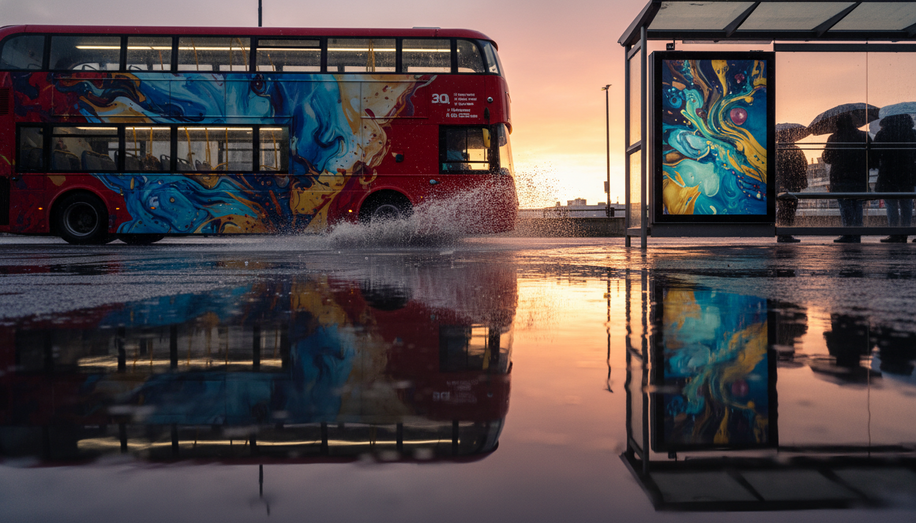

Out-of-home advertising has never been just about the giant rectangle looming over the highway, but the billboard has long dominated the conversation. As brands chase attention in a fractured media landscape, the real story of OOH today is unfolding on bus shelters, building facades, shopfronts, vehicles, and even pop-up experiences that barely resemble “ads” at all. The canvas has multiplied, and with it, the ways marketers can shape campaigns around context, behavior, and culture.
Street furniture has quietly become one of the most strategic real estate categories in OOH. Bus shelters, kiosks, phone booths, benches, and bike-share stations sit where people pause, wait, and look around. Unlike highway billboards, these placements invite closer inspection—copy can be denser, offers can be more granular, and creative can lean into local nuance. A national brand can run a consistent platform line across markets while tailoring the visual language to specific neighborhoods. In digital formats, dayparting turns these small canvases into utility: coffee brands own early mornings near transit hubs, food-delivery apps dominate late evenings around nightlife districts, and streaming services target commute windows with new releases. Because street furniture often lives within pedestrian eye-level, it’s also a natural bridge between OOH and mobile, driving QR-based engagements, app downloads, and contactless offers.
Wallscapes and building wraps are the spiritual cousins of traditional billboards, but their scale and placement change the dynamic entirely. Rather than sitting on a pole by the roadside, these ads become part of the urban fabric: a full-side-of-building takeover that crowns a city block, or a mural-like execution that blends art and branding. For marketers, wallscapes offer a way to signal ambition and cultural relevance, particularly in high-visibility neighborhoods where media and influencers congregate. A single wall in a trendsetting district can function like an always-on press shot, seeding content across social channels as passersby snap photos and share. Increasingly, these formats incorporate 3D elements or anamorphic illusions that are designed to be filmed from specific angles and pushed out on TikTok and Instagram. The physical impression count is just the starting point—the real reach comes from their second life online.
Transit environments extend the canvas into motion and routine. Train wraps, bus kings and queens, interior car cards, subway station dominations, airport dioramas, and digital networks in ride-hailing vehicles all intersect with moments of dwell time and repetition. Media planners have traditionally loved transit for its frequency: the same commuters see the same messages day after day. But formats are evolving. Digital screens in concourses and on platforms can respond to flight statuses, weather, or time of day, allowing brands to adjust creative in near real-time: a travel insurer messaging around delays, a food brand promoting quick grab-and-go meals when flights are late, a fashion retailer swapping rainwear for sunglasses as conditions change. For cities pushing sustainable mobility, transit OOH can also become part of a civic narrative, with advertisers aligning themselves to themes like green commuting or urban regeneration.
Vehicle wraps and mobile billboards sit at the intersection of transit and experiential. Branded cars, trucks, and specialty vehicles offer flexible targeting: they can be routed through key neighborhoods, parked at events, or used to shadow complementary media like sports stadiums and festivals. When combined with GPS tracking and geofenced mobile campaigns, moving OOH becomes a trigger for digital impressions, enabling synchronized messaging on nearby phones as the vehicle passes. For direct-to-consumer brands, wraps on delivery fleets transform logistics into media—every drop becomes an impression, and every neighborhood touched by the service sees the brand in their own streets. The best executions use design to surprise: playful illusions, functional elements like sampling windows, or storytelling that unfolds along the length of a truck.
Experiential and pop-up installations have pushed OOH into the realm of entertainment and utility. These are the immersive brand playgrounds that show up in plazas, parks, malls, and event spaces: interactive kiosks, AR activations, temporary structures, and sensorial experiences. They demand more investment and coordination than a standard placement, but in return they generate deeper engagement and earned media. A beverage brand may build a cooling station that dispenses free drinks and mists during a heat wave; a streaming platform might recreate a set from a hit show, allowing fans to step in and share photos; a tech company could demonstrate a new device in a hands-on hub that doubles as content studio. Data capture—via app signups, social tags, and on-site sensors—turns these installations into measurable performance assets rather than purely awareness plays.
Place-based digital networks add another layer of precision. Screens in gyms, doctor’s offices, co-working spaces, university campuses, gas stations, and retail environments let advertisers connect with audiences based on mindset and intent as much as demographics. Fitness apps speak to gym-goers between sets; financial brands target professionals in office towers; entertainment brands promote releases in cinema lobbies. Programmatic digital out-of-home (pDOOH) has made these networks more nimble, letting buyers adjust campaigns on the fly based on footfall, audience composition, or external signals like sports results and stock movements. The creative challenge is to respect the context—messaging in a medical waiting room, for example, ought to be calibrated differently than in a sports bar.
Across all these formats, the thread tying the evolving OOH canvas together is integration. Standalone spectacle still has its place, but the most effective campaigns treat OOH as both stage and signal. A street-furniture ad with a simple visual and QR code hands off to a mobile journey where personalization and conversion happen. An anamorphic wallscape launches alongside a social teaser and influencer seeding plan to ensure the installation is filmed, shared, and remixed. A fleet of wrapped vehicles syncs with geotargeted offers that appear on phones within a defined radius. Experiential pop-ups feed first-party data into CRM systems, informing retargeting and future site selection.
For marketers, the question is less “billboard or not?” and more “which environments, and in what sequence?” The diversity of OOH formats allows brands to design campaigns that match the rhythms of real life: a message first glimpsed on a train wrap, reinforced by a digital screen in a café, deepened in an interactive installation, and finally converted on mobile. As measurement tools improve and creative possibilities expand—from 3D builds to responsive digital content—the canvas outside the home is becoming not just bigger, but smarter. Those who understand how each format shapes perception, behavior, and storytelling will be best positioned to turn streets, stations, buildings, and vehicles into a cohesive, living media plan. Navigating this intricate, multi-layered OOH canvas demands sophisticated tools for orchestration and insight, enabling marketers to move beyond mere impressions to measurable impact. Platforms like Blindspot address this by unifying location intelligence for optimal site selection, powering programmatic DOOH campaign management, and providing comprehensive ROI measurement across diverse formats, ensuring a truly integrated and smarter OOH strategy. Discover more at https://seeblindspot.com/