
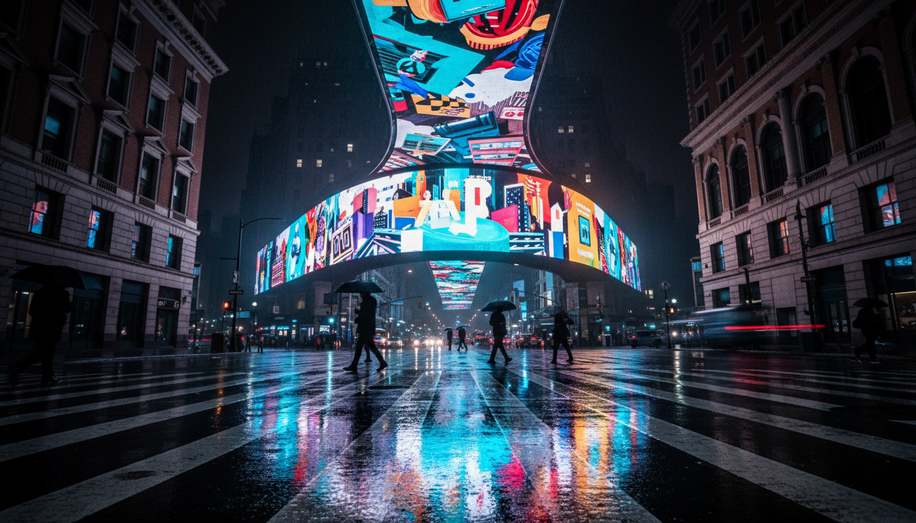

Long before LEDs flashed above highways and algorithms decided who saw what, the billboard was a simple, static message to anyone passing by on foot, horseback or wagon. Outdoor advertising has always been about one thing: capturing attention in motion. How that’s been done — from carved stone to programmatic digital screens — is a story of technology, urbanisation and changing consumer behaviour.
Historians often trace the roots of out of home advertising back to ancient civilizations. In Egypt, tall stone obelisks inscribed with laws and proclamations acted as early public notices, broadcasting messages to anyone entering a city. Roman merchants painted walls and used signs outside shops to indicate what they sold. These were not “billboards” in the modern sense, but they set the precedent: use public space to communicate to the masses.
The leap toward modern outdoor advertising began with the rise of printing. In the mid‑15th century, Johannes Gutenberg’s movable type press made it possible to produce handbills and broadsides in volume. These printed sheets were posted in marketplaces and at city gates, announcing everything from royal decrees to commercial offerings. Then, in 1796, the lithographic process was perfected, unlocking illustrated posters that could combine imagery and typography in bold, eye‑catching ways. Suddenly, outdoor ads could be both informative and visually persuasive.
By the early 19th century, the ingredients for the modern billboard were in place: cheap paper, improved inks, and expanding cities filled with pedestrians and, increasingly, commuters. In the 1830s, New York printer Jared Bell began producing large, colorful posters for traveling circuses. Measuring more than 50 square feet, these circus sheets are widely regarded as the first true American billboards. Pasted to walls and temporary structures, they shouted dates and dazzling promises to every town on the circus route.
As industrialisation and urbanisation accelerated through the 19th century, outdoor advertising followed suit. Posters began appearing on virtually any flat surface: building sides, fences, bridges and street railways. In the 1860s, a crucial shift occurred when entrepreneurs started leasing dedicated space for advertising, rather than simply plastering whatever surface was available. Purpose‑built structures appeared along busy roads and in growing downtowns, turning billposting into a scalable business instead of a guerrilla tactic.
Standardisation soon followed. By the late 19th century, billposter associations were forming across the United States and Europe to regulate practices and establish common formats. At the Paris Exposition of 1889, the now‑familiar 2:1 poster format was showcased as printers stitched together multiple sheets to create a single large image. In 1900, a standardized physical structure for billboards was introduced in the U.S., making it easier for national brands to run the same creative in multiple markets with predictable production and placement costs.
The early 20th century brought what many regard as the golden age of outdoor advertising. The explosion of the automobile — turbocharged by Henry Ford’s Model T — transformed the medium. Roads stretched farther, cities sprawled, and billboards followed, lining highways and city entrances to catch the eyes of motorists. What had been a largely urban, pedestrian‑focused format became a powerful way to reach a mobile, national audience. Brands such as Coca‑Cola, Kellogg and tobacco companies invested heavily, commissioning bold, modernist designs that burned themselves into popular culture.
During this period, outdoor advertising diversified. Streetcar exteriors, bus shelters and benches became surfaces for messages, embedding brands into the fabric of everyday commutes. Mobile billboards emerged in the 1920s as businesses retrofitted trucks with large panels, turning vehicles into roving ad space. Governments quickly saw their utility: during World War II, truck‑mounted displays were used for war bond drives and recruitment campaigns in areas poorly served by newspapers or radio.
Postwar prosperity and the rise of television forced billboards to sharpen their value proposition. With more media competing for attention, outdoor advertising leaned on its strengths: scale, visibility and simplicity. Creative teams distilled messages into a handful of words and a striking visual, designed to be absorbed at 60 miles an hour. Regulations also began reshaping the landscape. The Highway Beautification Act in the United States, for example, restricted billboard placement along certain roads, prompting the industry to adapt with better design standards, improved structures and more thoughtful siting.
The technological revolution of the late 20th century laid the groundwork for today’s high‑tech out of home. Advancements in printing allowed for larger, more detailed vinyl wraps and more durable materials that could withstand weather for months at a time. Computer‑aided design made it easier to experiment with 3D extensions and spectaculars. Time‑based posting schedules turned static structures into rotating platforms for multiple advertisers, increasing yield on prime locations.
Then came digital. The earliest electronic billboards were essentially giant TV screens, but their real significance lay in flexibility. Rather than a single printed poster that stayed put for weeks, digital screens could cycle through multiple creatives every minute, adjust content by time of day, and be changed remotely almost instantly. As LED technology improved and costs fell, digital out of home spread from flagship sites in major cities to secondary markets and roadside networks.
Today’s billboards sit at the intersection of media, data and technology. Many digital displays are connected to real‑time data feeds, enabling contextually relevant messaging based on weather, traffic, sports scores or even inventory levels. Programmatic buying platforms allow advertisers to purchase impressions on digital billboards in much the same way they buy online display ads, turning what was once a static rental into a dynamic, audience‑driven medium. Cameras and sensors can estimate traffic volumes and dwell time, feeding back anonymised information to refine planning and prove performance.
Yet despite the shift from hand‑painted signs to data‑driven networks, the core principles of the billboard remain remarkably consistent. The medium still rewards brevity, bold visuals and strategic placement. It still thrives on the human impulse to look up, to be surprised, to be entertained in the in‑between moments of travel and transit. What has changed is the sophistication behind the scenes: the logistics, the analytics, the ability to tailor and optimise campaigns in near real time.
From stone obelisks to smart screens, the evolution of the billboard mirrors broader changes in technology and society. Each major shift — printing, industrialisation, the automobile, digital networks — has expanded what outdoor advertising can do without erasing what made it powerful in the first place. The billboard has always been public, shared, and impossible to ad‑block. In an age of fragmented attention and personalised feeds, that simple, enduring proposition may be its most modern feature of all.
To fully capitalize on this evolution towards data-driven OOH, advertisers require sophisticated platforms for precise audience measurement, programmatic campaign management, and real-time performance tracking. Blindspot empowers brands to move beyond traditional OOH, leveraging location intelligence and robust analytics to optimize every impression and prove meaningful ROI in an increasingly dynamic media landscape. Discover how at https://seeblindspot.com/.