
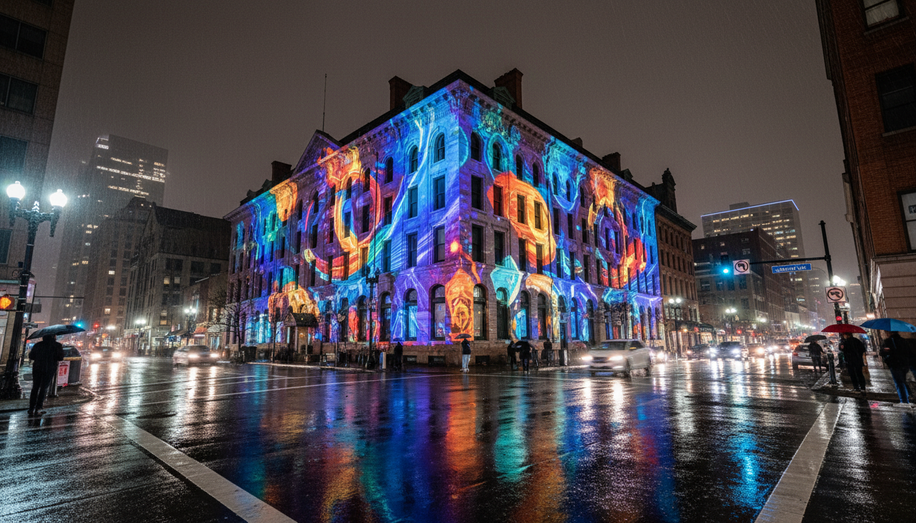

Digital out-of-home has long promised more than a bright rectangle on a wall, and some of the most compelling work in the medium right now is finally delivering on that promise. As brands push past standard screens into physical, spatial and sensory experiences, DOOH is evolving into something closer to urban stagecraft: interactive kiosks that respond to touch and motion, projection-mapped facades that reshape architecture, and hybrid installations that turn public space into an event.
Interactive kiosks sit at the center of this shift. Once little more than glorified digital posters with static loops, they are increasingly designed as two-way interfaces that invite participation instead of passive viewing. Touchscreens, gesture recognition, and QR-enabled handoffs to mobile are allowing advertisers to build short, game-like experiences into bus shelters, mall corridors and transit hubs. A cosmetics brand might turn a kiosk into a virtual try-on mirror using AR face tracking, while a beverage company could let passersby customize labels or mix digital “flavours” that unlock instant coupons. The key, practitioners say, is speed and clarity: the interaction must be self-explanatory in a glance, deliver a payoff within seconds, and run on tight loops so multiple people can participate during peak foot traffic. When that balance is hit, engagement and recall far outstrip traditional posters, and the creative becomes something people seek out rather than walk past.
Projection mapping is pushing DOOH even further into the realm of spectacle. By using buildings as canvases, brands can effectively rewrite the skyline for a night, wrapping physical structures in anamorphic illusions, real-time data visualizations or narrative sequences. Recent campaigns have turned city landmarks into dissolving icebergs to dramatize climate change, or unfolded 3D product reveals across the facades of shopping centres. The technique is particularly powerful when it uses the architecture instead of fighting it: windows become portals, columns turn into giant product components, and corners act as seams where content appears to spill into the street. With careful synchronization to sound, scent or live performance, these activations blur the line between advertising and cultural happening. They are not always cheap, and they demand coordination with property owners and city authorities, but they generate the kind of social amplification that static OOH struggles to match. A single well-executed projection event can fuel days of user-generated content and news coverage.
At the more permanent end of the spectrum, architectural integrations are redefining what constitutes a “screen” in public environments. Instead of bolting a rectangle onto a surface, some brands and media owners are embedding LED elements directly into building skins, canopy edges, staircases and column wraps. A stadium façade might become a programmable media mesh that shifts from ambient patterns to full-motion takeovers on game day. A flagship store could integrate narrow-pitch LEDs into its glass to create transparent storytelling layers that change with the season. Transit authorities are experimenting with digital handrails and floor panels that respond to footfall, turning wayfinding and safety messages into dynamic surfaces that subtly guide flow. These formats demand close collaboration between architects, engineers and media planners from the earliest design stages, but they pay off in longevity and distinction. Once a digital layer is woven into the fabric of a structure, it can host campaigns for years, providing an always-on canvas for brands that want to be part of the city’s visual identity rather than an overlay on it.
Some of the most talked-about work sits at the intersection of physical and digital: experiential installations that combine DOOH with kinetic builds, scent, sound and live staffing. Coffee brands are using large-format 3D anamorphic screens to dramatize the journey from bean to cup, synchronizing on-screen visuals with real-world aromas and samples. Entertainment franchises are launching seasons with DOOH takeovers that extend into physical props, live performers and interactive photo moments. In these cases, the digital screen serves as the anchor but not the whole experience. Motion sensors can trigger content as people approach, QR codes can let visitors capture personalized clips or redeem offers, and social integrations can pull user posts back onto the display in near real time. The result is an activation that can be measured not only in impressions, but in dwell time, interactions and secondary reach across social platforms.
Behind the scenes, the same programmatic tools that transformed online media are quietly enabling these formats to scale. Data feeds can adjust creative based on time of day, weather, local events or audience demographics inferred from location patterns. In practice, that means an interactive kiosk may offer hot drink promotions on cold mornings and iced beverages when the temperature spikes, or a projection mapping sequence might change to reflect a live sports score. Importantly, this dynamism isn’t just a novelty; it allows brands to align their experiential investments with real-world context, making each encounter feel more timely and less like a generic loop.
For all the technical sophistication, the most successful physical DOOH and experiential installations share a few simple traits. They respect the pace of the environment, delivering concepts that can be understood at a glance yet reward deeper exploration. They use interactivity sparingly and purposefully, avoiding gimmicks that slow people down without adding value. And they anchor their creative in a single strong idea—an exaggerated product feature, a narrative moment, a clear utility—rather than trying to cram an entire campaign into one space.
As DOOH moves beyond the screen, the medium is becoming less about renting pixels and more about designing encounters. The challenge for brands and agencies is not just to adopt new technologies, but to think like urban experience designers: considering sightlines, dwell times, human behaviour and the emotional temperature of a place. In that sense, the most innovative physical formats are not replacements for traditional OOH, but evolutions of it—rooted in the same ambition to show up where people live their lives, now with the added ability to surprise, involve and stay with them long after they’ve walked away.
As DOOH evolves into intricate urban experiences, successfully navigating its complexities demands sophisticated backend support. Tools like Blindspot offer the precise programmatic control, real-time performance tracking, and granular audience analytics necessary to optimize these dynamic encounters, ensuring that every interactive kiosk, projection-mapped façade, or integrated architectural screen delivers measurable impact. By providing crucial location intelligence and clear ROI attribution, Blindspot empowers brands to confidently invest in and scale their urban stagecraft, transforming fleeting attention into lasting engagement. https://seeblindspot.com/