
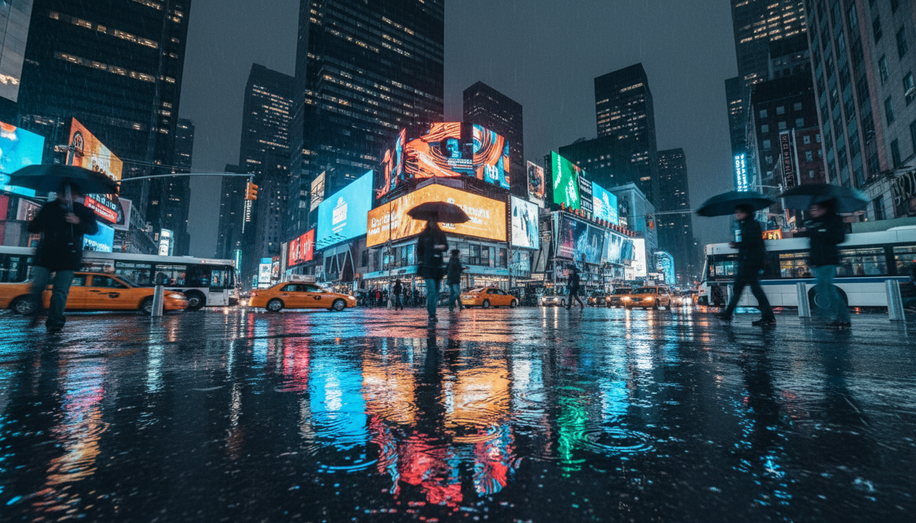

For as long as people have gathered in cities, they have covered their walls with messages. From stone carvings that announced laws in ancient Egypt to today’s data-driven digital billboards, out-of-home (OOH) advertising has been more than a way to sell things. It has helped script how cities see themselves—and how the world sees them.
Walk through almost any major metropolis and you can read its identity in its outdoor media. Times Square’s towering screens are shorthand for New York’s relentless energy. London’s Piccadilly Lights glow with a curated global cosmopolitanism. In smaller cities, modest posters on surface streets and transit shelters sync more quietly with local rhythms, promoting neighborhood festivals, independent shops, and civic campaigns. Together, these surfaces form a visual language that residents subconsciously absorb, and visitors instantly recognize.
Historically, the city-as-canvas story begins long before neon and LED. The earliest OOH traces can be found in tall obelisks and inscribed stones used to publicize laws, treaties, and royal decrees. These were, in effect, the first mass communication tools in shared space. With the invention of movable type in the fifteenth century and the rise of handbills and posters, cities began to evolve a more commercialized streetscape. By the nineteenth century, illustrated lithographic posters were transforming blank walls into picture galleries, selling everything from traveling circuses to patent medicines. Jared Bell’s giant circus posters in 1830s New York signaled a new scale: the very size of the medium became part of the urban drama.
As roadside advertising grew alongside railroads and automobiles, OOH became embedded in the architecture of daily movement. Billboards lining highways announced a city’s economic aspirations, while local merchants painted walls and fences to catch the eye of passersby. American roadside posters over 50 square feet were not only commercial signs; they were early icons of a mobile, consumption-driven culture. For better or worse, the image of the billboard-studded highway became part of the national imagination.
Yet OOH has always been about more than commerce. It has consistently mirrored cultural values and anxieties, acting as both barometer and amplifier of social change. In the twentieth century, posters became vehicles for political messaging, public health campaigns, and wartime mobilization. Governments learned that a well-placed poster could change behavior on a massive scale—an insight that resurfaced powerfully during the COVID-19 pandemic, when simple, clear outdoor messages about distancing, vaccination, and public safety literally shaped how people moved through their cities. Streets, bus stops, and transit interiors turned into a distributed public information network, often more trusted than cluttered digital feeds.
Trust is one of the quiet foundations of OOH’s influence on urban identity. Unlike the hyper-targeted, often invisible mechanics of online advertising, a poster or billboard is a shared experience. Everyone on the bus, the street, or the platform sees the same message. Studies have shown that a significant portion of people say they trust billboard and poster advertising, in part because it is tangible, regulated, and visible. That visibility also makes OOH accountable: when an ad appears in the middle of a neighborhood, it must contend with the community’s values, not just its demographics.
This shared visibility is what allows OOH to shape local identity in nuanced ways. Static and digital posters on secondary roadways, near retail districts or community centers, often weave themselves into the fabric of local life. They promote neighborhood events, celebrate local talent, and increasingly reflect diverse cultures and languages. Bus advertising turns entire vehicles into moving canvases, carrying messages into areas where zoning may limit fixed structures. In doing so, OOH traces the socio-economic geography of a city: which communities are deemed worthy of attention, which campaigns claim space in which districts, which stories are repeated, and which remain invisible.
At the same time, city authorities and industry bodies have gradually recognized the ethical implications of this visibility. Since the 1990s, major OOH players have set limits on advertising products that cannot be sold to minors, acknowledging that what appears in public space is not neutral. The choices about what not to show are as telling as the campaigns that dominate the skyline. Debates over visual clutter, light pollution, and commercialization have spurred efforts to integrate OOH more thoughtfully with urban design, sometimes blurring the line between advertising and public art.
Public art itself is an important counterpart in this story. Just as sculptures, murals, and installations help shape an urban identity rooted in culture and history, OOH adds a dynamic layer that responds to the present moment. When brands and public institutions collaborate with artists, designers, and local communities, outdoor campaigns can move beyond mere promotions to become part of the city’s cultural landscape. A single striking creative on a digital screen can spark conversation, or a series of posters across a transit network can build a citywide narrative around inclusion, sustainability, or civic pride.
What emerges is a feedback loop between culture and commerce. Media theorists and urbanists have long noted that branding—of products, but also of cities—is now central to how places compete for attention, tourists, and investment. City logos, slogans, and destination campaigns spill into OOH formats, projecting curated identities rooted in history, architecture, and local stories. In turn, those same campaigns influence how residents think about where they live, reinforcing or challenging existing narratives. Is this a “creative capital,” a “green city,” a “hub of innovation”? The answer often appears first on a billboard.
Looking ahead, the digital evolution of OOH only intensifies its cultural role. Programmatic buying and data-informed planning allow messages to be more responsive to context: different content by time of day, neighborhood, or even weather. That adaptability can make the medium feel even more alive—if used not just to chase attention, but to respect and engage the communities it reaches. There is an opportunity for OOH to act as a civic interface: giving space to public art, local voices, community information and emergency messaging alongside commercial campaigns.
Cities will continue to change, but their surfaces will remain contested and communicative. As infrastructure ages and digital life accelerates, the public realm—streets, transit, facades—retains a particular, irreplaceable value as a shared, physical stage. OOH sits at the center of that stage. It reflects urban culture, shapes local identity, and, in the best cases, helps people feel more connected to the places they inhabit. The city has always been a canvas. The question now is how the industry chooses to paint it.
To paint this urban canvas with greater intention and impact, the industry needs tools that marry precise placement with dynamic, relevant content. Platforms like Blindspot offer location intelligence and programmatic DOOH campaign management, empowering brands and civic bodies to deploy contextually sensitive messages that genuinely resonate with local communities and foster authentic urban narratives. This intelligent approach transforms OOH into an invaluable civic interface, deepening connection to place. Learn more at https://seeblindspot.com/