
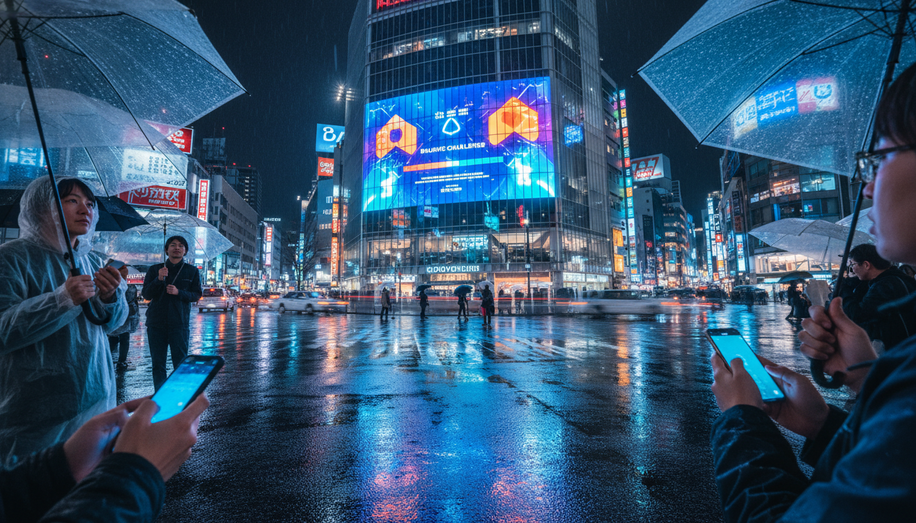

In a media landscape saturated with screens and skippable content, out-of-home advertising has quietly reclaimed a powerful role: it’s one of the few formats people can’t just close. Yet visibility alone is no longer enough. To cut through the noise, brands are increasingly turning static impressions into active participation, using gamification to make billboards, street furniture, and digital OOH feel less like ads and more like something you actually want to play with.
Gamification—adding game-like elements such as challenges, points, and rewards to non-game contexts—has migrated from loyalty apps and fitness trackers onto the streets. For OOH, that shift is significant. Instead of passersby glancing up, processing a message, and moving on, the goal is to invite them into a brief, voluntary interaction: scan this code, beat this challenge, unlock this reward, share this moment. That simple change in posture—from being “exposed to” advertising to “engaging with” it—can transform campaign performance.
The mechanics are straightforward, but the effect can be profound. A digital billboard that invites you to answer a quick quiz question, with live results displayed on-screen, taps into a natural desire to test yourself and see how you compare. A transit shelter poster that triggers an augmented reality experience on your phone turns dead time into discovery. A large-format site that features a live leaderboard for a brand’s mobile game makes a previously invisible digital campaign suddenly very public and social. Each of these experiences asks for more than a glance; they ask for a small investment of time and attention, and they reward it.
Technology has made this shift far more scalable. QR codes and NFC tags can transform static posters into gateways to mobile games or instant-win mechanics. DOOH screens equipped with cameras or motion sensors can respond to gestures, movement, or even crowd behavior, turning a busy intersection into an impromptu game space. Augmented reality overlays can bring 3D characters or challenges into the physical environment, triggered by pointing a phone at a storefront or bus shelter. Crucially, the device doing the heavy lifting is already in everyone’s pocket, reducing friction for participation.
The lure for marketers is not just novelty. Gamified OOH campaigns consistently report higher engagement rates, longer dwell times, and stronger brand recall than traditional impression-based executions. When someone chooses to play, they’re more likely to remember the brand that made the moment possible—and to talk about it. Many activations build in social components: share your score for an extra chance to win, post your AR photo with a campaign hashtag, challenge a friend to beat your time. That social amplification extends the reach of an OOH placement far beyond the physical radius of the site.
For brands, the data side of gamification is just as appealing as the buzz. Traditional OOH is powerful but largely top-of-funnel: it excels at reach and awareness, but it offers limited behavioral data. Gamified campaigns can bridge that gap, capturing opt-in information, measuring participation rates, tracking repeat plays, and tying interactions to downstream actions such as app installs, store visits, or coupon redemptions. A billboard that prompts a game can become a measurable acquisition channel, not just a branding statement.
This doesn’t mean every OOH campaign should suddenly become an arcade. The best gamified experiences are designed with context and simplicity in mind. People are on the move; they have seconds, not minutes. Mechanics need to be instantly understandable: tap to play, scan to unlock, answer to win. Overly complex rules or long onboarding flows kill participation. The game should be intuitive enough that someone walking past at speed can grasp what’s happening and decide, within a heartbeat, whether to join in.
Context also dictates the type of game that works. At a busy intersection, a quick visual challenge or gesture-based interaction will outperform anything requiring detailed reading. At a transit hub, where dwell time is longer, brands can stretch into multi-step mechanics or deeper AR experiences. In urban centers with high smartphone penetration, mobile-led gameplay makes sense; in other environments, simple on-screen participation—like crowd-controlled animations triggered by noise or movement—can be more effective. The key is to match the mechanic to the pace, behavior, and expectations of the audience in that specific space.
Rewards remain the most obvious hook, but they don’t have to be expensive to be compelling. Instant discounts, early access to products, or exclusive content can be just as motivating as large prizes, especially when framed as a “win” earned through play. For some audiences, the reward is status rather than stuff: seeing your name on a live leaderboard in the middle of the city, or being part of a visible collective achievement, can be powerful. Entertainment itself is also a reward; a clever, funny, or surprising game can generate goodwill even without tangible prizes, building a positive emotional association with the brand.
Gamification also offers powerful storytelling opportunities. A sustainability-focused brand might challenge people to make virtual choices that reduce a city’s carbon footprint, with collective progress visualized in real time on DOOH screens. A food brand could turn everyday commutes into scavenger hunts, with clues hidden across multiple sites that ultimately unlock a recipe or event. By distributing pieces of a narrative across different locations and formats, OOH becomes the physical backbone of a larger, cross-channel experience.
For media owners and OOH specialists, the rise of gamification is both a creative playground and a strategic tool. It encourages closer collaboration between creative, tech, and media planning teams, and it reframes OOH not as a static buy but as part of an interactive ecosystem. When integrated with broader campaigns—mobile, social, in-store—gamified outdoor activations can serve as catalytic touchpoints that move people from awareness to active involvement.
As consumers grow more selective about the messages they let into their lives, the most effective advertising will feel less like a demand on their attention and more like an invitation to participate. Gamification gives OOH a uniquely physical way to issue that invitation, turning city streets into playing fields and everyday journeys into moments of choice, challenge, and reward. For brands willing to think beyond impressions and embrace interaction, the game, quite literally, is on.