
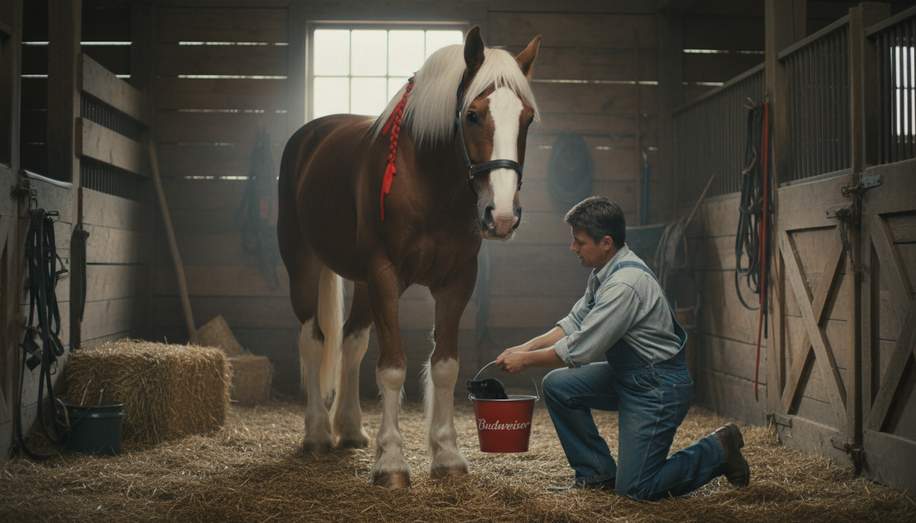

In the dimly lit stables of Budweiser’s St. Louis barn, five majestic Clydesdale horses stand in stoic formation, their breath visible in the cool air, until a metallic clatter disrupts the calm. An overturned bucket rattles across the hay-strewn floor, nudged by some unseen creature, prompting one horse to whinny in what appears to be amused surprise. The screen fades to bold text: “Heads Will Turn,” overlaid with the Super Bowl 60 logo. This 15-second teaser, titled “Stable” and released on January 15, 2026, has ignited rampant speculation across adland about what’s lurking under Budweiser’s bucket—and why it’s poised to steal the show during the Big Game on February 8.
Budweiser’s return marks its 48th national Super Bowl spot, a testament to the brand’s enduring presence in America’s biggest advertising arena. The Clydesdales, those towering symbols of equine grace and brewing heritage, have been fixtures in Budweiser’s U.S. campaigns for decades, evoking nostalgia for a bygone era of craftsmanship and tradition. This year’s effort ties directly into the “Made of America” platform, celebrating the beer’s 150th anniversary with a full Heritage Can Series—four limited-edition designs tracing Budweiser’s history—that hits shelves just in time for game day. Out-of-home (OOH) marketers take note: this multi-channel push, blending broadcast primacy with digital teasers and physical collectibles, exemplifies how legacy brands leverage the Super Bowl’s halo effect to dominate physical and virtual billboards alike.
The mystery creature remains Budweiser’s closely guarded secret, with the brand coyly refusing to spill details ahead of the full reveal. Is it a pint-sized foal, echoing the heartwarming “First Delivery” spot from 2025 that pivoted from digital-only to national airtime amid fan frenzy? Or perhaps another fluffy sidekick, like the golden Labrador from 2014’s viral “Puppy Love,” which paired the Clydesdales with a puppy’s boundless energy to rack up millions of views? Budweiser’s track record leans toward adorable disruptors—recall 2013’s “Brotherhood,” where a foal named Hope bonded with her trainer under the watchful eyes of the herd—suggesting the bucket’s occupant could blend cuteness with chaos to refresh the Clydesdales’ stately image.
For OOH specialists, the teaser’s barn-bound intrigue offers ripe inspiration. Imagine static billboards morphing into digital extensions: Clydesdale silhouettes against twilight skies, a shadowy form peeking from under a giant bucket emblazoned with “What’s Under Bud’s?” Transit wraps on buses could mimic the rattling bucket’s path, while high-traffic urban spectaculars pulse with the whinny audio synced to LED screens. Budweiser’s parent, Anheuser-Busch, is doubling down as one of Super Bowl 60’s top advertisers, with national spots for Bud Light and Michelob Ultra flanking the flagship ad. This three-brand blitz underscores a broader trend: conglomerates using the event’s 127.7 million viewer draw from last year to amplify portfolio plays across OOH, social, and retail.
The Super Bowl’s ad ecosystem buzzes with comparable ambition. SVEDKA Vodka breaks ground with its first Big Game spot in over 30 years, deploying AI-driven robots for a futuristic twist. Hellmann’s Mayo returns for a sixth year, transforming mealtime into “unexpected fun” via VML creative. RITZ crackers marks its third consecutive appearance, while newcomers like Liquid I.V. flip wellness narratives on hydration. Even Liquid Death circles back, proving the mountain water upstart’s staying power. Nostalgia reigns supreme—Budweiser’s Clydesdales embody it—but fresh faces and tech infusions keep the mix dynamic.
Yet Budweiser’s bucket teaser stands apart in its masterful suspense. Released via YouTube and social channels, it has already amassed views and shares, priming audiences for the 30-second (or longer?) national buy. OOH campaigns could mirror this buildup: teaser posters in stadium vicinities, escalating to full reveals post-kickoff, driving foot traffic to bars and stores stocked with those anniversary cans. Anheuser-Busch’s strategy reflects calculated risk—after 2025’s digital pivot succeeded, 2026’s national commitment bets on the Clydesdales’ magnetism plus the unknown to cut through a sold-out inventory where NBCUniversal commands around $7 million per 30 seconds.
As Super Bowl LX unfolds at Levi’s Stadium in Santa Clara, California—headlined by Bad Bunny’s halftime spectacle sponsored by Apple Music—the ad world’s eyes will fix on that bucket. Will the reveal deliver heartstring-tugging whimsy, slapstick hilarity, or something defiantly chaotic? Whatever emerges, Budweiser ensures it’s “Made of America”: rooted in heritage, forward-facing in appeal. For OOH pros plotting their own high-stakes plays, the lesson is clear—tease boldly, reveal memorably, and let the Clydesdales (and friends) carry the load. Heads are already turning..