
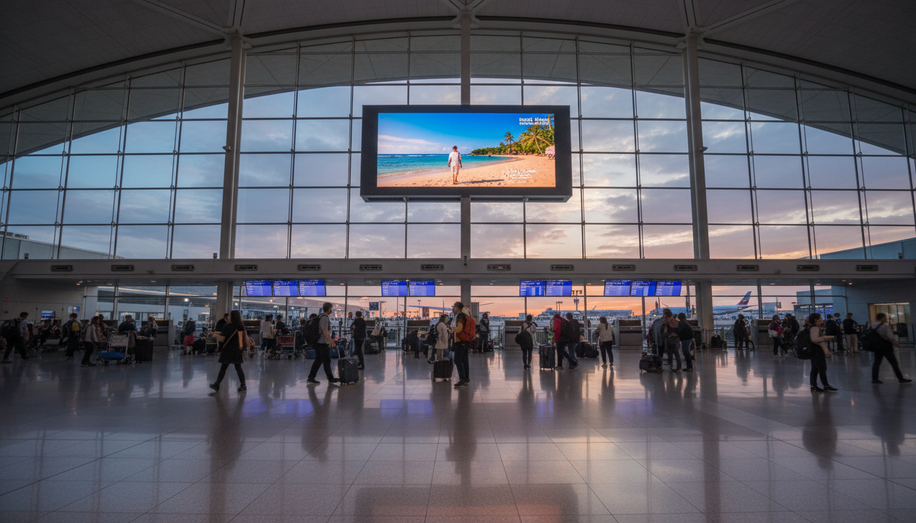

Out-of-home advertising has long thrived on its ability to command attention in the physical world, turning streets, billboards, and public spaces into canvases for bold storytelling. In 2025, a series of standout campaigns across industries proved that OOH’s power lies not just in visibility, but in clever integration with real-time data, experiential activations, and cultural relevance, delivering measurable lifts in awareness, traffic, and sales.
Consider the nonprofit sector, where Bank of America’s Chicago Marathon campaign harnessed OOH as the cornerstone of a multi-channel push, raising a record $71.9 million for 168 charities—a 78.4 percent year-over-year increase with 268,000 donations processed. By blending purpose-driven messaging on billboards and transit ads with digital amplification, the effort positioned the bank as a force for social good, demonstrating how OOH can amplify emotional resonance and drive tangible impact in community-focused initiatives. The lesson here is clear: when OOH anchors broader strategies, it elevates brands beyond commerce into cultural moments.
Retail and hospitality sectors echoed this success with hyper-local precision. Istrouma at Sugar Farms, a family-friendly venue in Louisiana, relaunched after a summer closure with targeted OOH within a five-mile radius, spotlighting its food, farm, and fun blend. The result? A 136 percent year-over-year foot traffic surge in December, 30 percent sales growth, and 95 percent new visitors, proving that geographically fenced OOH excels at reintroducing brands to untapped local audiences. Similarly, in the UK, Aldi transformed a mundane grocery run into buzzworthy excitement by rebranding a store as “cap-Aldi” for a surprise Lewis Capaldi rooftop gig, blending OOH signage with live activation to spike social shares and footfall. These cases underscore a key strategy: proximity and surprise convert passive passersby into active customers.
Fast food and consumer goods brands pushed experiential boundaries further. KFC’s “Out-Door” campaign in the UAE literally removed restaurant doors, turning entrances into 24/7 billboards proclaiming round-the-clock service—a cheeky, literal twist that reinforced availability while dominating urban sightlines. Meanwhile, Magnum ice cream tackled seasonality head-on with digital OOH in the UK, deploying geotagged billboards that tracked real-time sunny spots, complete with beacons sending discount notifications to nearby phones. This WARC Awards Grand Prix winner reversed winter sales dips by encouraging impulse buys during fleeting sunshine, highlighting OOH’s edge when fused with data-driven dynamism. The takeaway? Contextual relevance—whether weather-tied or availability-focused—turns static ads into interactive prompts.
Sports and fitness campaigns leaned into immersion for unforgettable impact. HOKA running shoes transported Manhattan’s concrete jungle into a 48-hour Joshua Tree desert on a city block, complete with rocks, wind, and a central treadmill to launch the Mafate X trail shoe. The stunt generated massive earned media, embodying OOH’s capacity for sensory disruption in dense urban environments. Decathlon took a practical tack in Czech parks, installing free-rental sports lockers that doubled as branded OOH, seamlessly merging utility with promotion to boost equipment trials and brand affinity. Both illustrate how physical interactivity fosters trial and loyalty in active-lifestyle sectors.
Even public service and awareness drives wielded OOH with provocative flair. Virginia’s Department of Motor Vehicles erected a 50-foot ladder roadside to equate speeding at 40 mph with a 54-foot fall, a visceral metaphor that amplified road safety messaging without preachiness. Breast Cancer UK’s “Street Nipples” used reverse graffiti—pressure-washing pavements through breast-shaped stencils—to spotlight early detection across UK cities, transforming overlooked studs into conversation starters. Skoda, sponsoring the Tour de France, reframed ubiquitous penis graffiti into posters promoting the women’s race, hijacking cultural quirks for progressive visibility. These efforts reveal OOH’s strength in shock value and repurposing environments, ideal for shifting behaviors or sparking dialogue.
Tourism and tech rounded out the year’s triumphs. Switzerland Tourism built miniature luxury hotels for bees, birds, and hedgehogs modeled after partner properties, a whimsical conservation play that garnered global press and reinforced eco-friendly branding. Samsung’s Galaxy S25 launch projection-mapped London’s Southbank, live-streamed for hybrid reach. In aviation, Gerald R. Ford International Airport’s “GRReat Billboard Hunt” gamified OOH to unveil a hidden billboard, driving engagement and awareness.
Across these diverse victories—from nonprofits to nightlife, runners to road safety—patterns emerge. Successful 2025 OOH campaigns thrived on integration: 78 percent of OAAA Local Case Study Award winners layered OOH with digital or events for compounded results. Location intelligence, as in Istrouma’s radius targeting or Magnum’s sun-tracking, maximized relevance. Experiential elements, like HOKA’s desert or KFC’s doorless doors, created shareable spectacles. And purpose, whether charitable or cheeky, forged emotional connections.
Yet challenges persist. Not all stunts landed perfectly—Skims’ 60-foot Kim Kardashian balloon in Times Square drew backlash for excess—reminding advertisers to gauge cultural fit. Budgets must justify activations, as Magnum did with proven ROI. Looking ahead, as programmatic digital OOH matures, expect more real-time adaptability, per JCDecaux insights on priming online traffic.
These cases affirm OOH’s evolution: no longer mere billboards, but dynamic ecosystems driving business in a fragmented media world. For brands daring to claim public space with ingenuity, the rewards—in traffic, sales, and sentiment—remain profoundly real.
To navigate this evolving landscape, platforms like Blindspot offer crucial capabilities for optimizing OOH’s impact, from leveraging real-time location intelligence for hyper-targeted campaigns to providing programmatic DOOH management and clear ROI attribution. This empowers brands to transform public spaces into precisely measured, highly engaging touchpoints that validate every strategic investment. Discover more at https://seeblindspot.com/