
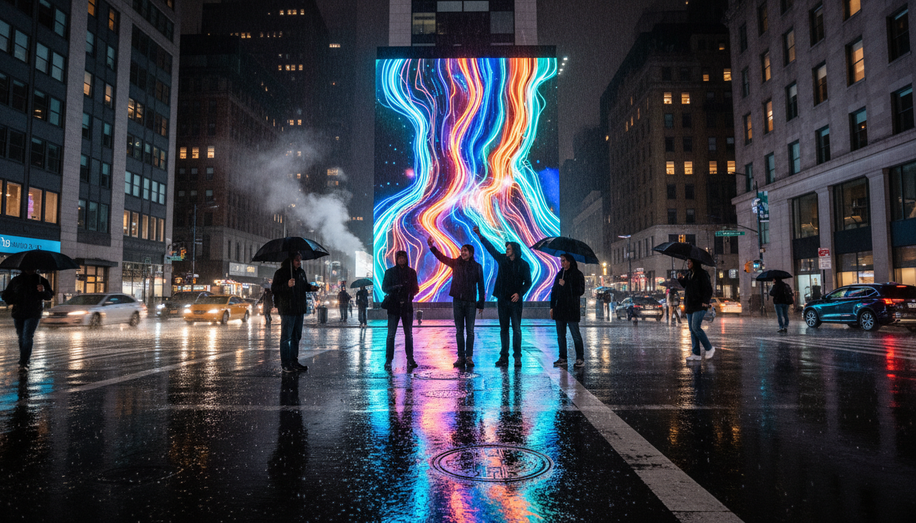

In the bustling streets of urban centers, where attention spans flicker like neon lights, interactive billboards are rewriting the rules of out-of-home advertising. These dynamic displays go beyond static imagery, responding in real-time to passersby through touch screens, motion sensors, augmented reality, and even social media integrations, transforming passive viewers into active participants. By adapting content based on gestures, weather, or location data, they forge deeper connections, boosting engagement and etching brands into collective memory.
Consider the tactile allure of touch-responsive billboards, which turn advertising into impromptu entertainment. Pedestrians scroll through games, rack up points, or uncover hidden messages on oversized screens, drawing crowds eager to “have a go.” This gamification not only halts foot traffic but also encourages sharing, amplifying reach organically. Nestlé’s KitKat campaign exemplified this with a vibration feature offering free massages under the slogan “Have a break, have a KitKat,” blending whimsy with product relevance to create shareable moments of delight.
Motion-tracking cameras elevate the experience further, placing viewers directly into the narrative. Sensors detect movements, inserting people into digital environments—dancing on screen, racing against virtual opponents, or posing in fantastical backdrops. Reebok’s “Speed Test” in Stockholm captured this thrill: a billboard with speed camera tech challenged runners to dash past at over 10.5 miles per hour, clocking times and awarding free ZPump 2.0 trainers to winners. The competitive edge turned a busy sidewalk into a spontaneous arena, generating buzz and user-generated content as participants shared their feats.
Social media integration adds a layer of real-time virality. Billboards prompt tweets or Instagram posts with branded hashtags, rewarding shares with discounts, samples, or tickets—then displaying that content live on the screen. This closed-loop engagement fosters community, as individual actions ripple outward, enhancing brand loyalty. Meanwhile, multi-function designs in high-traffic spots maintain visibility with baseline messaging, activated by buttons or levers to reveal surprises, ensuring constant prominence without overwhelming the audience.
Augmented reality (AR) pushes boundaries into the virtual realm, overlaying digital elements via smartphones or directly on displays. Users scan QR codes to unlock animations, product demos, or immersive worlds, bridging physical and digital seamlessly. Toyota’s collaboration with Yahoo invited commuters to AR experiences showcasing the Crown model, where customizable virtual test drives sparked personalized excitement and awareness. Such tech not only captivates but collects interaction data, enabling marketers to refine future campaigns with insights on dwell time and preferences.
Three-dimensional (3D) billboards amplify these effects with anamorphic illusions of depth and motion, making products appear to burst from the screen. Coca-Cola’s Guinness World Record-holding display in Times Square, a six-story behemoth with 1,760 independently moving LED modules, created a splashing bottle that interacted with the environment, drawing throngs and redefining spectacle. Nike’s Tokyo Air Max animation brought sneakers to life, rotating in hyper-real detail to highlight design features unattainable in 2D. Spider-Man’s Piccadilly Lights swing in London built movie hype, while Vivo’s X80 smartphone showcase in Los Angeles and Meta’s Quest metaverse portal demonstrated versatility across categories, from fashion to tech.
These innovations yield measurable impacts: higher participation rates, increased brand recall, and social amplification. Gymshark’s “Shoplifting” stunt pinned real clothes to a board, revealing a 60% sale message as items were taken—a clever pun on “lifting” that blended interactivity with urgency. Data from such campaigns shows dwell times extending minutes, not seconds, as audiences linger, interact, and share.
Yet, success hinges on execution. Placement in high-traffic zones maximizes exposure, while seamless tech integration avoids glitches that could frustrate. Streaming live elements like weather, scores, or news keeps content fresh, adapting to real-time contexts for relevance. As digital out-of-home (DOOH) evolves, interactivity democratizes advertising, turning every viewer into a storyteller.
The result? Memorable encounters that transcend traditional OOH, fostering emotional bonds and driving action. In an era of ad fatigue, interactive billboards don’t just advertise—they invite, entertain, and endure, proving that engagement is the ultimate currency.