
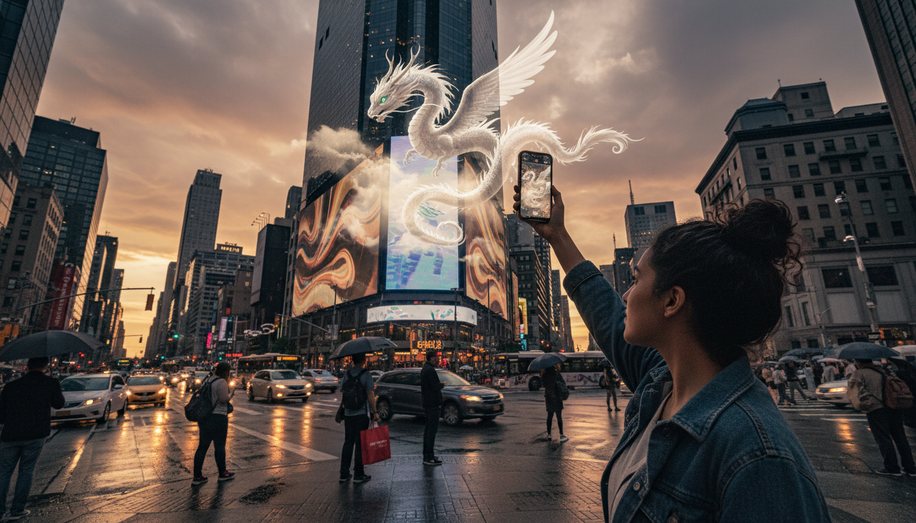

In the bustling streets of modern cities, where static billboards once competed for fleeting glances, augmented reality is reshaping out-of-home advertising into a dynamic gateway for immersive engagement. By overlaying digital layers onto physical spaces via smartphone cameras, AR transforms everyday posters, murals, and digital screens into interactive portals, drawing viewers into brand narratives that linger far beyond the initial encounter.
This integration hinges on simple QR codes or visual markers, accessible through web-based AR—no app downloads required in many cases—which lowers barriers for spontaneous participation. Passersby scan a billboard, and suddenly a holographic figure materializes or a scene bursts to life, fostering what marketers call an “emotional connection” through instant feedback and personalization. The result is a shift from passive observation to active involvement, elevating viewer experiences in high-traffic environments like subway stations, bus stops, and urban festivals.
Consider Burger King’s audacious “Burn That Ad” campaign in Brazil, which weaponized AR against competitors’ billboards. Users pointed their phones at rival fast-food posters—such as McDonald’s—and watched them erupt in virtual flames, replaced by a Burger King ad offering a free Whopper coupon. Powered by the brand’s app, the stunt garnered one million downloads in a month and boosted in-app sales by 56.4 percent, proving AR’s prowess in hijacking attention and driving conversions.
Similarly, the UK’s National Health Service (NHS) leveraged AR on blood donation posters to simulate life-saving impact. Scanning revealed a virtual needle overlay on the user’s arm, filling a patient’s empty blood bag on the billboard; as it filled, the patient visibly improved. This visceral demonstration not only educated but bonded users emotionally, turning a public service message into a memorable act of virtual altruism.
Wine brand Siduri, under Jackson Family Wines, pushed boundaries with the world’s first holographic Web AR experience. QR codes on in-store billboards and bottles summoned a photorealistic 3D hologram of founder Adam Lee, allowing interaction without apps—just a browser. This seamless tech highlighted the brand’s Pinot Noir heritage, blending storytelling with accessibility to captivate retail shoppers.
Telecom giants have embraced AR to visualize connectivity in tangible ways. Vodafone’s AR billboards in high-traffic areas start as unassuming visuals but reveal 3D graphics, interactive text, and mini-games upon scanning, surprising pedestrians and sparking social shares. The multi-sensory elements—visuals, audio, even haptic feedback—amplify brand recall, while real-time analytics track engagement for optimization.
Verizon took this to Art Basel 2024 in Miami, deploying three AR murals across Midtown, Coconut Grove, and Hialeah. In Midtown, skyscrapers animated with lights and vehicles to showcase network prowess; Coconut Grove’s fused digital vines with circuit boards symbolized tech-nature harmony; Hialeah’s evolved local portraits into futuristic 3D scenes, emphasizing human connections. Powered by Snapchat’s WebAR and BrandXR’s platform, these murals generated user-generated content that lit up social media, merging art, culture, and advertising during a global event.
Ally Bank’s Monopoly-themed treasure hunt across six U.S. cities installed 36 physical game board squares, each unlocking WebAR animations of Mr. Monopoly dispensing points and cash prizes. Aimed at financial literacy, it gamified money concepts, proving AR’s versatility in educational OOH campaigns.
Beverage brands have also innovated. BON V!V Spiked Seltzer placed QR-activated murals in Los Angeles and San Diego, letting users summon a virtual 3D vending machine, select flavors, and watch dispensations in animated detail. Integrated maps directed to stores or online purchases, boosting awareness and direct sales.
These examples underscore AR’s broader advantages: heightened engagement through participation, viral potential via shareable moments, and measurable outcomes like foot traffic from embedded calls-to-action. Unlike static OOH, AR extends campaign life—content updates keep experiences fresh—and scales via platforms like BrandXR, making it viable for brands beyond tech behemoths.
Challenges persist, including smartphone dependency and data privacy concerns, yet adoption surges as 5G and WebAR mature. In urban canvases now alive with possibility, AR isn’t just enhancing OOH—it’s redefining it, turning public spaces into prolonged conversations between brands and consumers. As cities evolve into interactive billboards, advertisers who master this fusion will command the gaze of a distracted world.