
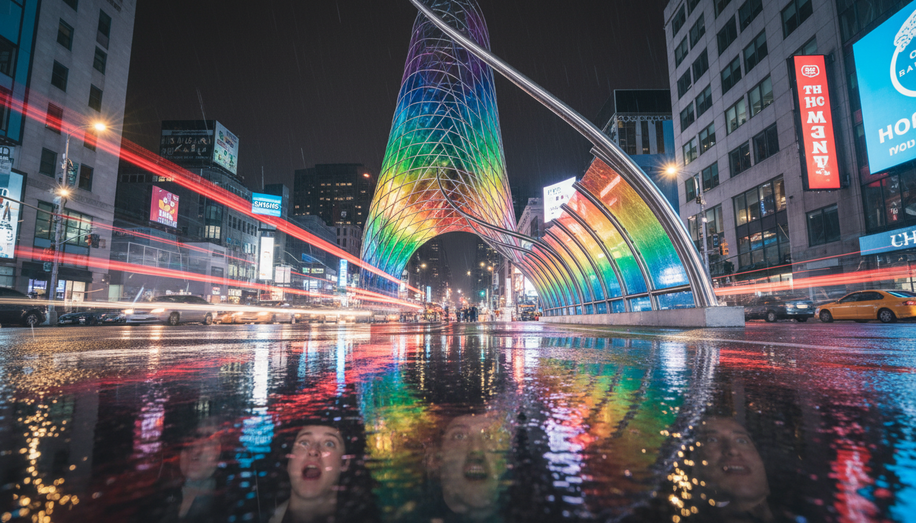

In the heart of bustling public spaces, brands are increasingly turning to immersive art installations and sculptures to captivate audiences, transforming passive billboards into dynamic experiences that demand interaction. No longer confined to static messaging, out-of-home (OOH) marketing now leverages sculptures that light up underfoot, rain simulations that defy physics, and towering 3D illusions that leap from screens, drawing crowds and fostering emotional connections in real time. This shift marks a pivotal evolution, where art and advertising converge to create shareable moments that extend far beyond the physical site.
Consider “The Pool” by artist Jen Lewin, a network of 106 illuminated pads arranged in concentric circles that respond to every step, run, or dance with rippling waves of light and sound. Each pad operates independently via wireless controllers, forming a decentralized ecosystem that reacts intuitively to human movement without a central command. Brands have adapted this concept for OOH campaigns, installing similar interactive floors in high-traffic urban plazas to promote products like sneakers or beverages, turning commuters into unwitting performers whose actions amplify the message through social media videos. In Montreal, CS Design and Lateral Office’s “Impulse” took a playful twist with LED-equipped seesaws that emit light and sound as visitors rock back and forth, converting a winter plaza into a communal playground. Such installations encourage prolonged engagement, with participants lingering to experiment, far outpacing the fleeting glance of traditional ads.
Immersive sculptures extend this interactivity into surreal realms, as seen in Random International’s “Rain Room,” where motion sensors halt a simulated downpour precisely above visitors, allowing them to wander dry through sheets of falling water. The installation’s sensory assault—the roar and scent of rain without a drop touching skin—creates an uncanny bond between human, machine, and environment, a principle brands now replicate in pop-up OOH activations. Meow Wolf’s “Convergence Station” in Denver elevates this further: a 30-foot-tall interactive art museum spanning viaducts, blending sculpture, narrative, and technology into explorable worlds. Luxury brands have sponsored comparable structures in city centers, embedding product placements within labyrinthine installations that invite exploration, boosting dwell time and organic buzz.
Digital advancements have supercharged these physical forms, birthing hybrid OOH spectacles like naked-eye 3D billboards that employ anamorphic illusions for jaw-dropping depth. In Bonifacio Global City, Philippines, Netflix and Disney launched the country’s first such screen, distorting animations into lifelike eruptions from the facade, reminiscent of Tokyo’s Shibuya Crossing or New York’s Times Square. Coca-Cola’s Times Square billboard takes it further, with an anamorphic bottle appearing to float and splash into the street, dynamically shifting content to maintain intrigue amid pedestrian chaos. Entertainment giants like Sony amplified this for Super Nintendo World’s “Mario Kart: Bowser’s Challenge” on a 300-foot-wide, 50-foot-high Los Angeles display, where characters race alongside virtual guests in high-definition 3D, halting traffic and igniting gamer fervor.
Japan’s Shinjuku Vision exemplifies the global frenzy, where Duck River Sea World’s 3D billboard conjures immersive marine worlds—schools of fish swirling from the screen—that compel passersby to stop and stare, effectively turning the ad into a tourist draw. In South Korea, Public Media Art’s 80-meter-wide “Wave Wall” at COEX K-pop Square simulates crashing ocean waves with such realism that viewers instinctively brace, blending sculpture-like motion with LED precision. Hollywood followed suit with Spider-Man’s Piccadilly Lights swing through London, the hero seemingly vaulting from the billboard to interact with real surroundings, heightening movie hype. Meta Quest’s metaverse promo transitioned physical streets into virtual realms, visually bridging realities to demystify VR.
These installations thrive on participation, often incorporating augmented reality (AR) for deeper immersion. Digital screens now overlay AR filters via QR codes, letting users “donate” virtual blood in NHS campaigns or dive into liquid billboards like Adidas’s Dubai spectacle, where swimmers plunged into a pool projected live onto a mall screen. Such tactics forge emotional ties: instant feedback from interactive elements lingers, driving recall and positive associations long after exposure.
The data underscores the impact. Immersive OOH commands up to 40% higher engagement than static formats, with social shares multiplying reach exponentially as users capture and post their encounters. In 2025, campaigns like Mafate X’s trail-running activation morphed convention spaces into 3D billboards, blending elite footage with interactive visuals to captivate passersby. Yet challenges persist: high production costs demand precise targeting, and urban regulations can temper scale. Still, as technology democratizes creation—via accessible LEDs and sensors—more brands, from beverages to tech, are commissioning bespoke sculptures that redefine public spaces as brand playgrounds.
This rise signals OOH’s maturation into experiential marketing, where art installations don’t just advertise; they orchestrate joy, surprise, and connection in the everyday urban tapestry. As cities pulse with these living sculptures, the line between advertisement and public art blurs, promising a future where every plaza holds a branded wonder waiting to be touched, stepped on, or marveled at.