
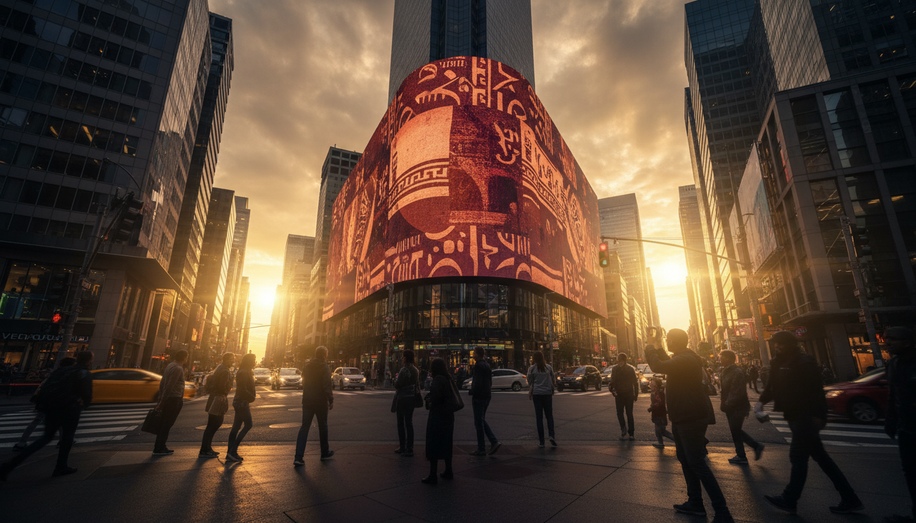

In the bustling arteries of cities worldwide, towering billboards and expansive digital screens do more than hawk products—they weave themselves into the fabric of society, subtly steering cultural currents and public sentiment. Large-format out-of-home (OOH) campaigns, with their commanding scale and inescapable presence, amplify this influence, transcending mere commerce to embed messages in the collective psyche. A Statista study reveals that 45 percent of UK adults respond to outdoor ads, while 40 percent trust billboards and posters, underscoring their subliminal power to shape perceptions without overt confrontation.
Consider the Woolmark campaign in 2022, which blanketed New York, London, and Paris during fashion weeks with hero placements promoting Merino wool as a sustainable luxury fabric. Crafted to mimic high-end fashion branding, these OOH sites didn’t just capture on-the-ground eyes; they became visual anchors for over 100 fashion articles, elevating wool’s narrative from commodity to cultural imperative. This exemplifies how grand-scale OOH elevates commercial pitches into broader dialogues, fostering environmental awareness amid luxury’s glare. Research bolsters this: larger advertisements outperform smaller ones in engagement, with exterior bus wraps drawing more interaction than interior displays, particularly for general climate messages over niche sustainable fashion pleas.
Such potency stems from OOH’s unique executional alchemy. As a “background medium,” it leverages visual saliency, repetition, and contextual relevance to bypass rational filters, engaging peripheral persuasion routes that spark emotional shifts in attitudes and preferences. Studies confirm that factors like photography, humor, bold colors, and minimal copy enhance recall and behavioral nudge, while large formats—KING-sized billboards, for instance—generate statistically superior engagement, with climate action messages averaging 58 interactions versus 18 for fashion-specific ones. In urban hives like Shanghai, cultural undercurrents amplify this: individualism, uncertainty avoidance, and long-term orientation mold consumer attitudes toward interactive OOH, moderated by perceived personal efficacy. Ads infused with traditional Chinese motifs resonate deeply, blending heritage with modernity to sway locals and tourists alike in a city where economic vibrancy fuels advertising receptivity.
History offers stark proof of OOH’s opinion-molding might. Texas’s “Don’t Mess with Texas” anti-litter campaign, now 35 years strong, slashed roadside trash by 72 percent in its first two years; a decade later, 98 percent of Texans knew its slogan, aligning governance messaging with regional identity. Similarly, CPB London’s International Women’s Day posters pose disarming questions to challenge biases, running annually to provoke re-evaluation without accusation. These aren’t fleeting sales ploys; they’re enduring societal interventions, proving large-format OOH can catalyze revolutions in thought and habit.
Urban lifestyles supercharge this dynamic. City dwellers, perpetually mobile—commuting, socializing, consuming—encounter OOH relentlessly via billboards, transit wraps, and LED spectacles. In Ho Chi Minh City, a trendsetter in Vietnam’s ad evolution, urban aesthetics and international art influences make OOH a vanguard for cultural absorption, blending global trends with local flair. Shanghai’s interactive screens, responsive to cultural values, heighten this, as consumers deem culturally attuned ads more effective, judging their power to reflect shared norms. Cross-culturally, attitudes favor OOH’s personal influence, positioning it as a cityscape landmark in the experience economy, where ads cluster in entertainment zones to enrich urban narratives.
Yet this unseen sway isn’t unidirectional. OOH mirrors and molds public discourse, from climate mobilization—where creative visuals counter industry pushback—to bias-busting social calls. In high-mobility metropolises, vibrant typography and bold elements cut through chaos, aligning brand stories with urban aspirations. A PLOS Climate study affirms: OOH’s emotional pull complements scientific appeals, driving awareness and action amid persuasion-resistant contexts.
Critically, large-format dominance matters. Bigger canvases command attention, their immensity imprinting messages subconsciously as commuters glance skyward. Woolmark’s fashion-week takeovers didn’t sell wool; they recast it as ethical chic, infiltrating editorial calendars. “Don’t Mess with Texas” didn’t lecture; it bonded with Texan pride, embedding anti-littering as identity. Women’s Day queries didn’t shame; they invited introspection, normalizing equity talks.
As digital saturation grows, OOH’s physicality endures, forging tangible community impacts. It beautifies streets when aesthetically attuned, as in Vietnam’s design-forward scenes, while shaping behaviors via cultural resonance. Positive societal ripples—from sustainability pushes to bias challenges—reveal OOH’s nuanced role: not just visible commerce, but a stealth architect of trends and opinion.
In an era of fragmented media, large-format OOH stands sentinel, its grandeur ensuring messages linger. By marrying scale, creativity, and cultural savvy, these campaigns don’t merely advertise—they redefine what’s normal, desirable, and discussable, proving advertising’s quiet command over culture’s unseen reins.