
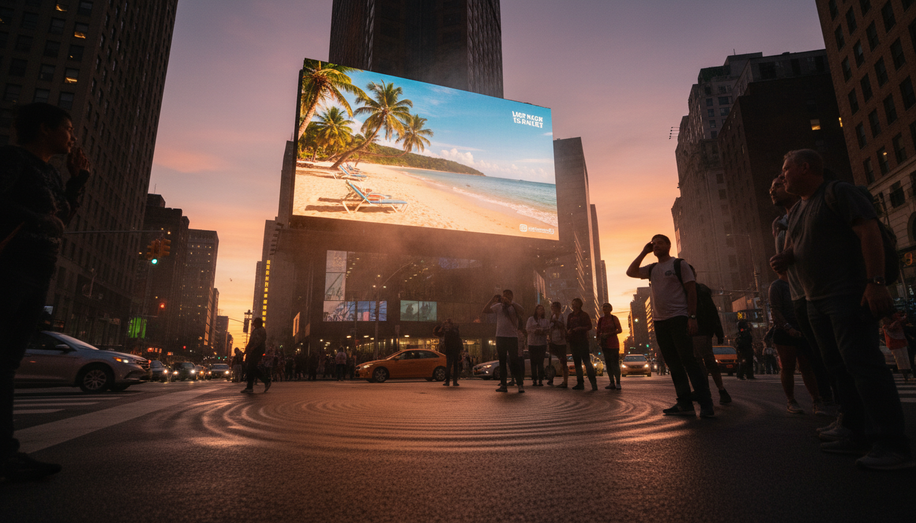

In the bustling heart of London’s Piccadilly Circus, where eyes are bombarded by flashing lights and towering screens, advertisers are pushing beyond the visual spectacle. A new wave of out-of-home (OOH) campaigns is harnessing haptic feedback, scent dispensers, and multi-sensory elements to forge connections that linger long after passersby move on, transforming passive glances into profound, tactile memories. These innovations tap into the brain’s preference for multi-sensory experiences, where touch and smell amplify recall and emotional resonance, making brands unforgettable in an era of fleeting attention.
Haptic technology, which delivers physical sensations through vibrations, pressure, or ultrasound, is at the forefront of this sensory revolution. Ocean Outdoor, a leading UK digital OOH provider, partnered with Ultraleap to deploy touchless advertising screens that use mid-air haptics, allowing users to interact with content via hand gestures without physical contact. As commuters wave their hands, they feel customized sensations on their palms—fizzy bubbles for a soft drink ad, an electric forcefield for a tech gadget, or the click of a virtual button—perfectly synced to on-screen visuals. This post-COVID innovation addresses hygiene concerns while adding a layer of immersion; Catherine Morgan, Ocean’s Director of Labs, notes it creates a “wow factor” that emotionally resonates, driving market share in cautious public spaces. Ultraleap’s ultrasound waves simulate touch in real time, tracking hand movements to make interactions feel startlingly real, proving haptics can elevate DOOH from observational to participatory.
Touch-based executions take this further, inviting direct physical engagement. KitKat’s “Have a Break” campaign in Colombia turned billboards into relaxation stations, where pedestrians leaned back against the structure to receive a free massage, embodying the brand’s promise of respite through literal touch. The campaign’s genius lay in its alignment: the soothing vibration not only relaxed users but etched the slogan into muscle memory, boosting recall through kinesthetic reinforcement. Similarly, textured posters and interactive installations, like those from 4OVER4’s street furniture displays, encourage tactile exploration—runners tracing rugged surfaces on a HOKA shoe ad or commuters feeling the grit of a desert landscape recreated in Manhattan. HOKA’s 48-hour immersive block, complete with wind, heat, and rocky terrain, blurred OOH with pop-up experiential marketing, drawing crowds who physically navigated the branded environment.
Scent dispensers add an olfactory dimension, evoking nostalgia and desire that visuals alone can’t match. While still emerging in OOH, brands are experimenting with timed releases triggered by proximity sensors—imagine a coffee chain’s billboard wafting fresh brew aromas during rush hour, or a perfume ad dispersing floral notes to mimic the bottle’s essence. These align with haptic principles, as shapes and textures in packaging already influence perception: rectangular forms convey power, rounded ones cheerfulness, enhancing brand recognition multisensorially. In virtual extensions, VR haptic gloves simulate product feel—vibrations for fabric texture or heat for a hot beverage—paving the way for hybrid OOH setups where AR murals, like Verizon’s in Miami, pair visual animations with scent and vibe feedback.
The impact is measurable and profound. Haptic video ads boost brand connection by 62 percent and heighten positive perceptions, as seen in campaigns by Arby’s and Showtime, where vibrations synced to visuals made viewers more excited and loyal. Multi-sensory OOH outperforms static billboards; Pepsi Max’s AR bus shelter, with illusory tigers and UFOs, went viral by blending sight, surprise, and implied motion, while British Airways’ “Magic of Flying” used real-time plane data to trigger a child’s pointing gesture, stirring awe without touch. Research underscores why: sensory integration strengthens neural pathways, with touch and smell anchoring memories 40 percent more effectively than vision alone, per haptic marketing studies.
Yet challenges persist. High costs for custom tech like Ultraleap screens or scent systems limit scale, confining them to premium locations like Times Square or Oxford Street. Technical glitches—fading scents in wind or haptic lag—can undermine immersion, and over-stimulation risks sensory fatigue in crowded urban zones. Still, as 2025’s standout campaigns like KitKat’s Cannes-winning visuals show, the future favors boldness.
Brands embracing this shift are redefining engagement. Ocean’s touchless rollout signals a hygienic, inclusive standard, while pop-up hybrids like HOKA’s desert prove physicality trumps pixels. In a world craving authentic connection post-pandemic, haptic and multi-sensory OOH doesn’t just advertise—it envelops, ensuring the brand’s essence clings to skin, nostril, and mind long after the walk away. As advertisers evolve, the flat billboard fades, replaced by canvases alive with sensation.