
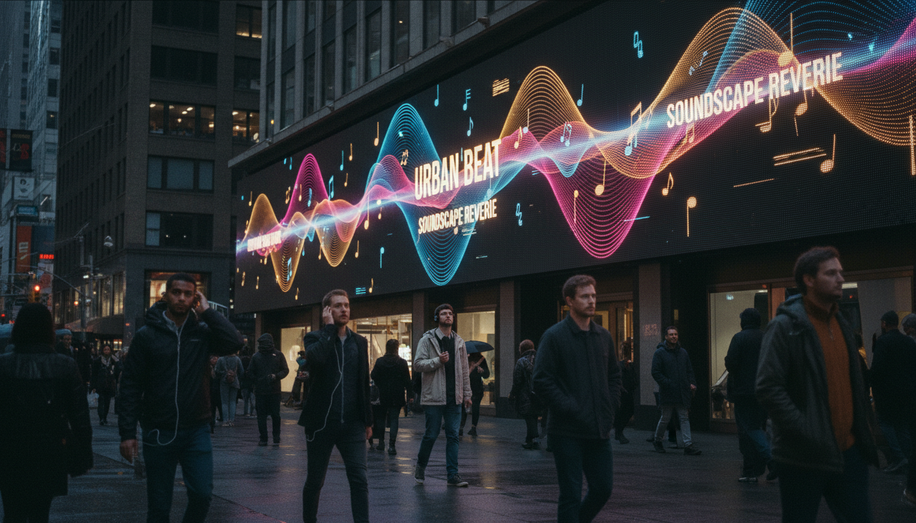

In the bustling streets of London and Manchester, a familiar crack echoes through the air, synchronized perfectly with towering digital billboards. This is Magnum ice cream’s latest campaign, where the signature snap of breaking chocolate isn’t just heard—it’s felt as a multisensory hook pulling passersby into the brand’s indulgent world. As out-of-home (OOH) advertising evolves, the integration of audio is transforming static visuals into dynamic sonic experiences, blending ambient soundscapes with targeted messages to forge deeper connections and elevate sonic branding to new heights.
Sonic branding, the strategic use of sound to build brand identity, has long powered icons like McDonald’s “I’m Lovin’ It” jingle or Coca-Cola’s five-note signature, instantly evoking emotion and recall even without visuals. Now, digital out-of-home (DOOH) technology is extending this auditory power outdoors. Sound-enabled screens, once rare, are proliferating in high-traffic zones, allowing brands to layer audio onto visuals for immersive encounters. Magnum’s “Nothing Cracks Like a Magnum” activation, crafted with Ocean Outdoor and Global, exemplifies this shift. Using Global’s API, the campaign synced the chocolate crack on Heart Radio in real-time with roadside DOOH displays, creating a cross-sensory surprise that Natasha Irwin of Mindshare UK described as letting consumers “hear” the product’s quality. Melanie Blood of Ocean Labs called it a “novel way to surprise and delight outdoor audiences,” proving audio’s ability to amplify engagement in fleeting urban moments.
This fusion taps into the brain’s preference for multisensory cues. Research underscores that unique sonic elements outperform visual assets alone in driving brand attribution, with audio fostering emotional resonance and memory activation. IPSOS data highlights sonic cues as more effective than celebrities or licensed music, a lesson Coca-Cola mastered decades ago by embedding its melody across diverse ads—from polar bears skating to World Cup anthems—ensuring instant recognition. In OOH, this translates to ambient soundscapes that envelop environments rather than interrupt them. Imagine a coffee chain’s DOOH ad emitting the gentle hiss of steaming milk and aroma-evoking beans, not as a loud blast but a subtle layer enhancing the visual steam rising from a cup. Such designs draw from stadium innovations like Borussia Dortmund’s Signal Iduna Park, where architecture amplifies crowd roars into a weaponized soundscape, structurally reinforced to withstand vibrations. Adapted to streets, these principles create “terrifyingly” memorable brand atmospheres.
Targeted audio messages take it further, personalizing the OOH experience. Proximity-based triggers on DOOH screens could deliver a brand’s sonic logo—think Intel’s mnemonic “bong” or Netflix’s “ta-dum”—only when a pedestrian lingers, turning billboards into conversational partners. Just Eat’s “Did somebody say…” line, now linked to 70% of UK consumers per SoundOut data, shows how repetition across touchpoints builds Pavlovian responses; OOH audio could extend this osmosis outdoors. Pioneers like Sonic Drive-In have flirted with the concept, earning “Best Billboard Campaign” in 2015 for 3D slush visuals that begged for auditory accompaniment, hinting at untapped potential. More recently, Newcastle United’s “Unsilence the Crowd” shirts vibrated stadium roars for deaf fans, a haptic twist on sonic immersion that could inspire OOH vibrations synced to sound for tactile branding.
Yet, the trend’s promise lies in immersive soundscapes pushing beyond jingles. KFC’s 2024 “Kentucky Fried Chicken Rain” ASMR campaign turned frying sounds into sleep-aid tracks on Spotify and Hatch devices, redefining the brand as soothing rather than shouty. OOH could replicate this with weather-reactive audio: rain-synced ads emitting calming drips for a spa brand or thunderous beats for energy drinks. AR and VR integrations, as in TOMS’ empathy-building “A Walk in Their Shoes,” foreshadow hybrid OOH where smartphones unlock layered soundscapes via geofenced apps. Domino’s “Domin-oh-hoo-hoo” choir saturated the UK at 95% reach across TV, OOH, and apps, demonstrating engineered audio’s scalability.
Challenges remain, from regulatory noise limits to ensuring accessibility—Newcastle’s vibrations offer a blueprint for inclusivity. Technical hurdles like speaker durability in harsh weather are yielding to advancements in directional audio, focusing sound on passersby without spillover. Early metrics are compelling: Magnum’s campaign not only trended but fused “premium with primal,” boosting propensity to buy through short, ownable sounds.
As urban spaces densify, OOH’s sonic evolution positions it as a canvas for full-spectrum branding. Brands like Ring, with crystal-clear audio UX up to seven meters outdoors, prove minimal palettes pack punch when placed strategically. UEFA’s choreographed Champions League anthem, fan-voted and replicated stadium-to-stadium, mirrors this: consistent sonic DNA across global touchpoints. For OOH publishers, investing in audio-ready inventory isn’t optional—it’s the next frontier. Magnum didn’t just crack chocolate; it cracked open a multisensory era where soundscapes don’t just advertise—they inhabit the city, lingering in ears and minds long after the screen fades. This integration promises not mere visibility, but visceral loyalty in an ad-saturated world.