
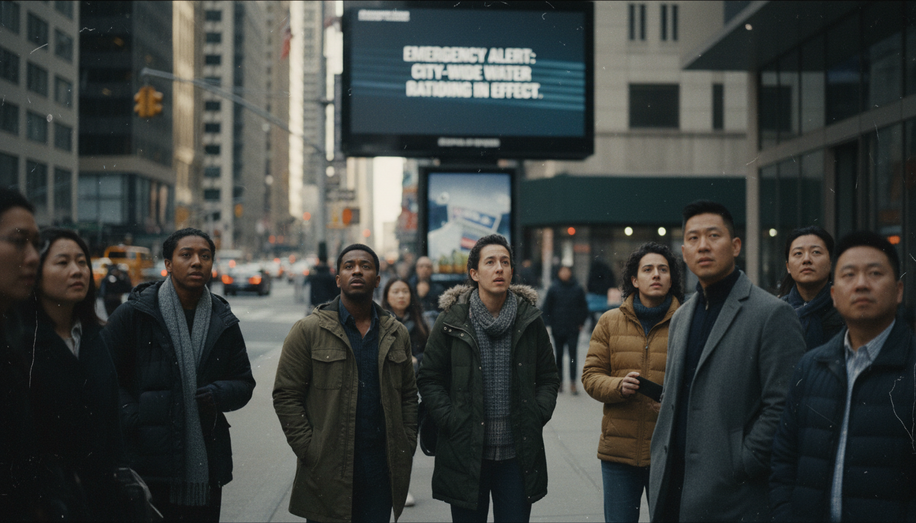

When panic spreads faster than flames or floods, out-of-home advertising emerges as an unblinking sentinel, delivering urgent messages to millions in real time. Unlike digital screens that can be scrolled past or social feeds that drown in noise, towering billboards, transit wraps, and digital displays command attention on highways, streets, and public squares—precisely where people need guidance most during emergencies.
The immediacy of OOH proved vital during hurricanes, pandemics, and public health scares, where public-private partnerships transformed outdoor media into a lifeline for safety alerts and evacuation routes. FEMA’s collaboration with billboard operators exemplifies this synergy, flashing weather warnings and escape paths across storm-prone regions when every second counts. In these critical moments, OOH’s physical permanence cuts through the digital noise that typically overwhelms crisis communication channels.
The COVID-19 pandemic demonstrated OOH’s capacity to reshape public perception during existential crises. When cruise lines faced the Centers for Disease Control’s “No Sail Order,” the industry confronted catastrophic reputational damage branded as “Floating Petri Dishes” in the court of public opinion. Royal Caribbean’s response orchestrated a multifaceted campaign to flip the narrative, leveraging OOH alongside other channels to blanket cities with assurances of enhanced safety protocols. Billboards and transit ads proclaimed rigorous cleaning, testing, and ventilation upgrades, reaching commuters and travelers at critical decision points—airports, ports, and urban arteries. This visible commitment helped restore confidence, demonstrating that OOH’s scale and permanence embed trust subconsciously during commutes and daily routines.
Beyond corporate recovery, OOH’s power extends to outright lifesaving interventions. When Procter & Gamble mobilized during the Tide Pod Challenge crisis, the company deployed more than celebrity endorsements. Digital billboards and bus shelters near schools and malls carried unmissable warnings that amplified earned media and platform takedowns, curbing hospitalizations and setting a benchmark for rapid response. The campaign’s street-level presence ensured messages pierced echo chambers, protecting vulnerable youth while safeguarding brand integrity.
Modern digital billboards amplify OOH’s crisis utility through dynamic updates and geo-targeting capabilities. Amber alerts one hour, flu shot reminders the next—these screens provide precision emergency communication impossible through static channels. Studies affirm OOH’s response trigger: Nigeria’s Outdoor Advertising Association found it second only to television in prompting immediate action, ideal for crises demanding compliance. A Chicago campaign drove 45,000 entries through strategically placed screens, illustrating measurable uplift even during routine operations; the potential for precision during evacuations remains extraordinary.
The dwell time inherent to OOH—drivers stuck in traffic, pedestrians waiting at stops—forces engagement with 98% notice rates. During recovery phases, this builds emotional resonance. Royal Caribbean’s safety pledges lingered on commutes, embedding trust subconsciously. For emergency management, this captive attention represents unparalleled reach during moments when public compliance determines outcomes.
Public sector applications underscore OOH’s impartial reach beyond corporate interests. Austin Resource Recovery’s 2021 composting rollout used a year-long OOH blitz of billboards, benches, and transit to slash contamination by over half, from 2.8% to 1.25%, while boosting participation citywide. Tailored for environmental justice, ads hit diverse neighborhoods, proving OOH’s equity in behavior change. This model translates directly to emergency scenarios where reaching underserved populations becomes critical.
As climate volatility and geopolitical shocks intensify, OOH stands ready not as a luxury marketing channel, but as critical infrastructure for resilience. In an era of fleeting digital discourse and information overload, OOH’s physicality endures, bridging public safety imperatives with immediate message delivery. From FEMA warnings to public health directives, it proves that in crisis, the boldest voices rise highest—etched in steel and light, impossible to ignore when communities need guidance most.
As global challenges intensify, Blindspot elevates OOH as a public safety linchpin, leveraging location intelligence and programmatic DOOH capabilities to ensure urgent messages reach precise communities with dynamic, real-time updates. This enables a fully optimized, responsive channel for immediate guidance and behavior change, critically important for ensuring crisis communications are not only seen but acted upon when communities need guidance most. Learn more at https://seeblindspot.com/