
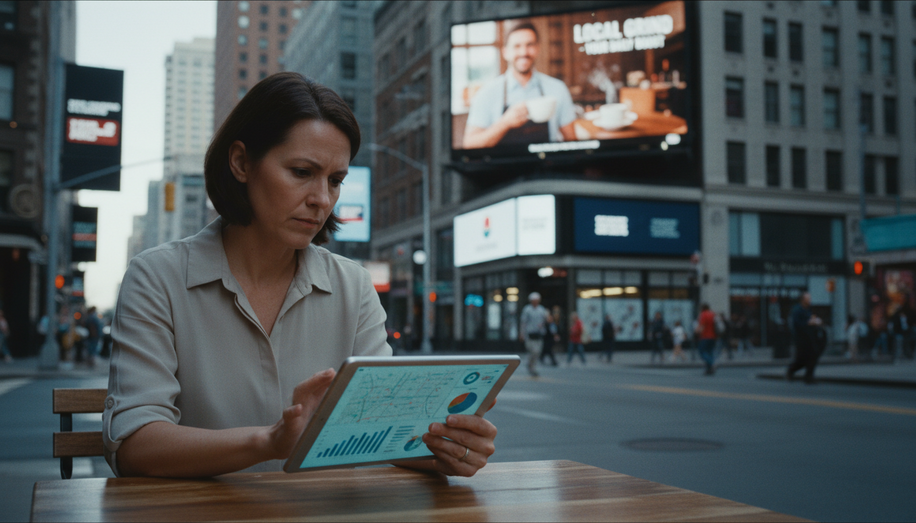

For small and medium businesses long intimidated by the high-tech jargon of digital advertising, programmatic digital out-of-home—or pDOOH—offers a game-changing way to reach real-world audiences without breaking the bank or needing a dedicated media team. This automated approach to buying and selling ad space on digital screens in public spaces like bus stops, malls, and billboards replaces cumbersome manual negotiations with real-time bidding, data-driven targeting, and flexible budgeting, making outdoor campaigns as nimble as online ones.
At its core, programmatic DOOH streamlines the process through specialized platforms. Advertisers use demand-side platforms (DSPs) to set campaign parameters—such as location, time of day, weather conditions, or audience demographics—while supply-side platforms (SSPs) connect screen owners to these buyers via auctions. When a digital screen has an available slot, the SSP notifies DSPs, advertisers bid in milliseconds, and the winning ad appears instantly, tailored to the moment. This differs sharply from traditional out-of-home (OOH), where fixed bookings lock in placements weeks ahead, often leading to wasted spend on irrelevant exposures. For SMBs, the appeal lies in its scalability: no need to commit massive upfront budgets to prime billboards; instead, bids start small and scale based on performance.
Data is the secret sauce that demystifies pDOOH for budget-conscious owners. Unlike static OOH, which relies on estimates, programmatic uses aggregated signals like foot traffic patterns, nearby points of interest, or even local events to ensure ads reach receptive audiences. A local coffee shop, for instance, could target screens near office districts during morning rush hours, activating ads only when commuter data shows high density—without relying on invasive personal tracking. Third-party insights on demographics, behavior, and real-time factors like rain (perfect for promoting umbrellas) enable hyper-relevant messaging, boosting recall and intent. Studies show DOOH drives 66% more online searches and 50% more purchases than traditional formats, with programmatic amplifying this through optimization.
SMBs can dive in without a steep learning curve by starting with self-serve DSPs familiar from digital campaigns, like those extending workflows to OOH inventories. Set a daily budget—say, $500—and define rules: run bakery promos on transit screens near residential areas from 7-9 a.m. on weekdays, pausing if impressions exceed targets. Platforms handle creative swaps dynamically; upload multiple ad versions, and algorithms select the best fit, such as sunny-day beachwear versus cozy indoor offers. Measurement follows suit: tools like geo-fencing, in-screen sensors, and impression multipliers track exposures, store visits, and website lifts, providing ROI proof that justifies every dollar. This transparency closes the loop, with centralized reporting showing exactly how a $2,000 campaign lifted foot traffic by 20%.
Budget constraints? Programmatic DOOH shines here, representing over 30% of DOOH spend and growing 18.8% year-over-year as of 2026 forecasts, precisely because it democratizes access. SMBs avoid agency markups by buying directly, allocating funds to high-impact moments rather than blanket coverage. A regional retailer might test $1,000 on urban screens during a weekend sale, using audience movement data to refine for the next round, achieving efficiency traditional OOH can’t match. Dynamic pricing via auctions means paying market rates only for premium slots, with flexibility to pivot if a competitor floods the market.
Yet success demands smart strategies. First, audit your audience: map customer journeys to screen types—roadside for drivers, venue interiors for shoppers—and layer in contextual triggers. Partner with reputable DSPs offering OOH integrations, ensuring clean data and fraud protection. Test small: launch a two-week pilot, analyze metrics like viewability and attribution, then scale winners. Compliance matters too; pDOOH emphasizes aggregated, privacy-safe signals over individual IDs, aligning with evolving regulations. For creative, keep it bold and brief—10-second loops with clear calls-to-action that pop in busy environments.
Real-world wins abound. A mid-sized apparel chain used pDOOH to target event-goers near stadiums, swapping creatives based on game schedules and weather, yielding 40% higher engagement than static buys. SMBs like craft breweries geo-fence brewery tours, serving ads on nearby screens to capture impulse visits. These cases prove that with modest spends—often under $10,000 monthly—businesses can rival big brands in reach and relevance.
Programmatic DOOH isn’t a luxury; it’s a practical equalizer for SMBs craving data-driven OOH without the overhead. By automating buys, harnessing real-time data, and prioritizing measurable outcomes, it turns public screens into precise sales drivers. Start simple, iterate fast, and watch local campaigns convert passersby into loyal customers—proving that in today’s hybrid world, the most effective ads meet people where they actually are.