
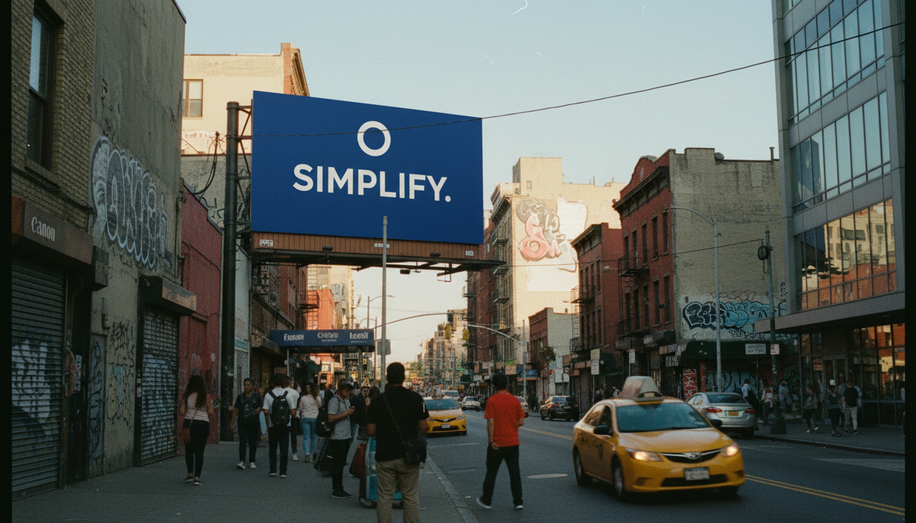

In an advertising landscape increasingly crowded with competing messages and visual noise, minimalist out-of-home campaigns have emerged as a counterintuitive solution to capture and hold consumer attention. By stripping away excess and embracing strategic simplicity, brands are discovering that less truly translates to more—more impact, more memorability, and more measurable results.
The psychology behind minimalist billboard design aligns perfectly with how consumers actually engage with outdoor advertising. Motorists and pedestrians typically have only eight seconds to process an advertisement as they pass by. In this fleeting window, clarity becomes paramount. A billboard cluttered with competing colors, multiple messages, and complex imagery forces viewers to work harder to extract meaning, often resulting in cognitive overload and brand recall failure. Minimalist design flips this equation, presenting information so distilled and direct that audiences can absorb the entire message instantly. This efficiency paradoxically encourages longer engagement—when there is less to process, viewers may actually spend more time contemplating what they see.
The creative challenge of minimalism lies in its apparent simplicity. Designers must identify and isolate what is genuinely remarkable about a brand or product, then communicate it with surgical precision. When executed successfully, minimalist billboards achieve a sophistication that resonates far more deeply than ornate, information-heavy alternatives. Consider Apple’s iPhone X campaign, which featured nothing but the device set against pure white space, accompanied only by the product name, release date, and logo. The restraint itself became the message—a statement about the product’s elegance and self-evident appeal. Similarly, Coca-Cola’s 2020 Italian campaign reduced their entire brand identity to an expanse of signature red with a gently curved logo and two words: “Feel it.” The minimalist execution transformed basic branding elements into an emotionally resonant experience.
Nike’s enduring “Just Do It” campaign demonstrates how three words paired with bold imagery can sustain cultural relevance for decades. McDonald’s “Follow the Arches” campaign took minimalism to an even more extreme level, stripping away the brand’s iconic Golden Arches logo entirely and instead using only fragmented visual hints accompanied by directional cues like “On your left” or “Next exit.” This approach ingeniously turned the consumer into an active participant in the advertising experience, creating curiosity and engagement through strategic absence rather than presence.
The effectiveness of visual simplicity rests on three core design principles. First, bold, high-contrast visuals must capture attention from distance, with colors and imagery that naturally draw the eye without requiring detailed examination. Second, messaging must be ruthlessly condensed—ideally to six to eight words maximum—so the headline stands alone and registers instantly with passersby. Third, brand elements such as logos or taglines must occupy clear, unobstructed spaces, ensuring immediate recognition and recall.
What makes minimalist OOH particularly powerful in the current media environment is its defiance of digital advertising trends. While social media platforms reward information density and constant stimulation, outdoor advertising’s inherent constraints—limited viewing time, outdoor settings, mobile audiences—favor the opposite approach. Brands that have mastered this paradox, including Apple, Nike, and McDonald’s, have built iconic campaigns that achieve what most advertising aspires to: they are remembered not despite their simplicity, but because of it.
As advertisers increasingly compete for attention in saturated urban environments, the minimalist approach offers a proven methodology for breaking through clutter. By embracing creative constraint and trusting in the power of a single, powerful idea, brands can craft out-of-home campaigns that don’t just inform—they captivate, intrigue, and endure in consumer memory long after the viewing moment has passed.