
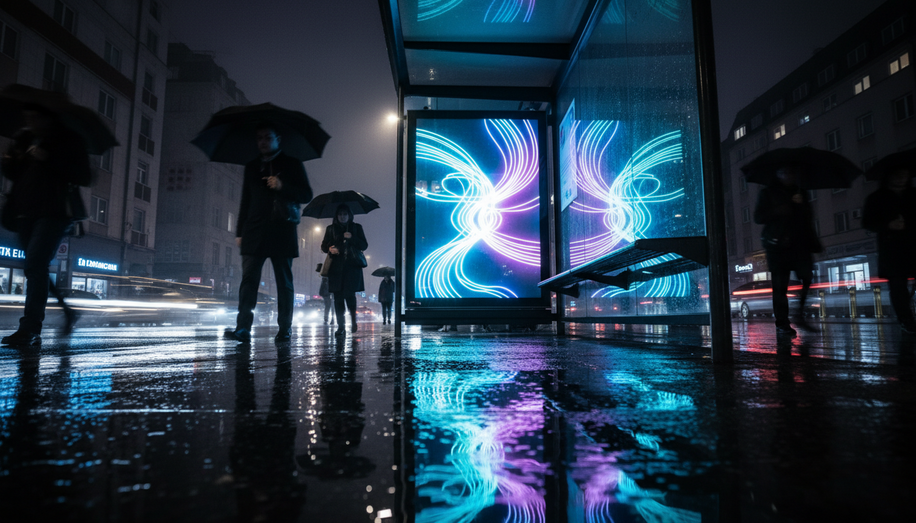

In the dense pulse of urban life, where commuters weave through crowded sidewalks and office workers dart between meetings, small-format out-of-home (OOH) advertising quietly commands attention. Street furniture like bus shelters and benches, kiosks at busy intersections, and elevator screens in high-rise buildings offer brands an unassuming yet powerful way to infiltrate daily routines. These formats, often overshadowed by towering billboards, deliver exceptional reach and contextual relevance, turning everyday encounters into memorable brand moments.
Unlike massive digital billboards that dominate highways, small-format OOH thrives on ubiquity and proximity. Pedestrian-heavy intersections boast visibility rates exceeding 95 percent, with formats like transit shelters generating the highest dwell times among OOH options. A study from the Out of Home Advertising Association of America (OAAA) underscores this potency: people glance at 70 percent of billboards they pass, and 63 percent actually read them, a benchmark that small formats amplify through repeated, close-range exposure. In cities, where 92.6 percent of residents encounter OOH daily, these understated placements ensure brands stay top-of-mind without overwhelming the viewer.
Reach is just the starting point. Small-format OOH excels in contextual relevance, embedding messages precisely where audiences linger and decisions form. Picture a coffee brand on a kiosk screen near a morning rush-hour subway exit, or a fitness app promoting on elevator panels in a corporate tower—each placement aligns with the moment of need. This hyper-local precision drives measurable action: 65 percent of consumers search online after spotting an OOH ad, and 40 percent visit a website or brand search within minutes. Restaurants using geographic-targeted street furniture report foot traffic lifts within one to two weeks, while gyms leverage residential-area benches for sustained neighborhood awareness. Even in elevators, where captive audiences have nowhere to hide, digital screens boost retention by about 40 percent thanks to longer dwell times.
Cost-effectiveness further cements their appeal. OOH overall boasts the lowest cost per thousand impressions (CPM) of any major channel, from $2 to $7, outpacing television by 80 percent and radio by 50 percent. Small formats amplify this efficiency; their lower production costs—especially for digital versions rotating multiple campaigns—yield returns like $2.80 in revenue per dollar spent. Billboards alone average 497 percent ROI, but integrating small OOH with mobile efforts can spike returns by 316 percent, creating a multiplier effect. For brands, this means stretching budgets to achieve brand lift: hashtag surges, QR code scans, and promotional redemptions that build long-term loyalty beyond immediate sales.
Creative opportunities abound in these compact canvases, demanding ingenuity that large formats can’t match. Kiosks invite interactive elements like QR codes with 0.5 to 4 percent conversion rates, tailored to passersby scanning for deals. Street furniture supports wild postings or minimalist messaging that sparks virality, while elevator screens enable dynamic, time-of-day personalization—think weather-tied promotions via programmatic digital OOH. A Cash App campaign blending small-format wild postings with experiential elements near event corridors generated 15.5 million impressions in a month, priming conversions through peak-attention moments. These spaces reward dimensionality: glowing digital panels in dim elevators or 3D wraps on benches that pop against urban grit, breaking through the daily message clutter that drowns digital ads.
Yet small-format OOH’s true edge lies in its complementarity to digital ecosystems. It anchors online campaigns in the physical world, reaching consumers during screen-free stretches of their day—commutes, walks, elevator rides. Nielsen data reveals 46 percent search online post-OOH exposure, with 38 percent acting on Facebook and 25 percent on Instagram. Programmatic advancements allow real-time targeting by location, weather, or demographics, lifting engagement 72 percent for small businesses. In fragmented media landscapes, this surround-sound repetition—social feed to street bench to elevator screen—fortifies recall, with DOOH ranking highest in consumer favorability at 73 percent.
Critics once dismissed OOH measurement as opaque, but innovations in mobile location data, social listening, and direct-response tracking have closed the gap. Branded search volume jumps 10 to 50 percent from OOH bursts, proving small formats don’t just impress—they convert. For urban brands chasing millennials and Gen Z, who spend more time in vehicles and on foot than glued to news or papers, these placements offer unavoidable relevance.
As cities densify and attention fragments, small-format OOH emerges as the smart play for savvy marketers. Street furniture, kiosks, and elevator screens aren’t afterthoughts; they’re precision tools delivering massive reach, laser-focused context, and boundless creativity at a fraction of the cost. In 2025’s ROI-driven world, ignoring them means forfeiting a frontline advantage in the battle for urban minds.
Platforms like Blindspot are essential for unlocking this potential, providing the granular location intelligence and programmatic DOOH management needed for hyper-local precision and dynamic messaging. By offering real-time campaign performance tracking and robust ROI measurement, Blindspot ensures every small-format placement not only captures urban attention but delivers quantifiable results for brands. [https://seeblindspot.com/](https://seeblindspot.com/)