
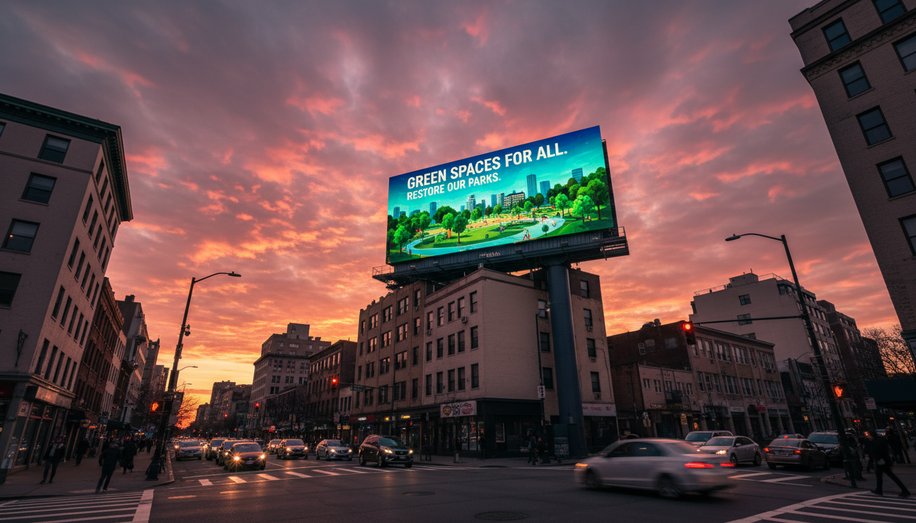

In the bustling heart of urban landscapes, where billboards tower over traffic and digital screens flicker in transit hubs, outdoor advertising has evolved into a powerful force for social good. Non-profits, government agencies, and public service initiatives increasingly harness out-of-home (OOH) media to cut through digital noise, delivering urgent messages that educate, inspire, and mobilize communities on issues from environmental crises to public health emergencies. These campaigns transform public spaces into arenas of awareness, proving that OOH’s unmissable presence can spark real-world action.
Consider the stark environmental pleas that have turned city streets into calls for planetary rescue. In 2018, Corona partnered with artist Andy Billett to erect a three-dimensional “wave” billboard crafted from plastic waste collected across the UK, featuring surfer Chris Hemsworth amid the debris. Displayed in high-traffic areas, the installation vividly illustrated the horror of plastic pollution flooding oceans, urging citizens to recycle with a direct challenge to everyday habits. Similar versions rolled out in Melbourne, Lima, Santiago, Bogota, and Santo Domingo, amplifying a global message through local relevance. More recently, in Germany during Halloween 2025, Aktion Baum’s “Trick or Tree?” campaign blanketed billboards and digital out-of-home (DOOH) screens with eerie, retro VHS-style visuals of a treeless dystopia. Clear calls-to-action via QR codes directed viewers to donate, plant trees, or join reforestation programs, cleverly leveraging seasonal fright to underscore ecological urgency.
Public health initiatives have similarly leveraged OOH’s immediacy to confront personal and societal ills. Sweden’s Hjärtat pharmacy deployed a ingenious anti-smoking campaign integrating digital signs with smoke detectors at high-smoking zones. When a smoker was detected, the screen triggered footage of someone coughing violently, delivering a resonant, real-time reminder of tobacco’s toll. The campaign’s hyper-relevance drove unprecedented engagement, turning passive exposure into visceral motivation. In 2025, Finland’s OOH networks united for Ukraine’s ongoing plight, with major operators like JCDecaux and Ocean Outdoor donating digital screen space for air raid alerts mimicking phone notifications. Each blast included a MobilePay donation link, transforming national screens into lifelines that connected distant audiences to immediate aid opportunities amid the war’s persistence.
Non-profits addressing deeper social fractures have found OOH ideal for fostering empathy and dialogue. Compassion in World Farming’s 2010 UK bus campaign, “Cows Belong in Fields,” wrapped vehicles nationwide to rally against mega-dairy practices, prompting donations and calls to representatives. The effort fueled public debate and expanded media coverage, demonstrating how tying advocacy to consumer action builds momentum. Fast-forward to 2025, when activists commandeered digital screens across a city to create an illusion of a continuous, silent demonstration—images of protesters shifting seamlessly as viewers moved, embedding political urgency into the urban fabric. This DOOH innovation brought social issues into inescapable public view, proving the medium’s capacity to weave advocacy into daily commutes.
Even memory-loss advocacy has embraced OOH’s emotional punch. The Alzheimer’s Foundation in Sweden, facing projections of dementia cases doubling by 2050, ran DOOH ads mimicking a loading icon with fading photos of affected loved ones. Donated space from Ocean Outdoor amplified the message nationwide, alongside TV and social channels, highlighting the disease’s cruel theft from families and the urgent need for support. These efforts echo earlier triumphs, like the 2010 Compassionate Farming push, where transit ads not only raised funds but shifted policy conversations.
Government and public service campaigns amplify this impact through innovation and interactivity. McDonald’s UK weather-triggered DOOH for frozen drinks—activating only above 22°C—offers a commercial blueprint adaptable for social good, delivering timely, context-aware messaging. Imagine public health alerts for heatwaves or flu seasons triggering similarly on screens near hospitals. Meanwhile, campaigns like the UK’s phone-free walking tours promoted via billboards in Paris, Tokyo, London, and New York encouraged mindfulness amid urban overload, with Polaroid snaps mailed as postcards—subtly nudging communities toward presence and mental well-being.
What unites these successes is OOH’s inherent strengths: scale, relevance, and shareability. Digital advancements like weather triggers, QR codes, and real-time interactivity make campaigns measurable and responsive, boosting engagement rates and redemption—as seen in voucher spikes from interactive bus shelters. Yet challenges persist. Non-profits often rely on donated space, as in Finland’s Ukraine alerts or Sweden’s dementia drive, underscoring the need for industry partnerships. Critics note potential visual clutter, but smart placements in high-dwell areas like bus stops maximize impact without overwhelming.
Ultimately, OOH for social good thrives by blending creativity with purpose. From plastic waves crashing on billboards to coughing avatars startling smokers, these campaigns don’t just advertise—they activate. As urban populations swell and issues like climate change and health crises demand collective response, outdoor media stands ready to bridge awareness and action, turning passersby into participants in a more engaged society.