
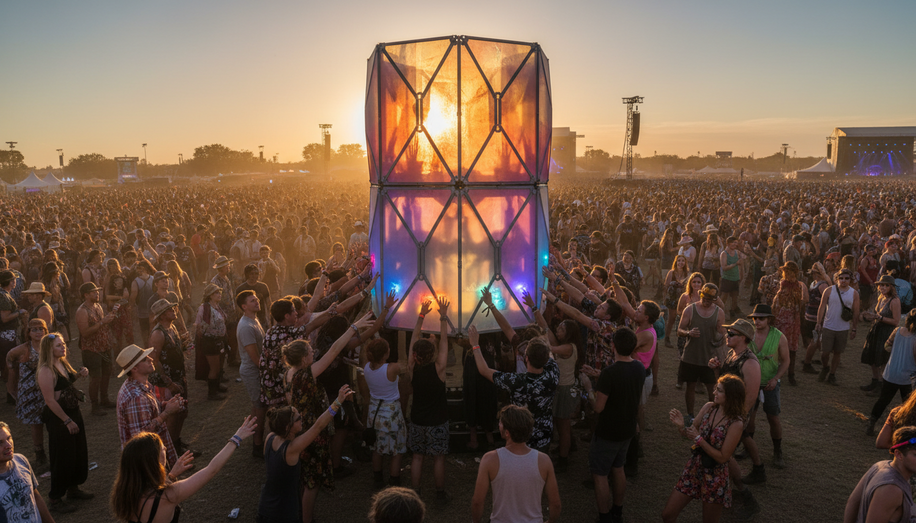

In the bustling heart of urban festivals and alpine slopes, brands are transcending static billboards to forge physical connections that linger long after the encounter. Out-of-home (OOH) advertising, once confined to visual messaging, has evolved into a dynamic platform for experiential activations, turning passive passersby into active participants. This shift positions OOH as a catalyst for deeper consumer engagement, where memorable interactions amplify brand loyalty in an era saturated with digital noise.
Consider Goose Island’s Block Party activation, a masterclass in subtle yet immersive OOH integration. Amid high-traffic festival zones, the beer brand erected 90s-style phone booths alongside a towering bear photo opportunity, strategically placed near bar and food lines. Attendees, idling in queues, found themselves drawn into artistic installations that echoed the brand’s gritty, cool aesthetic—far from corporate billboards, these felt like organic art pieces. The result? Spontaneous photo ops that attendees shared widely, blending OOH visibility with user-generated content to extend reach exponentially.
This approach exemplifies how experiential OOH capitalizes on dwell time, transforming wait moments into brand moments. In 2026, such tactics dominate because they prioritize shareability and personalization, key drivers of engagement metrics like social reach and lead capture. Brands no longer shout from afar; they invite consumers into the narrative, fostering emotional ties that digital ads struggle to replicate.
High in the Austrian Alps, Kiehl’s Ski(n) Adventure campaign further illustrates OOH’s power as a multifaceted touchpoint. Promoting its Ultra Facial Cream, the skincare giant blanketed the Hochzillertal-Kaltenbach ski region with traditional OOH ads, experiential pop-ups, and influencer tie-ins. A pop-up store offered “try-before-you-buy” trials amid snowboarding and hiking trails, positioning Kiehl’s as the essential companion for adventure seekers. The campaign’s integration of physical advertising with hands-on demos not only boosted brand awareness but solidified its adventurous identity, proving experiential OOH excels in contextually relevant environments.
Retail and consumer goods brands are leaning heavily into these immersive environments. Pop-up transformations in malls or flagship locations create “transported” experiences, where shoppers step into branded worlds—think interactive zones that mimic product universes, encouraging trials and immediate purchases. Why does this resonate? Consumers crave authenticity; experiential OOH delivers tangible proof of a brand’s promise, outperforming abstract online claims.
Technology and SaaS sectors, ever innovation-hungry, push boundaries with tech-infused activations. At conferences and product launches, AI-powered photo booths, interactive LED walls, and VR demos turn OOH into live demonstrations of capability. A roaming AI light ring or GlamBOT slow-motion video booth captures personalized moments, instantly shareable via social channels. These formats thrive because they *show* rather than tell, aligning with tech audiences’ expectations for cutting-edge encounters that generate buzz and qualified leads.
OOH’s resurgence in 2026 stems from its evolution into a “global operating system,” blending offline precision with digital amplification. Trends like mistake marketing—playful, humanized stunts—and integrated campaigns, as seen with KFC and Kiehl’s, underscore this hybrid potency. Data underscores the impact: experiential activations yield higher dwell times, with consumers 65% more likely to recall brands after interactive encounters compared to static views. Placement remains crucial; high-traffic, context-aligned spots maximize organic engagement, turning OOH into a springboard for omnichannel strategies.
Yet success demands more than spectacle. Top campaigns tie experiences to clear outcomes—sales lifts, app downloads, or community building—measured via QR codes, NFC tags, or geofenced analytics. Challenges persist: scalability in diverse markets and weather-dependent executions require meticulous planning. Still, as consumers tire of screen fatigue, OOH’s physicality offers unmatched tangibility, driving deeper loyalty.
Brands like Netflix and Spotify have long harnessed outdoor ads for cultural relevance, but 2026’s experiential pivot elevates them further. Imagine a Spotify installation where pedestrians remix tracks via touchscreens, or Netflix pop-ups reenacting show scenes—real-world examples that worked by sparking joy and virality. These activations remind us: in a fragmented media landscape, OOH’s experiential layer creates indelible memories, propelling brands from peripheral awareness to passionate advocacy.
As OOH matures, its role as an engagement engine solidifies. By crafting interactive touchpoints that blend art, technology, and context, brands not only capture attention but cultivate communities. The lesson is clear: the most effective advertising doesn’t interrupt life—it enhances it.