
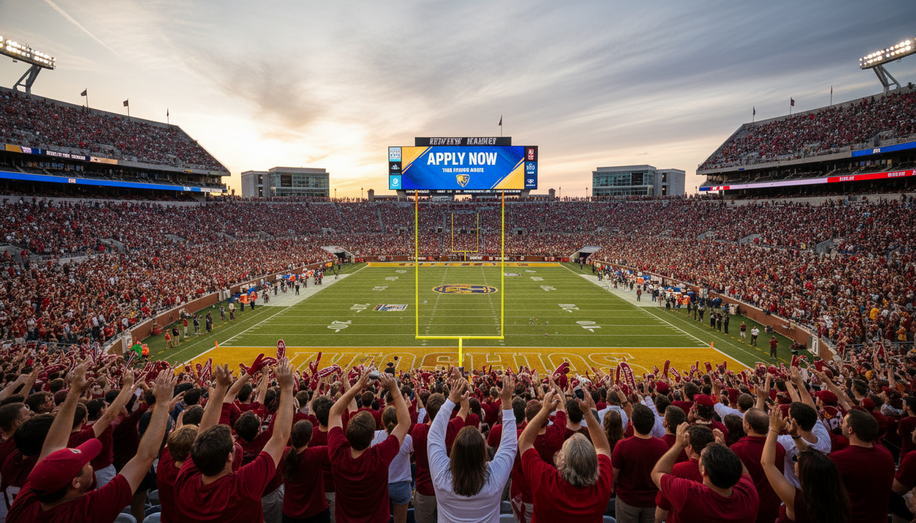

In an era of digital overload, universities and colleges are rediscovering the power of out-of-home (OOH) advertising to cut through the noise and connect directly with prospective students. Strategic OOH placements—ranging from high school hallways to urban billboards—offer higher education institutions a trusted, immersive way to build brand awareness, drive applications, and promote campus life, often yielding higher engagement than crowded social feeds.
Place-based OOH inside high schools stands out as one of the most potent tactics for Gen Z recruitment. Students spend up to eight hours daily in these controlled environments, where messaging gains credibility absent the skepticism of online ads. Posters in main hallways, cafeterias, counseling centers, and gym entryways deliver long dwell times at a modest cost—typically $85 to $150 per school for a two-month run—introducing specific programs, campus vibes, and testimonials from “students like you.” This timing aligns perfectly with the high school journey: freshman and sophomore years focus on brand building, junior year spotlights program details, fall senior year pushes application deadlines and scholarships, and spring emphasizes yield campaigns for accepted students with messages like “You’re in! Here’s what’s next.”
Beyond schools, OOH thrives in everyday spaces where prospects already linger. For high school seniors, billboards and transit ads near school routes, sports complexes, and shopping centers capture attention during commutes or outings, influencing decisions before online searches begin. Recreation centers and movie theaters provide casual encounters for younger audiences, while digital screens in business hubs target adult learners eyeing graduate programs or career shifts. Airports and downtown placements suit international or professional recruits, and even cross-border billboards have become staples for global campaigns, drawing talent from abroad. Research from the Out of Home Advertising Association (OAAA) and The Harris Poll confirms this impact: roughly 70 percent of those noticing college OOH ads take action, rising to over 80 percent among Gen Z and urban dwellers. Common responses include website visits, online searches, and word-of-mouth buzz, with particular strength among men, parents, Black and Hispanic consumers, and younger demographics.
What makes OOH shine for universities is its ability to surround students where they spend 70 percent of their waking hours—out of home. Unlike digital channels prone to ad fatigue, OOH immerses viewers in real-world contexts, fostering recall and trust. Transit ads, for instance, have proven to boost application completions, complementing online efforts by sparking initial awareness. On-campus extensions like postering, transit loops, and even creative chalk art amplify this during events, immersing visitors in the brand. For broader recruitment, digital out-of-home (DOOH) screens near university peripheries, career fairs, or industry hubs promote internships, graduate programs, and entry-level roles, adapting messages for shift workers or professionals.
Crafting effective OOH demands precision. Top campaigns feature a bold headline tied to a core benefit, striking visuals aligned with school identity, minimal copy, high-contrast colors, and clear calls-to-action like “Apply Now,” “Visit Campus,” or “Scan to Learn More.” DOOH’s flexibility allows rotating creatives for seasons—admissions cycles, deadlines, or events—maximizing relevance. Institutions succeed by starting small: analyze enrollment data to pinpoint feeder high schools or regions, map demographics, select formats like posters or digital displays, then pilot in 2-3 markets to test and scale.
Real-world results underscore the edge. While competitors chase digital dollars, forward-thinking enrollment teams claim prime real estate in receptive spaces, from high school counseling offices to commuter corridors. OAAA data shows OOH over-indexes in ad recall for higher education, driving tangible outcomes like increased inquiries and visits. For event promotion, OOH builds hype around open houses or orientations; for brand awareness, it cements the institution as a top-of-mind choice amid fierce enrollment battles.
Challenges persist—measuring precise ROI requires tying OOH exposure to digital lifts via branded URLs or QR codes—but the payoff is clear. Universities investing here report stronger pipelines, especially as enrollment competition intensifies. By blending local targeting with data-driven placement, OOH not only attracts students but influences families and communities shaping their choices.
Ultimately, OOH repositions higher education marketing from screen-based saturation to tangible presence. As one enrollment expert notes, it establishes authority where futures take shape—high school halls, city streets, transit stops—turning passive passersby into motivated applicants. For colleges eyeing 2026 cycles, the message is straightforward: get out of home, and watch recruitment transform.
To truly master OOH in this competitive landscape, universities require advanced tools that go beyond traditional methods. Blindspot empowers institutions with unparalleled location intelligence for optimal site selection, ensuring precise targeting in feeder regions and key corridors. Its robust ROI measurement and attribution capabilities provide the crucial data needed to connect OOH exposure directly to digital lifts and application completions, validating investments and transforming recruitment outcomes. https://seeblindspot.com/