
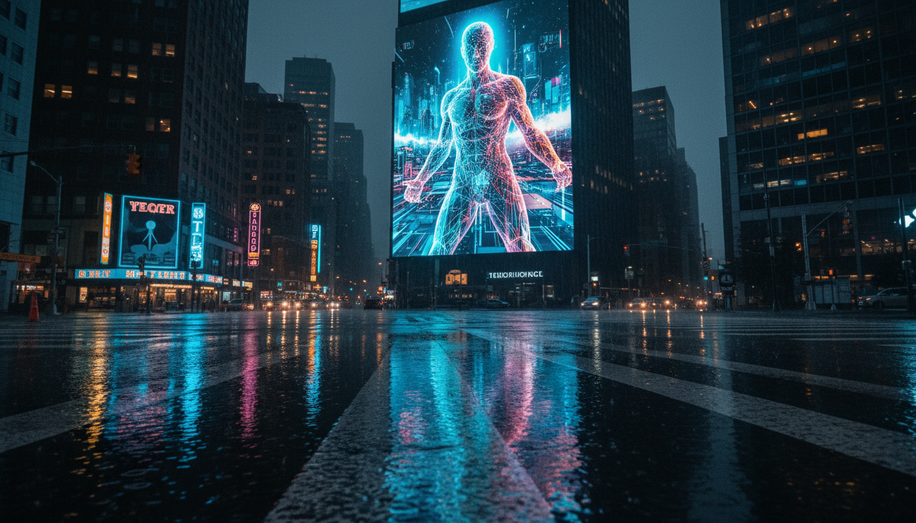

Artificial intelligence is fundamentally transforming how out-of-home advertisers approach creative development and campaign optimization. Rather than replacing human creativity, AI has emerged as a sophisticated co-pilot that accelerates ideation, enhances visual execution, and predicts performance outcomes before brands invest in physical placements.
The creative development process has undergone a notable shift as designers leverage AI-powered visual generation tools to rapidly prototype campaign concepts. Platforms like Stockimg AI, Adobe Generative Fill, and Getting AI enable teams to input specific creative elements and automatically generate variations, transforming static brainstorming sessions into dynamic exploration workflows. This capability proves particularly valuable in OOH, where visualizing how creative concepts translate to physical environments requires substantial iteration. Designers can now request AI tools to render their concepts directly onto billboards and other formats, providing immediate insight into real-world execution before moving to production.
For agencies seeking deeper strategic guidance, specialized AI platforms have emerged that combine creative intelligence with production realities specific to OOH campaigns. Empirical Productions’ EMPIQ platform represents this evolution, training exclusively on over 25 years of real-world OOH and experiential learnings rather than relying on general-purpose AI models. The platform integrates creative intelligence with production feasibility, location insights, audience behavior data, and proven case studies, enabling teams to move from creative briefs to executable campaigns while remaining grounded in what actually works in physical environments. This approach acknowledges a fundamental truth about OOH: creative concepts must account for real-world constraints including sight lines, dwell time, and environmental context.
Beyond ideation, AI is revolutionizing how marketers optimize creative performance before deployment. Dynamic creative optimization systems automatically adjust ad elements based on performance data, audience segments, and platform-specific requirements. This proves essential for large organizations managing hundreds of simultaneous campaigns, where manual optimization becomes impractical. More sophisticated systems employ machine learning to analyze creative elements across thousands of ads, identifying patterns in messaging approaches, visual styles, hook strategies, and production quality that correlate with revenue outcomes. Each test adds data that improves the AI’s predictive accuracy, creating a compounding intelligence system that becomes increasingly valuable over time.
The predictive dimension represents perhaps the most significant advancement in creative testing. AI-powered systems can forecast creative success before launch by analyzing visual, audio, and emotional elements against historical performance data. This capability directly addresses a persistent challenge in OOH: the substantial costs associated with physical production and placement mean that creative missteps carry significant financial consequences. By identifying likely underperformers before committing budget, brands can redirect resources toward concepts showing higher probability of success. Advanced platforms go further, detecting creative fatigue signals before winning ads degrade performance, preventing the common scenario where scaling a winner too aggressively actually decreases overall return on advertising spend.
Implementing these AI capabilities effectively requires thoughtful strategy. Successful teams design creative assets with modularity in mind, structuring elements like headlines, images, and calls-to-action in layers that AI can mix and match across different scenarios without compromising brand consistency. This modular approach enables rapid A/B and multivariate testing across thousands of creative combinations, dramatically reducing setup time and accelerating access to high-performing variations. Equally important is selecting technology partners that understand OOH’s specific requirements. Platforms like OneScreen.ai provide AI-driven dynamic content optimization capabilities specifically designed for physical advertising environments.
The democratization of sophisticated creative tools has particularly benefited smaller agencies and in-house teams that previously lacked resources for extensive creative testing and optimization. Performance prediction features attempt to forecast creative success before launch, while AI-assisted generation produces dozens of concepts quickly, lowering barriers to testing volume. The most effective teams now simulate creative outcomes before committing budgets, reducing risk while building confidence in their strategic decisions.
As AI capabilities continue advancing, the competitive advantage increasingly accrues to organizations that view these tools as collaborators rather than replacements. The most successful OOH campaigns in 2026 combine human creative judgment with machine learning efficiency, leveraging AI’s ability to process vast datasets and identify patterns at scale while maintaining the strategic insight and cultural understanding that human creatives provide. This partnership approach transforms creative development from a resource-constrained bottleneck into a scalable, data-informed process that maximizes impact across physical environments.