
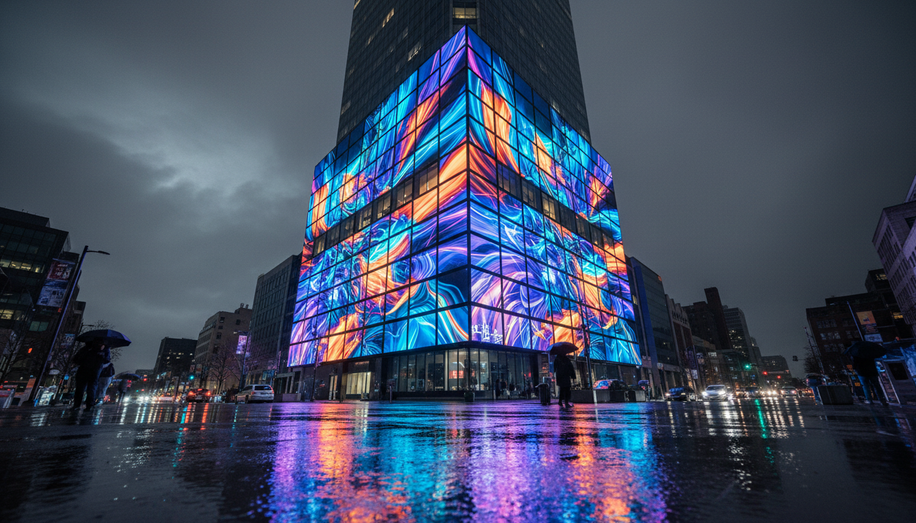

In the heart of Delhi, a colossal LED structure resembling a towering tree has redefined the skyline, its four screens perched atop illuminated branches that sway with interactive digital life. Weighing 350 tons and boasting 12K resolution, the Skycom Social Tree stands as India’s most ambitious digital out-of-home (DOOH) installation, blending sculptural form with high-definition visuals to create a landmark that demands interaction from passersby. This is not mere advertising; it is architecture reimagined through light and code, where screens cease to be flat rectangles and evolve into organic extensions of the urban environment.
Such innovations mark a pivotal shift in DOOH, moving beyond conventional billboards to installations that fuse digital displays with physical sculpture and architecture. At Manchester’s Printworks leisure destination, a 1,000-square-meter LED ceiling—Europe’s largest—stretches across the entire venue, integrating seamlessly with interior lighting and audio systems. Unveiled in March 2024, this vast canopy transforms a bustling entertainment hub into a hypnotic spectacle, where brands can project immersive content that envelops visitors from above. Far from the rectangular norms of traditional DOOH, its horizontal expanse mimics a digital firmament, proving that non-traditional shapes can amplify engagement without sacrificing functionality.
Custom-shaped LED screens are pushing these boundaries further, injecting personality into public spaces through bespoke forms. In Shanghai’s Huangpu River promenade, the People’s Architecture Office unveiled Curly Cube, a modular installation inspired by the Gyroid minimal surface—a mathematical form that bridges nature and geometry. Curvilinear tensile membranes stretch over lightweight frames, creating a playground of light, shadow, and reflection that warps urban walkways into dynamic experiences. Here, the screen is not a passive surface but a flowing sculpture, its irregular contours adapting to pedestrian flows while hosting DOOH content that dances with the environment.
Similarly, in China’s Wuhan MIXC shopping mall, LED.ART erected a cylindrical LED structure as a central sculptural element, eschewing flat panels for a 360-degree immersive canvas. Initial skepticism gave way to awe as digital artworks animated the column, turning a retail atrium into a living gallery. This cylindrical form allows content to wrap around viewers, fostering a sense of enclosure and drawing eyes upward in a space typically dominated by horizontal signage. LED.ART’s vision extends to Incheon International Airport, where sculptural motion blends human figures with natural textures across large-scale facades, merging digital mastery with the terminal’s architecture to contemplative effect.
These projects echo broader trends in sculptural DOOH, where physical form enhances digital impact. Nparallel’s OOH campaigns incorporate 3D elements extending from billboard surfaces, paired with LED integrations that react to weather or time of day, creating responsive sculptures that evolve with their surroundings. Artist Can Buyukberber’s digital sculptures, showcased in immersive installations like “The Doors of Metaverse,” further blur lines between art and advertising, using LED to craft architectural portals that invite physical interaction. Even Refik Anadol’s data-driven urban video walls, spanning 68 feet long and 37 feet high, draw from environmental and social media inputs to generate living facades that pulse with the city’s rhythm.
Non-traditional screen geometries are key to this evolution. Cheng Tsung Feng’s Structural Botany at Swiio Villa Yilan in Taiwan employs modular stems rising 2.5 to 5 meters, mimicking plant growth patterns with deliberate spacing that evokes natural resilience. While primarily sculptural, its potential for LED integration hints at DOOH’s future: adaptive forms that respond to site-specific architecture. Kuo Hsiang Kuo’s “Flowers and Butterflies Are Dancing” at the 2018 Taichung World Flora Exposition uses reflective stainless steel to mirror surroundings, a technique ripe for LED augmentation where screens could dynamically reflect and distort real-time environments.
This sculptural turn in DOOH addresses a core challenge: standing out in saturated urban visuals. Traditional flat screens blend into the background, but architectural integrations like the Social Tree or Printworks ceiling command space through sheer presence and novelty. They create immersive environments that linger in memory, turning advertising into public art. Brands benefit from heightened dwell time—visitors pause, interact, share—while cities gain cultural landmarks that elevate everyday architecture.
Yet challenges persist. Engineering these behemoths demands precision; the Social Tree’s two-year build underscores logistical hurdles, from structural integrity to power demands. Custom shapes complicate content mapping, requiring advanced software to warp visuals seamlessly across curves or ceilings. Maintenance in harsh outdoor conditions adds cost, though advancements in modular LED panels mitigate this, as seen in Curly Cube’s lightweight frames.
Looking ahead, as LED technology miniaturizes and costs drop, expect more hybrid forms: facades that breathe with kinetic elements, tunnels lined with undulating screens, or totems that morph like living organisms. These installations are not just ads; they are the new public monuments, where DOOH sculpts the city as much as it advertises within it. By embedding screens into architecture’s very fabric, they invite us to see streets anew—not as backdrops, but as stages for digital poetry.